
When Were CNC Machines Invented?
The short answer: numerical control arrived in 1952, and the first true computer numerical control machine followed in 1957. This page walks through the dates, the hardware behind them, and why any of it still matters when you tolerance a part today.
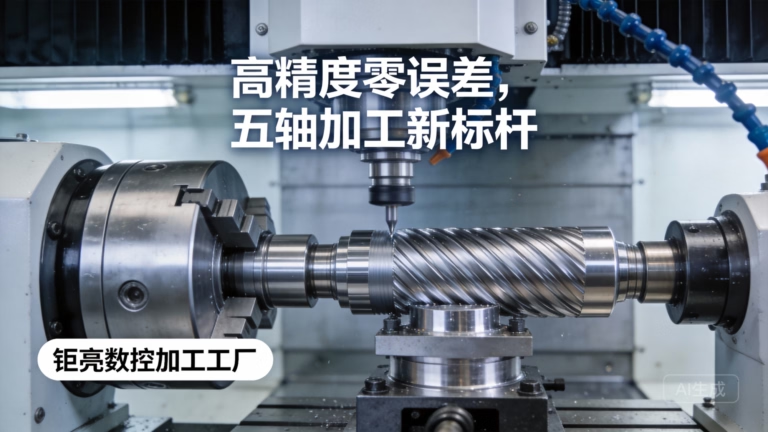
When Were CNC Machines Invented? The Short Timeline
Ask when were cnc machines invented and most people answer with one year. The honest answer is three. Numerical control, or NC, was demonstrated on a modified milling machine in 1952. Computer numerical control, where a stored program drives the axes, arrived in 1957. The microprocessor version that made the technology affordable landed in 1972. Each step changed what a shop could hold on a drawing.
The 1952 machine was not a computer. It read punched tape and moved a Cincinnati Hydro-Tel milling machine through a set of coordinates. The control cabinet filled a room and the tape tore if you looked at it wrong. Still, the part came out the same way twice. That repeatability is the whole point.
By 1957 the control unit contained a real computer, so the machine could be reprogrammed without rewiring. The 1972 shift to microprocessors cut cost and size by an order of magnitude. From there, CNC moved out of aerospace labs and into job shops.
- 11952First NC demonstration on a modified milling machine at MIT.
- 21957First computer numerical control, program stored in memory.
- 31972Microprocessor control brings CNC to commercial shops.
What Actually Changed Between NC and CNC
NC reads a fixed tape. Change one dimension and you cut a new tape. CNC reads a program that lives in memory, so the operator can edit a feed rate or a tool offset at the console and rerun the cycle. That difference sounds small. In practice it is the difference between a dedicated machine and a flexible one.
The second change is feedback. A CNC axis carries a servo motor and an encoder. The control compares commanded position to actual position thousands of times per second and corrects the error. This closed loop is why a modern machine holds ±0.005 mm on a production run while an open-loop NC machine drifted with temperature and tool wear.
The third change is compensation. Tool radius, tool length, backlash and thermal growth are stored as offsets. The programmer writes the nominal path; the control applies the corrections. On a 5-axis machine with a Ø400 mm rotary table, that compensation math runs on five axes at once, which is not something a tape reader could ever do.
- 1Editable programOffsets and feeds change at the console, no new tape.
- 2Closed loopEncoder feedback corrects position in real time.
- 3CompensationTool and thermal offsets applied by the control.
The Hardware That Made the Dates Possible
Early NC depended on the servo valve, a hydraulic device that could follow an electrical signal. Without it, there was no way to move a heavy table smoothly under program command. Hydraulic drives gave way to DC servos, then to AC servos with digital drives. Each generation tightened the loop and cut maintenance.
The tape itself is a good measure of progress. Paper tape, then Mylar, then magnetic tape, then floppy disk, then a serial cable to a PC. Today the program arrives over the network and the machine reports its own status back. The physical medium disappeared, but the command structure barely changed.
G-code survived all of it. A G01 move written for a 1960s control still means the same thing on a 2026 machining center. That backward compatibility is unusual in manufacturing and it is why programmers can still read forty-year-old process sheets.
- 1Servo valveHydraulic actuator that followed an electrical command.
- 2EncoderTurned axis motion into a position signal.
- 3MicroprocessorMade the control cabinet small and cheap enough to sell.
Why the 1952 to 1972 Window Still Shapes Your Drawings
Engineers who know when were cnc machines invented tend to tolerance parts differently. The closed loop that appeared in the late 1950s is the reason you can call out a bore at ±0.005 mm and expect it to hold across a 10,000-part run. On a manual machine, that callout depends on the operator. On a CNC, it depends on the control.
The same history explains why 5-axis work exists at all. Once the control could solve five simultaneous axes, a single setup could produce a contoured surface that used to need three fixtures and three operators. Complex geometry became a programming problem instead of a fixturing problem.
It also sets expectations. A CNC holds tolerance, but it does not fix a bad process. If the tool is wrong or the stock moves, the loop just corrects to the wrong place. The control is only as good as the setup feeding it.
- 1RepeatabilityThe loop holds the dimension, not the operator.
- 2Single setup5-axis work replaced multiple fixtures.
- 3Process firstGood control will not rescue a bad setup.
Where the Timeline Stops Being Useful
History is a poor guide for choosing a machine. A shop with a 1975 machining center and a shop with a 2025 machine both run G-code and both can hit a general tolerance. The gap shows up in the hard parts: deep pockets, thin walls, five-sided access, and materials like TC4 or Inconel that fight the cutter.
At GreatLight we run 127 high-precision CNC machines, including 16 simultaneous 5-axis machining centers and 16 mill-turn centers, across three wholly-owned plants and 7,600 m² of floor space. That capacity matters for parts up to 4,000 mm and for runs from one prototype to 10,000 pieces. The dates do not, but the control generation does.
If your part is a simple bracket with generous tolerances, a 3-axis machine is the right call and the history is irrelevant. If it has compound angles, deep ribs, or a medical-grade surface finish, the machine generation and the compensation software are what you are really buying.
- 1Simple parts3-axis or manual work is cost-effective.
- 2Complex parts5-axis and mill-turn reduce setups and error.
- 3Hard materialsRigidity and control speed decide the outcome.
NC, CNC and Modern CNC Compared
Which generation fits which part
| Generation | Control method | Typical tolerance | Best for |
|---|---|---|---|
| NC (1952–1957) | Punched tape, open loop | ±0.05 mm or looser | Simple profiles, one-off aerospace work |
| Early CNC (1957–1972) | Stored program, analog servo | ±0.025 mm | Repeatable batches, moderate geometry |
| Microprocessor CNC (1972–2000) | Digital loop, G-code offsets | ±0.010 mm | General machining, 3 and 4 axis |
| Modern CNC (2000–now) | Digital 5-axis, thermal comp | ±0.005 mm | Complex geometry, medical, aerospace |
The Takeaway
If your part needs one or two setups and a general tolerance, any modern 3-axis machine will do. If it needs five-sided access, thin walls, or a medical finish, choose a shop running current 5-axis controls with thermal compensation, because that is what actually holds ±0.005 mm.
Frequently Asked Questions
Was the first CNC machine built in 1952 or 1957?
1952 is the first numerical control demonstration. It used punched tape and had no stored program.
1957 is the first true CNC, where a computer held the program in memory. If you are dating CNC specifically, 1957 is the correct year.
Did the invention of CNC replace manual machining?
No. Manual lathes and mills are still used for one-off repairs and simple parts.
CNC took over where repeatability, complex geometry, or hard materials made manual control unreliable.
Why did it take until 1972 for CNC to reach normal shops?
The control cabinet before microprocessors was expensive and needed constant maintenance.
Once the microprocessor arrived, the control became small, cheap, and reliable enough for a job shop to justify.
Does an older CNC machine still hold tight tolerances?
It can, if the mechanicals are in good condition and the control has working compensation.
The limit is usually the servo response and thermal drift, not the G-code itself.
What tolerance can a modern 5-axis CNC hold?
GreatLight holds ±0.005 mm on production parts with 100% inspection before shipment.
Surface finish runs from Ra 1.6–3.2 μm as-machined down to Ra 0.2–0.8 μm on request.
Does the history of CNC affect how I should design a part?
Indirectly. If you know the control has closed-loop compensation, you can call out tighter tolerances and fewer datums.
If you are working with an older machine, leave more stock and expect more setups.
Need a Part Cut on Current CNC Controls?
Send your drawing and we will return a quotation and a free DFM analysis within 12 hours.
12-hour quote100% inspectionISO 9001 / IATF 16949
More Machining Notes
We publish setup notes, tooling trials and inspection data from the factory floor.











