
Where Are Smart CNC Machines Made?
Smart CNC machines are assembled in a handful of industrial hubs, and the origin of a machine shapes the tolerances it holds, the materials it cuts, and how fast it can be serviced. This page breaks down where those machines are built and what it means for the shop you source parts from.
In this article
- 1
- 2
- 3
- 4
- 5
- 6
- 7
- 8
What actually goes into a smart CNC machine
A smart CNC machine is not one factory's product. It is an assembly of parts that come from several countries. The castings and the ballscrews may be poured and ground in Taiwan. The servo drives and the CNC controller often come from Japan or Germany. The linear guides can be Swiss or Japanese. The spindle cartridge may be built in Italy. Final assembly, alignment, and software commissioning happen in the plant whose nameplate goes on the door.
This matters because origin questions are usually really asking about the last step, the machine builder, not every component inside it. Two machines can share the same servo brand and still cut very differently depending on how the builder scraped the bed and how they tuned the control loop.
The smart layer is software. Thermal compensation, tool-wear tracking, in-process probing, and adaptive feed control run on top of the same iron. So when you read where smart CNC machines are made, you are reading where the builder integrates mechanical alignment with the control and sensor package.
- 1Iron and motionCastings, ballscrews, and linear guides set the static geometry.
- 2Control and drivesServo tuning and interpolation decide how that geometry performs under load.
- 3Sensor and softwareProbing and thermal compensation hold size drift in check over a long run.
Asia: the largest build base for smart CNC machines made at scale
Asia is where most smart CNC machines are made today, by volume. Japan, Taiwan, South Korea, and mainland China each sit at a different point on the price and precision curve, and buyers often mix brands from all four inside one shop.
Japan is the reference point for long-life spindles and tight thermal behavior. Fanuc controls dominate there, and the machines are usually specified for unattended running and 10-year service life. Taiwan builds a large share of the vertical machining centers and lathes used in job shops worldwide, with a strong cost-to-accuracy balance. South Korea pushes user-friendly interfaces and CAD/CAM integration, aimed at automotive and consumer electronics volume work.
Mainland China is now the biggest single producer by unit count. Early machines were copies. Current builders ship machines with domestic controllers, linear scales, and probing as standard, and the gap in repeatability at the mid-range has narrowed a lot in the past decade.
The practical result: an Asian-built smart machine is a broad category, not one quality level. A Japanese 5-axis center and an entry-level Chinese VMC are both 'made in Asia' and are not interchangeable on a medical implant job.
- 1JapanLong spindle life, tight thermal control, high duty cycles.
- 2TaiwanStrong cost-to-accuracy balance for job-shop VMCs and lathes.
- 3South KoreaAutomation-friendly controls for mid-to-high volume production.
- 4Mainland ChinaHighest unit volume, wide spread from entry to mid precision.
Europe: precision engineering where smart CNC machines are made for micromachining
European builders sit at the top of the accuracy curve. Swiss and German machines are common in shops that cut surgical instruments, watch parts, and fuel-system components with tolerances measured in micrometers. The Swiss sliding-head lathe is the clearest example: it was developed for watch work and still dominates small, long, slender parts that a chucking machine cannot hold.
German and Italian builders focus on thermal stability and rigidity. Castings are aged and stress-relieved before machining, and the beds are hand-scraped. These machines hold size over an 8-hour run with less warm-up drift than most mid-range machines.
That precision costs money and lead time. A Swiss sliding-head machine is not the tool for a 300 mm aluminum bracket. It is slow on large parts and its bar capacity limits stock size. Buying European only makes sense when the part geometry or tolerance actually needs it.
Europe also leads in measurement-integrated machining. On-machine probing and closed-loop compensation are common options, which is why European machines often appear in first-article approval workflows.
North America: specialty builds and aerospace-driven designs
North American builders are fewer, and they tend to aim at specific industries rather than broad catalogs. Aerospace and defense drive large gantry mills, high-accuracy 5-axis profilers, and machines designed around titanium and nickel alloys. Heavy machinery and energy work push large swing lathes and boring mills.
The design priority is often stiffness at size. A US-built gantry mill may travel 4,000 mm or more and still hold position on a thin-wall titanium structure. The trade-off is price and production volume. Many of these machines are built to order, with lead times measured in months.
Tooling and control ecosystems also differ. North American shops often standardize on one control platform across the floor, which affects how easily a new machine can be integrated into existing CAM post-processors.
For a buyer, North American origin usually signals application-specific engineering, not a general precision advantage. If your part is a 1.2 m aerospace rib, this is the category to look at. If it is a 40 mm stainless fitting, a Taiwan or China VMC will do the same job for less.
What machine origin actually changes in your parts
Origin does not set part quality by itself. The machine is one input. Fixturing, tool choice, coolant strategy, and in-process inspection decide the final number on the drawing. A well-run Taiwan VMC with probing will beat a neglected European machine every time.
What origin does change is the ceiling. A machine with a hand-scraped bed and linear scales can hold ±0.005 mm on a stable part. A machine with rolled screws and no compensation will drift as the bed warms, and no amount of operator skill removes that drift.
It also changes the floor. A Swiss sliding-head lathe cannot take a 250 mm diameter blank. A large gantry mill is inefficient on a 20 mm fitting. Matching the machine class to part size is the first decision, before brand enters the conversation.
Service is the third effect. A machine built near your region is easier to support, but a shop that runs mixed origins and stocks its own spares removes most of that risk. The real question is not where the machine was made, but whether the shop can prove the tolerance it promises.
- 1CeilingGeometry and compensation set the tightest tolerance the machine can hold.
- 2FloorTravel and bar capacity rule out part sizes before tolerance matters.
- 3DriftThermal behavior over an 8-hour run is where cheap machines lose size.
How a machining partner should choose machines by part, not by flag
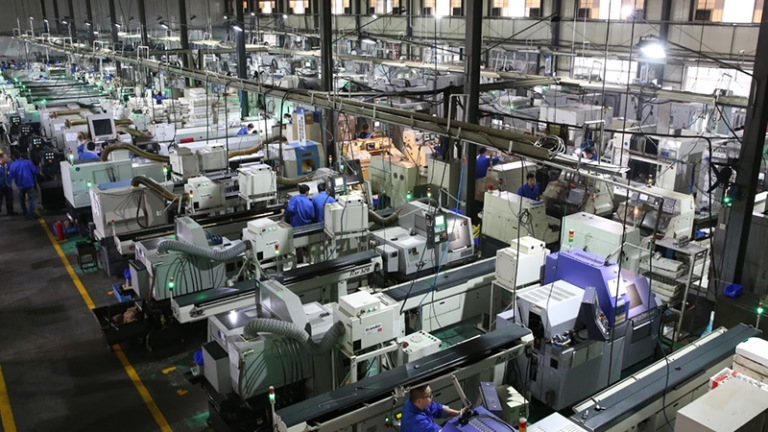
A shop with 127 high-precision CNC machines cannot run one brand and cover every job. The practical approach is a fleet split by part class. Simultaneous 5-axis centers for contoured aerospace and medical parts. Mill-turn centers for parts that need turning and milling in one setup. Three-axis machines for plate work and fixtures where the tolerance is loose and the volume is high.
At GreatLight we run 16 simultaneous 5-axis machining centers, 12 four-axis mills, 27 three-axis machines, and 16 mill-turn centers across three wholly-owned plants in Dongguan and Singapore. Maximum processing size is 4,000 mm, and the tightest routine tolerance is ±0.005 mm. Those numbers come from machine class and process control, not from country of origin.
Machine selection starts with the drawing. A 500 × 310 × 200 mm envelope with a ±0.05 mm callout does not need a 5-axis center. A thin-wall titanium housing with 12 angled faces does. Putting the wrong class on a job either wastes money or misses the tolerance.
The second filter is material. Aluminum 6061 and 7075 cut fast on most platforms. Inconel and Ti-6Al-4V punish light spindles and weak fixturing. Tool steel and 17-4PH need the right insert grade and a machine with enough torque at low rpm. Origin tells you little here; spindle power and rigidity tell you everything.
Questions that reveal more than the machine's country of origin
Ask which machine will run your part, not which brands the shop owns. The answer should name a class: 3-axis, 4-axis, 5-axis simultaneous, or mill-turn. If the answer is vague, the quoting is vague too.
Ask how size is verified. A shop with in-process probing and a final CMM report can show you the actual deviation on the feature that matters. A shop that only reports 'within tolerance' is asking you to trust the machine, not the measurement.
Ask about thermal control for long runs. On a 10,000-part run, the first 50 parts and the last 50 parts are where drift shows up. Coolant temperature control and warm-up routines are the usual answer, and they matter more than the nameplate.
Ask what happens when a part fails inspection. Rework, remeasure, and a documented cause are the signs of a process that holds up. A shop that cannot answer this will not hold ±0.005 mm on a repeat order.
- 1Class, not brandWhich machine type runs the part, and why.
- 2Evidence of sizeProbing data or CMM reports on the critical feature.
- 3Drift controlCoolant temperature and warm-up routines for long runs.
- 4Failure pathA clear rework and re-inspection process.
How the main build regions compare
Typical positioning by region, not a ranking of individual brands.
| Region | Typical strength | Common part types | Watch out for |
|---|---|---|---|
| Japan | Spindle life, thermal stability | High-mix production parts | Higher purchase and part cost |
| Taiwan | Cost-to-accuracy balance | Job-shop brackets, housings | Wide gap between low and high trims |
| South Korea | Controls and automation | Automotive, electronics volume | Less common in small job shops |
| Mainland China | Unit volume, price spread | Enclosures, fixtures, mid-tolerance parts | Verify repeatability, not just spec sheet |
| Switzerland | Micromachining on small parts | Surgical, watch, fuel components | Slow on large parts, bar-size limits |
| Germany and Italy | Rigidity, hand-scraped geometry | Dies, molds, tight-tolerance parts | Long lead times, high price |
| United States | Large aerospace structures | Titanium ribs, gantry work | Built to order, months of lead time |
The short answer
If your part is small, intricate, and needs micrometer-level control, European or Swiss-built machines are the usual choice. If it is a mid-tolerance housing at volume, an Asian-built VMC does the job at lower cost. If it is a large titanium aerospace structure, North American gantry machines exist for exactly that reason. Match the machine class to the part first, then check that the shop can prove the tolerance it quotes.
Frequently asked questions
Does the origin of a smart CNC machine directly affect the precision of the parts it produces?
It sets the ceiling, not the result. A machine with hand-scraped geometry and linear scales can hold ±0.005 mm on a stable part. A machine with rolled screws and no thermal compensation will drift over a long run no matter who operates it.
Fixturing, tooling, coolant, and in-process inspection decide the final number. Origin only tells you how much headroom the machine has.
How does GreatLight select its CNC machines?
By part class and material, not by brand loyalty. Contoured and multi-face work goes to the 16 simultaneous 5-axis centers. Parts needing turning and milling in one setup go to the 16 mill-turn centers. Plate work and fixtures go to the 27 three-axis machines.
The fleet includes 12 four-axis mills as well. Maximum processing size is 4,000 mm and routine tolerance is ±0.005 mm.
Can a shop handle jobs that require a machine from a specific region?
Usually yes, because the machine brand rarely appears on the drawing. What appears is tolerance, material, surface finish, and volume. Those are what the shop should quote against.
If a print names a specific process, such as Swiss-type turning for a slender part, that is a process requirement and should be quoted as one.
Are smart CNC machines from China as reliable as imported ones?
At the mid-range, the repeatability gap has narrowed a lot in the past decade. Many Chinese machines now ship with domestic controllers, linear scales, and probing as standard.
Reliability depends more on the specific builder and the shop's maintenance routine than on the country. Ask for drift data from a long run, not a brochure.
How does machine origin affect lead times for custom parts?
Origin affects machine purchase lead time for the shop, not your part lead time, as long as the shop already owns the right class of machine.
At GreatLight, quotation and DFM analysis come back within 12 hours, production can start within 24 hours, and parts ship in 3–5 days.
What certifications should I check on a machining partner?
For general industrial work, ISO 9001:2015 is the baseline. Automotive adds IATF 16949:2016, medical adds ISO 13485:2016, and information security adds ISO 27001:2022.
GreatLight holds all four, runs 100% inspection before shipment, and provides reports on request.
Send your drawing and get a process plan, not a guess
Upload your files and our engineers will come back with a quotation and free DFM analysis within 12 hours. No minimum order quantity, from one prototype to 10,000+ part runs.
12-hour quoteFree DFM analysis100% inspectionNDA on request
More from GreatLight
We publish setup notes, tooling trials and inspection data from the factory floor.











