
Where Are Syil CNC Machines Made?
Syil builds its CNC mills in China, with main production in Suzhou and Dongguan. This page explains where the machines come from, which subassemblies are sourced elsewhere, and what that origin actually changes on a shop floor like ours. Written for engineers and buyers who judge a machine by the parts it holds tolerance on.
In this article
- 1
- 2
- 3
- 4
- 5
- 6
- 7
Where Are Syil CNC Machines Made: The Short Answer
Syil is a Chinese machine tool builder. Its CNC mills are assembled in China, and the two production sites most often cited are Suzhou in Jiangsu Province and Dongguan in Guangdong Province. Suzhou sits in the Yangtze River Delta, a dense cluster of machine tool, casting and motion component suppliers. Dongguan sits in the Pearl River Delta, where electronics, mold making and precision machining supply chains overlap. Both regions export machine tools worldwide and both have mature subcontracting networks for castings, sheet metal and wiring harnesses.
Assembly location is only part of the answer. A vertical mill is a stack of bought-in subsystems: spindle, linear guides, ball screws, servo motors, drives, controller, and the cast or welded frame. Syil designs the machine envelope and control integration, then sources the subsystems. Some come from Chinese suppliers, some from Japanese, Taiwanese or European brands. That mix is normal in this machine class and it is why a country-of-origin label never tells the whole story.
So when someone asks where are syil cnc machines made, the useful answer is two-layered. Final assembly, alignment and testing happen in China. The precision components inside may come from several countries. For a buyer, the second layer matters more, because spindle runout, guide preload and thermal behavior decide what the machine can hold on a real part.
- 1Final assemblySuzhou and Dongguan, China
- 2Frame castingsRegional foundries in China
- 3Spindles, guides, screwsMixed Chinese, Taiwanese, Japanese, European supply
- 4Control and drivesThird-party CNC platforms, integrated by Syil
Why the Assembly Region Shapes Machine Behavior
A machine tool is not assembled in a clean room. It is scraped, shimmed, aligned and tested by people who have done it for years. The density of that skill in a region is a real technical asset. Suzhou and Dongguan both host thousands of machining and mold shops, so the labor pool understands preload, squareness and spindle break-in. A builder in those regions can hire experienced fitters and can subcontract a casting or a wiring loom within a day.
The downside of any concentrated supply chain is that it also concentrates risk. A foundry delay, a guideway shortage or a port backlog hits every builder in the same region at once. That is why lead time on a new mill can move by weeks without the machine design changing at all. Buyers who track delivery should ask about the specific subsystem, not just the brand.
There is also a thermal story. Cast iron frames need stress relief and seasoning. A frame that was poured, machined and assembled quickly will move as it settles. Shops that run a new mill on aluminum at light loads rarely notice. Shops that run steel at heavy loads for eight hours a day will see the geometry drift if the frame was not stabilized properly. Origin does not determine this, but the process discipline at the assembly plant does.
Practically, this means a machine's address tells you about logistics, labor and support distance. It does not tell you the tolerance you will hold on your part. Only a test cut does that.
- 1Skill densityTrained fitters and scrapers are easier to hire near machine tool clusters
- 2Shared riskA regional shortage affects every builder in that region
- 3Frame stabilityStress relief and seasoning decide long-run geometry
How We Judge a Mill Before It Touches a Customer Part
We run 127 high-precision CNC machines across three wholly-owned plants, with 16 simultaneous 5-axis machining centers, 12 four-axis mills, 27 three-axis machines and 16 mill-turn centers. Our largest travel is 4,000 × 400 × 150 mm and our compact cells run 500 × 500 × 450 mm. That range covers everything from a 20 mm connector body to a 4,000 mm structural rail. When a machine enters the shop, it goes through a fixed acceptance routine before it earns a production slot.
First, geometric accuracy. A dial indicator on a test bar shows spindle runout and taper error. A granite square and a dial test indicator show squareness in XZ and YZ. A laser interferometer maps positioning error across full travel and lets us build a pitch-error compensation table. On a mill that will hold ±0.005 mm, that table is not optional; without it, thermal drift alone will push a long part out of tolerance by mid-shift.
Second, thermal behavior. We warm the spindle for 30 to 60 minutes and log displacement at the tool tip. A spindle that grows 20 μm from cold to hot can still make good parts if the control compensates for it. One that grows 60 μm and wanders is a problem for any job with a tight bore. We record these curves and re-check them every six months.
Third, the test cut. We machine a known geometry in 6061-T6 and in 4140, then measure on a CMM. This is the only test that answers the real question. Everything before it is a proxy.
- 1Runout checkDial indicator on a test bar, cold and after warm-up
- 2Squareness checkGranite square, XZ and YZ planes
- 3Positioning mapLaser interferometer across full travel
- 4Test cutAluminum and alloy steel, verified on a CMM
When Origin Matters Less Than You Think
Origin matters when you buy a machine. It matters far less when you buy a machined part, because the part is the output of a process, not of a country. Two shops can run the same mill model and ship very different quality. The difference sits in fixture design, tool selection, coolant strategy, in-process checks and how quickly someone stops the cycle when a sound changes.
There is a real limit to what any 3-axis or 5-axis mill can do, regardless of where it was built. Deep pockets with a small cutter deflect. Thin walls move when you release the vise. Hardened steel above 45 HRC needs a different process route, usually grinding or EDM after roughing. Titanium and Inconel cut hot and work-harden if the feed is too light. No machine origin fixes those physics.
The practical boundary is this: origin is a sourcing question with a supply chain answer. Capability is an engineering question with a tolerance answer. Keep them separate and you will make better decisions on both.
- 1Thin wallsUnder 1 mm, plan multiple light passes and stress relief
- 2Deep pocketsCutter length-to-diameter above 4:1 needs reduced feed
- 3Hardened steelAbove 45 HRC, rough then grind or EDM
What a Properly Set Up Mill Delivers in Practice
GreatLight has been machining since 2011, currently across 7,600 m² and three plants in Dongguan plus a factory in Singapore. We hold ±0.005 mm (±0.0002 in) on production work when the geometry allows it. Surface finish lands at Ra 0.2–0.8 μm on fine-finished faces, Ra 0.8–1.6 μm on standard machined surfaces, and Ra 1.6–3.2 μm as-machined. Our qualification rate is 99.99%, measured after 100% inspection before shipment.
Materials we run every week include 6061-T6, 7075, 2024 and ADC12 aluminum; 303, 304, 316L, 17-4PH and 440C stainless; 1018, 1045, 4140 and 4340 steel; C36000 brass and C110 copper; Ti-6Al-4V, Inconel and magnesium AZ31B. Plastics cover ABS, POM, PEEK, PC and carbon fiber. Each material has its own feed, speed and coolant recipe, and each one changes how you plan a setup.
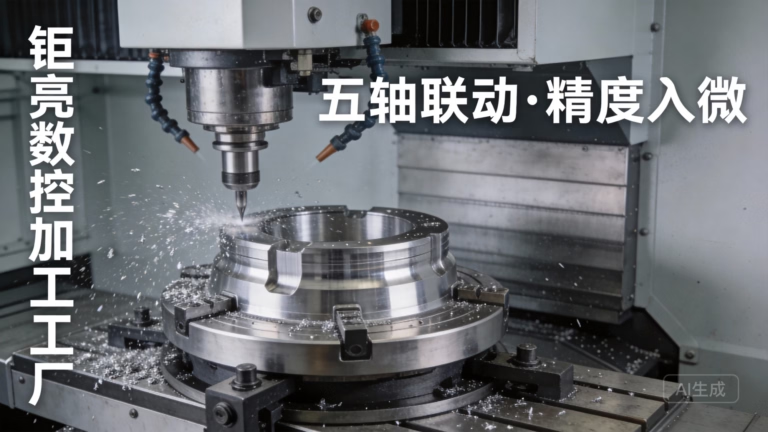
A 5-axis machine earns its cost on parts with compound angles, deep pockets on multiple faces, or features that would need three separate fixtures on a 3-axis mill. Every extra setup adds stack-up error. Removing two setups often improves tolerance more than buying a tighter machine would. That is the engineering case for 5-axis, not the marketing one.
We quote with a free DFM analysis within 12 hours, can start production within 24 hours, and ship parts in 3–5 days. Prototypes and 10,000+ part runs both run through the same cells, with no minimum order quantity.
- 1Tolerance±0.005 mm (±0.0002 in) where geometry permits
- 2Finish rangeRa 0.2–3.2 μm depending on operation
- 3InspectionRaw material, in-process and final; reports on request
Certifications and What They Cover
Machine origin and quality system are separate questions. A mill can be built anywhere and still produce aerospace or medical parts if the shop around it is controlled. Our quality system holds ISO 9001:2015 for general manufacturing, IATF 16949:2016 for automotive, ISO 13485:2016 for medical devices, and ISO 27001:2022 for information security. Those certificates cover process control, traceability, calibration and data handling, not the country stamped on a machine.
For regulated work, raw material certificates and inspection reports travel with the parts. If a drawing calls out a material grade, we verify the incoming stock before it reaches a machine. If it calls out a finish, we verify the finish after processing. Uploads stay confidential and we sign an NDA on request.
The honest framing for a buyer: ask where the machine was made if you are buying the machine. Ask about the process control, the inspection plan and the calibration records if you are buying the parts. Those are the documents that protect your assembly.
- 1ISO 9001:2015General quality management
- 2IATF 16949:2016Automotive production
- 3ISO 13485:2016Medical device manufacturing
- 4ISO 27001:2022Information security for customer data
Machine Origin vs. What It Changes on the Floor
Use this to separate marketing claims from shop-floor effects.
| Factor | Where it comes from | What it changes | How to check it |
|---|---|---|---|
| Frame casting | Regional Chinese foundry | Vibration damping, long-run stability | Cut steel for 4 hours, re-check geometry |
| Spindle | Often Taiwan, Japan or Europe | Surface finish, tool life, runout | Dial indicator on a test bar, cold and hot |
| Linear guides | Taiwan, Japan or China | Rapid speed, positioning repeatability | Ballbar test at 3 feed rates |
| Ball screws | Taiwan, Japan or China | Backlash, thermal growth | Laser interferometer over full travel |
| Control + drives | Third-party CNC platform | Look-ahead, 5-axis kinematics | Run a known 3D surfacing program |
| Final alignment | Suzhou or Dongguan plant | Squareness, parallelism, real accuracy | ISO 230-2 style circular test |
Buying the Machine or Buying the Part?
If you are buying a machine, visit the assembly plant, run the acceptance tests and check the error map. If you are buying machined parts, the machine's address is background noise. Judge the shop on fixtures, inspection data and whether it will stop a cycle instead of shipping a marginal lot.
Common Questions
Are Syil CNC machines made entirely in China?
Final assembly, alignment and testing happen at Syil plants in China, most commonly cited as Suzhou and Dongguan. The frame and many mechanical parts are sourced from Chinese suppliers.
Spindles, guides, ball screws, drives and the control platform often come from suppliers in Taiwan, Japan or Europe. A country-of-origin label describes where the machine was assembled, not where every subsystem was built.
Does machine origin change the tolerance I can hold on my part?
Only indirectly. Origin affects supply chain reliability, service distance and labor skill at the assembly plant. It does not set the tolerance on your part.
The tolerance comes from the machine's geometric accuracy, thermal compensation, fixture rigidity and the process route. Two shops with the same mill model can hold very different tolerances.
How do we verify a machine before it runs production work?
We run four checks: spindle runout on a test bar, squareness with a granite square, a laser interferometer map across full travel, and a test cut in 6061-T6 and 4140 verified on a CMM.
We also log thermal growth at the tool tip from cold to hot. A machine with repeatable growth can be compensated. One that wanders cannot.
What tolerance and finish can GreatLight hold on production parts?
We hold ±0.005 mm (±0.0002 in) where part geometry allows it. Surface finish ranges from Ra 0.2–0.8 μm on fine-finished faces to Ra 1.6–3.2 μm as-machined.
Every part is inspected before shipment, covering incoming material, in-process checks and final inspection. Reports are available on request.
Does GreatLight use Syil machines in production?
Our capacity is built around 127 high-precision CNC machines, including 16 simultaneous 5-axis machining centers, 12 four-axis mills, 27 three-axis machines and 16 mill-turn centers.
Machine selection follows the part: travel size, spindle power, axis count and thermal behavior. We match the cell to the geometry rather than standardizing on one brand.
What is the lead time for a quote and for parts?
We return a quotation with free DFM analysis within 12 hours. Production can start within 24 hours after approval, and parts ship in 3–5 days.
There is no minimum order quantity. One prototype and a 10,000+ part run both go through the same process control.
Send the Drawing, Get a Process Plan
Upload your CAD file and we will return a quote with DFM feedback in 12 hours. We will tell you which machine the part belongs on and where the tolerance risk sits.
12-hour quoteNo minimum orderNDA on request100% inspection
More from the shop floor
We publish setup notes, tooling trials and inspection data from the factory floor.











