
CNC Machine in Ohio: How the Supply Chain Actually Works
Four channels sell machine tools into Ohio, and each one carries a different risk profile. This page explains what each channel is good at, where it breaks down, and which questions to ask before you sign. Written for engineers and shop owners who need to justify the purchase internally.
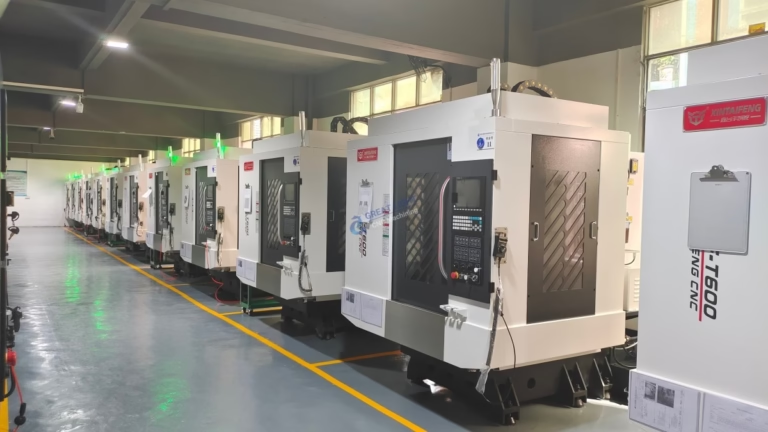
Where a CNC machine in Ohio actually comes from
Almost every machine tool that lands in an Ohio shop arrives through one of four channels: an authorized dealer, a used-equipment broker, an online industrial platform, or a builder that configures a machine around your part family. The channel decides who owns the installation risk, how fast a service tech can reach you, and how much of the documentation you actually receive.
Authorized dealers hold territory agreements with the builder. They stock spares, employ factory-trained technicians, and carry demo machines you can cut metal on before you buy. The trade-off is price discipline: list pricing is rarely negotiable beyond a package discount, and delivery slots follow the builder's allocation calendar.
Used brokers work on consignment or buy outright, then resell. The upside is capital cost, often 40 to 60 percent below a comparable new machine. The downside is documentation. You may get a spindle hours reading and a ballbar plot, or you may get a machine that was pulled from a line and power-washed.
Online platforms list machines from many sellers at once. Useful for price discovery and for finding odd sizes, less useful for verifying geometry. Nobody on the platform has stood next to that machine with an indicator in hand.
- 1DealerFactory support, demo cuts, slower lead time
- 2Used brokerLower capital cost, variable documentation
- 3Online platformWide listings, weak verification
- 4Custom builderFits your part family, longest lead time
Specification checks that decide the purchase
Start with the part envelope, not the machine envelope. A 40-taper vertical mill with 750 × 1,150 × 550 mm travels covers most job-shop work. If your parts need five-sided access in one setup, you are looking at a simultaneous 5-axis center, and the price step between 3-axis and 5-axis is not linear.
Spindle is where the money goes. A 12,000 rpm belt-driven spindle handles aluminum and mild steel fine. Titanium, Inconel and hardened tool steel push you toward a 15,000 rpm or higher integral spindle with through-coolant, and that changes both the machine price and the tooling budget.
Control choice matters for hiring. Haas, Fanuc, Siemens and Heidenhain all have strong regional installer bases in Ohio, which means a programmer can be found. An obscure control saves capital cost and costs you every time you need a setup person.
Check the accuracy claim against how it was measured. A positioning accuracy of ±0.005 mm on a warm machine, measured per ISO 230-2, is a different number from a cold-machine marketing figure. Ask for the test report, not the brochure.
What the machine costs after you install it
The sticker price is roughly half the story. A new 3-axis vertical mill needs a concrete pad, 3-phase power, compressed air, tooling, workholding and a CAM seat. That package often adds 15 to 25 percent to the purchase before the first chip.
Used machines carry deferred maintenance. A spindle rebuild runs into five figures, and a control retrofit can exceed the machine's resale value. If you cannot inspect the spindle taper, the way covers and the backlash yourself, budget for someone who can.
Floor space and labor are the quiet costs. A 5-axis center needs a programmer who understands rotary kinematics, and that person is harder to hire than a 3-axis operator. If your volume does not support a dedicated programmer, the machine will sit idle more than it runs.
For low-volume or high-mix work, the math often favors outsourcing over buying. A machine that runs 20 hours a week still depreciates 168 hours a week.
- 1InstallationPad, power, air, rigging: 15–25% of machine cost
- 2Spindle rebuildFive figures on a used machine
- 3Programming labor5-axis needs a dedicated programmer
- 4Idle timeDepreciation does not care about utilization
Why service radius is a real specification
Ohio's manufacturing is clustered: Cleveland and Akron in the north, Columbus in the center, Cincinnati and Dayton in the southwest, Youngstown and Toledo on the edges. A dealer with a strong Cleveland presence may still send a technician four hours to reach a shop outside Cincinnati.
Ask for the actual response commitment in writing. Same-day service, next-day service and best-effort service are three different contracts. When a spindle bearing fails on a machine running a production order, the difference between 8 hours and 48 hours is the difference between a late shipment and an on-time one.
Spare parts stocking is the second half of service. A dealer that keeps a spindle cartridge on the shelf can swap it in a day. A dealer that orders from the builder may quote four to six weeks. Ask what they stock for the specific model you are buying.
Remote diagnostics help but do not replace a person. Most modern controls support remote access for alarm logs and parameter review. That shortens diagnosis, not repair.
When buying a CNC machine in Ohio is the wrong move
Buying makes sense when you have a stable part family, steady volume, and at least one person who can program and set up the machine. It also makes sense when your geometry is confidential and you do not want it leaving the building.
Buying is the wrong move when your volumes swing, when your parts change every few months, or when your tolerances sit at ±0.005 mm and your only inspection tool is a pair of calipers. A machine cannot hold what you cannot measure.
It is also the wrong move when the real constraint is engineering time. If your team is still designing the product, spending six months standing up a machine shop delays the product more than it saves.
Outsourcing fills that gap. A contract shop with 127 high-precision CNC machines, including 16 simultaneous 5-axis centers, can absorb prototype and low-volume runs while you build internal capability. When volume justifies the purchase, you buy with real cycle-time data in hand.
Four channels, side by side
Match the channel to your part family, budget and tolerance band.
| Channel | Best for | Main risk | Ask before buying |
|---|---|---|---|
| Authorized dealer | Production shops needing factory support | Slow allocation slots | Written service response time |
| Used broker | Capital-constrained first machine | Worn spindle or ways | Spindle hours and ballbar plot |
| Online platform | Price discovery and odd sizes | No geometry verification | Who inspected the machine |
| Custom builder | One part family, tight tolerance | Longest lead time | Acceptance test criteria |
| Contract shop | Prototype and low-volume runs | Less control over schedule | Tolerance and finish capability |
The short answer
If you have steady volume and an in-house programmer, buy from a dealer with a written service commitment. If volumes are uncertain or tolerances are tight, outsource first and buy later with real cycle-time data.
Frequently asked questions
What does a CNC machine in Ohio cost to run?
Machine price is the entry ticket. Add a concrete pad, 3-phase power, compressed air, tooling, workholding and a CAM seat, which together often add 15 to 25 percent to the purchase.
Then add spindle maintenance, coolant and chip handling, and the labor of whoever programs and sets up the machine.
Can I get training on a new machine?
Authorized dealers usually include operator and maintenance training in the purchase package, and most builders run factory training classes.
For used machines, training is negotiable. Ask the broker whether the original control manuals and parameter backups come with the machine.
Do Ohio suppliers offer financing?
Many dealers work with equipment finance companies and can structure a lease or installment plan. Terms depend on your credit and the machine age.
Used machines are harder to finance than new ones, and machines older than about ten years often need a specialty lender.
When should I outsource instead of buying?
Outsource when volumes swing, when parts change every few months, or when your team is still designing the product.
Also outsource when the tolerance band is at ±0.005 mm and you do not yet have the metrology to verify it in-house.
How long does delivery take?
Stock machines from a dealer can ship in days. Built-to-order machines follow the builder's allocation calendar, which is often measured in months.
Used machines move faster but depend on rigging availability. Always confirm who arranges the rigging and who insures the move.
Does GreatLight ship machined parts to Ohio?
Yes. GreatLight runs 3 wholly-owned plants with 127 high-precision CNC machines, including 16 simultaneous 5-axis centers, and ships finished parts to customers in North America.
Quotation and DFM analysis come back within 12 hours, production can start within 24 hours, and parts typically ship in 3 to 5 days.
Need parts before the machine arrives?
Send your drawings and get a quotation with free DFM analysis within 12 hours.
12-hour quoteNo minimum order quantity100% inspection before shipment
More from GreatLight
We publish setup notes, tooling trials and inspection data from the factory floor.











