
Where Can I Access a CNC Machine?
Five routes exist, and each one fits a different part. This page explains how to access a CNC machine by shop type, what tolerance and envelope each route realistically holds, and when you should stop looking and send the part out. Written for design engineers and sourcing staff comparing options.
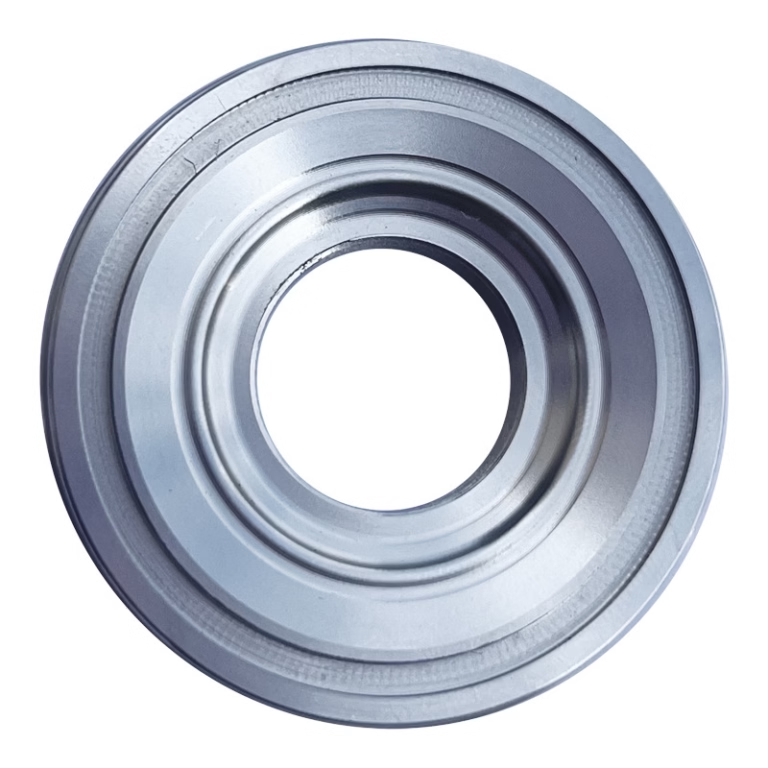
Where can I access a CNC machine? Five real routes
People ask where they can access a CNC machine because they have a part and no machine. There are five practical routes: a makerspace or fab lab, a university or trade school shop, a machine rental or lease, buying a used machine, and a contract machining supplier. Each one trades money, time and control differently.
A makerspace works when the part is simple and the material is soft. You pay a membership, sit through a safety course, and run the machine yourself. Aluminum brackets, acrylic panels, and wooden fixtures fit here. A titanium housing with a ±0.02 mm bore does not.
A school shop offers better machines but limited hours. Access usually depends on enrollment or a sponsor. Students get lathe and mill time; outside companies rarely do. Rules are strict, and supervision is constant.
Rental and lease suit short projects. You get the machine, but you also get maintenance, tooling, and operator training. Used machines cost less upfront and more later. A contract shop is the only route that gives you a certified process, inspection reports, and a fixed price without owning anything.
How part geometry decides which route works
Tolerance comes first. If every dimension is loose, say ±0.1 mm, a makerspace router or a manual mill can hold it. Once you need ±0.02 mm, the machine, the fixture, and the operator all matter. At ±0.005 mm, you need a temperature-stable shop and a metrology plan.
Feature count decides the number of setups. A part with holes on five faces needs either five setups on a three-axis machine or one setup on a five-axis machine. Every extra setup adds stacked error. If the drawing has true position callouts on angled faces, five-axis is cheaper than the fixture you would build to avoid it.
Material pushes the choice too. Aluminum 6061 cuts easily on light machines. Stainless 316 work-hardens and needs rigidity. Titanium and Inconel need coolant pressure, low surface speed, and a machine that will not chatter. A community router will not finish a Ti-6Al-4V impeller.
Size sets the floor. A 4,000 mm rail cannot fit a benchtop mill. A 12 mm connector pin wastes a large gantry. Match the envelope to the part before you compare hourly rates.
What each route really costs in time and risk
The sticker price is not the cost. A makerspace charges by the hour, but you also lose weekends learning the controller. A rental adds freight both ways and a damage clause. A used machine adds rigging, a phase converter, and a first-year repair bill you cannot predict.
A contract shop rolls material, programming, fixturing, machining, finishing, and inspection into one line item. You pay more per hour than a makerspace, and less than the fully loaded cost of owning a machine you use twice a year.
Risk is the hidden line. If you machine the part yourself and it is wrong, you eat the material and the delay. A supplier with in-process checks catches the error before the second operation. That difference matters more as the part gets closer to the customer.
Volume settles it. One prototype, a makerspace or a job shop works. Ten thousand parts, you need a supplier with capacity and a process that repeats. No community shop holds that schedule.
When access at home stops making sense
Stop looking for local access when the part needs a certified process. Medical, aerospace, and automotive buyers ask for traceability, material certs, and inspection reports. A makerspace cannot issue those.
Stop when the finish matters. Anodizing, electroless nickel, and powder coating need controlled chemistry. You can machine a part at home and still have no way to finish it to spec.
Stop when the deadline is fixed. Learning a controller takes weeks. A supplier that quotes in 12 hours and ships in 3–5 days removes that variable. GreatLight runs 127 CNC machines across three plants, including 16 simultaneous five-axis centers, with a 4,000 mm maximum processing size.
Stop when confidentiality matters. Uploads are secure, and an NDA is available on request. That is hard to arrange with a shared shop bench.
Five routes side by side
Pick the route that matches tolerance, volume and paperwork, not the one that is closest.
| Route | Best for | Typical tolerance | Main limit |
|---|---|---|---|
| Makerspace / fab lab | Simple parts, soft material, learning | ±0.1 mm | No certs, limited hours |
| School or trade shop | Students, small personal projects | ±0.05 mm | Enrollment required |
| Rental or lease | Short projects, machine trials | Machine dependent | You own maintenance |
| Used machine | Long-term in-house work | Wear dependent | Rigging, power, repairs |
| Contract supplier | Tight tolerance, volume, certs | ±0.005 mm | Lead time and MOQ terms |
The short answer
If the part is simple, soft and yours to scrap, a makerspace is fine. If it needs tight tolerance, a certified process or volume, send it to a contract shop and skip the learning curve.
Common questions
Can I access a CNC machine without owning one?
Yes. Makerspaces, school shops, rental companies and contract suppliers all give you access without a purchase. The trade is control: you give up some scheduling freedom in exchange for not carrying the machine cost.
For one-off parts, a contract shop is usually the fastest path because programming, fixturing and inspection are already in place.
What file format does a shop need to quote?
A STEP file plus a 2D drawing with tolerances and finish callouts. STEP carries the geometry; the drawing carries the intent. A DXF is fine for flat sheet parts.
If you only have a model, say so. We can flag missing callouts during the free DFM review.
Is there a minimum order quantity?
No. GreatLight runs from one prototype to 10,000+ part runs. Small runs use the same machines and inspection as large ones.
Unit cost drops with volume because setup is spread across more parts, but the first part is never turned away for being alone.
How fast can parts ship?
Quotation and free DFM analysis come back within 12 hours. Production can start within 24 hours, and parts ship in 3–5 days.
Historical late-delivery probability is below 2%. Rush timing depends on material stock and finish, so confirm it at quote.
What materials can a contract shop machine?
Aluminum 6061, 7075 and ADC12; stainless 303, 304, 316L and 17-4PH; steel 1018, 4140 and 4340; copper and brass; titanium TA1, TA2 and TC4; Inconel; magnesium; and plastics including POM, PEEK and PC.
Material choice drives tooling and speed more than any other decision on the drawing.
Can you sign an NDA before I send files?
Yes. Uploads are secure and confidential, and an NDA is available on request before you share drawings.
ISO 27001:2022 certification covers our information handling process.
Send the drawing, get a real answer
Upload your STEP file and get a quote plus free DFM feedback within 12 hours.
12-hour quote100% inspectionNo MOQ
More from GreatLight
We publish setup notes, tooling trials and inspection data from the factory floor.











