
Where to Find Rapid CNC Machining Services for Custom Parts
A practical sourcing guide for engineers and buyers who need machined parts fast. It covers the five checks that separate a shop that can actually hit your print from one that only quotes it, plus the data you should collect before sending a PO.
In this article
- 1
- 2
- 3
- 4
- 5
- 6
- 7
Key takeaways
Five checks before you award a rapid machining order
Use this as a scorecard when you compare two or three shops on the same RFQ.
| Check | What a capable shop shows | Warning sign | Why it matters |
|---|---|---|---|
| Tolerance | States ±0.005 mm and explains how it is verified | Vague 'high precision' claims | Drives fit, assembly, and rework cost |
| Lead time | Quote and DFM analysis inside 12 hours | No start date after the PO | Late parts stall your build schedule |
| MOQ | One prototype to 10,000+ part runs | High setup charge per order | Blocks design iteration and pilot runs |
| Certifications | ISO 9001, IATF 16949, ISO 13485, ISO 27001 | No certificate numbers to check | Gatekeeper for auto, medical, and defense work |
| Inspection | 100% inspection before shipment, reports on request | Sampling only, no data | You inherit the risk on every lot |
| Quote scope | Material, finish, tolerance, and quantity listed | One number with no breakdown | Impossible to compare shops fairly |
The short version
Pick the shop that gives you a 12-hour quote, a 24-hour start, a written tolerance, and inspection data. Everything else is a detail you can negotiate.
Tolerance and equipment: what to ask before you trust a quote
Tolerance is the first hard filter. A shop that machines to ±0.005 mm has to hold that number on the features that matter, not just on the easy outside profile. Ask which machines will run your part and how the critical dimensions are measured. If the answer is 'we will check it', ask with what. Calipers are not a measurement plan for a 0.01 mm bore tolerance.
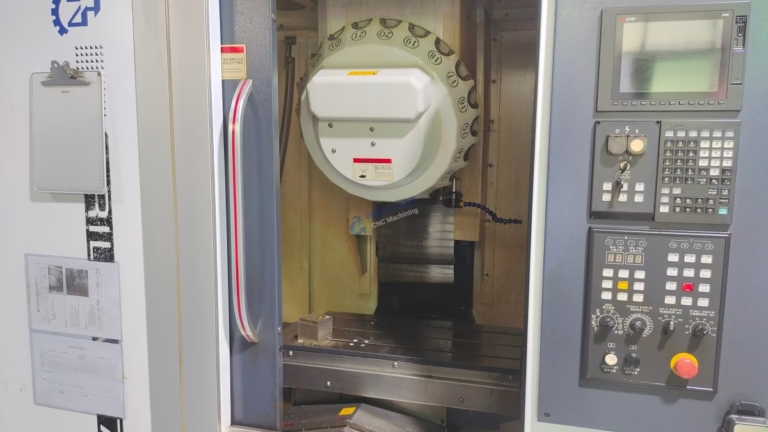
Geometry decides the machine class. Parts with undercuts, deep pockets, or features on five faces need simultaneous 5-axis work. Shafts and bushings with a single turning axis plus cross-holes fit mill-turn centers. A shop with 16 simultaneous 5-axis centers, 12 four-axis mills, and 27 three-axis machines can route your job to the right spindle instead of forcing it onto the wrong one.
Size matters as much as tolerance. A 4,000 mm maximum processing size covers large frames and rails. Small medical and electronics parts run better on compact travels like 500 × 500 × 450 mm, where thermal drift across the bed is smaller. Ask for the work envelope of the specific machine, not the factory maximum.
One more question: what happens when a dimension is out? A shop that inspects 100% before shipment and offers rework on confirmed quality problems is easier to work with than one that only promises to try harder.
- 1Ask for the machine, not the brandThe spindle that runs your part determines the tolerance you get.
- 2Match envelope to part size4,000 × 400 × 150 mm travel for long parts; compact travels for small ones.
- 3Confirm the measurement methodCMM, optical, or gauge pins, stated in the inspection plan.
Lead time, MOQ, and certifications: the three filters that kill most suppliers
Lead time has two clocks. The first is quoting: a shop that returns a price and a DFM analysis within 12 hours is set up for fast turnarounds. The second is production start. If the shop can begin machining within 24 hours of order release, simple parts can ship in 3–5 days. Historical late-delivery probability under 2% is a useful number to request, because it reflects the shop's real scheduling, not its best week.
No minimum order quantity is a practical advantage during development. You can order one prototype to prove the design, then scale the same supplier to 10,000+ part runs without re-qualifying a new shop. Suppliers with a high MOQ push you into a tooling decision before the design is stable.
Certifications are a gate, not a badge. ISO 9001:2015 covers general quality systems. Automotive work usually needs IATF 16949:2016. Medical device parts point to ISO 13485:2016. If your drawings or data are sensitive, ISO 27001:2022 matters for how files are stored and shared. Ask for the certificate scope and expiry date.
Materials and finishes sit in the same filter. A shop that stocks 6061, 7075, 17-4PH, Ti-6Al-4V, and PEEK, and that runs anodizing, electroless nickel, and bead blasting in-house or through qualified partners, keeps your part on one schedule. Splitting material and finish across vendors adds days.
- 1Quote in 12 hours, production in 24Ask for both clocks separately.
- 2No MOQOne prototype now, 10,000+ parts later.
- 3Match cert to industryIATF for auto, ISO 13485 for medical, ISO 27001 for data.
How to read a rapid CNC machining quote
A usable quote lists material grade, stock form, quantity, tolerance class, surface finish, inspection scope, and lead time. If any of those are missing, you are comparing apples to oranges across suppliers. The cheapest number is often the one that quietly excludes deburring, anodizing, or a first-article report.
Surface finish should be called out as a Ra value. As-machined at Ra 1.6–3.2 μm is normal for brackets and housings. Sealing faces and bearing bores move to Ra 0.8–1.6 μm. Optical and medical surfaces can go to Ra 0.2–0.8 μm, but that adds polishing time and cost. Specify finish only where the function needs it.
Ask what the shop will do before cutting. A DFM review that flags thin walls, deep pockets, or tolerances tighter than the process can hold saves a scrapped lot. Free DFM analysis with the quote is standard at a shop built for rapid work.
Finally, check how files move. Secure uploads and an NDA on request protect your design. If the shop cannot explain its file handling in one sentence, keep looking.
- 1Demand a line-item scopeMaterial, finish, tolerance, inspection, lead time.
- 2Specify Ra by functionRa 1.6–3.2 μm as-machined; Ra 0.2–0.8 μm only where needed.
- 3Get DFM feedback firstCatch unmakeable features before the first chip.
Where to find rapid CNC machining services for custom parts
There are four common routes, and each fits a different stage of the project. Local job shops are close and easy to visit, but their capacity is limited and quoting can take days. Online marketplaces give fast prices, yet the actual machine and operator change order to order, so tolerance consistency is hard to predict.
Overseas contract manufacturers with dedicated rapid lines are the third route. This is where you find shops that run 5-axis, mill-turn, and turning cells under one roof, with DFM support and documented inspection. The trade-off is shipping time, which is manageable when production starts in 24 hours and parts ship in 3–5 days.
The fourth route is a hybrid: prototype locally for the first article, then move to a rapid manufacturer for the production run. It works when the local shop can hold tolerance but cannot scale, and when the overseas shop can repeat the same print at volume.
For most custom parts under 4,000 mm, the deciding factor is not geography. It is whether the shop can quote in 12 hours, start in 24, and show inspection data at the end. Those three data points are what to compare.
- 1Local job shopShort shipping, limited capacity, slower quotes.
- 2Online marketplaceFast price, variable machine assignment.
- 3Rapid contract manufacturerDFM, 5-axis capacity, documented inspection.
Step by step: qualify a rapid machining supplier
Run these steps on two or three shops with the same RFQ package.
- 1Send a complete RFQInclude 3D model, 2D drawing, material grade, quantity, finish, and tolerance callouts. Missing data invites a padded price.
- 2Time the quote responseCapable rapid shops return a price and DFM notes within 12 hours. Anything past 48 hours signals a scheduling problem.
- 3Ask for the machine and envelopeConfirm the specific machine class and travel. Check that your largest dimension fits with room for clamping.
- 4Verify certification scopeRequest certificate numbers and confirm they cover your industry: IATF 16949, ISO 13485, ISO 27001, or ISO 9001.
- 5Confirm production start and shippingAsk when chips fly after order release. 24 hours is realistic for straightforward parts; shipping follows in 3–5 days.
- 6Agree on inspection deliverablesState which dimensions need reported values, and whether you want material certs and first-article reports.
- 7Protect your dataUse secure upload links and sign an NDA before releasing sensitive geometry.
- 8Run a pilot orderOrder one or two parts, measure them yourself, then scale to the full quantity with the same supplier.
Questions buyers ask before the first order
What materials can a rapid CNC shop machine?
Common metals include aluminium 6061, 7075, 2024, and 6082; stainless 303, 304, 316L, and 17-4PH; steel 1018, 1045, 4140, and 4340; and titanium Ti-6Al-4V.
Plastics such as POM, PEEK, PC, ABS, and PA are also routine. The material list should be confirmed in the quote, because stock availability drives lead time.
How fast can custom parts be produced?
A quote and DFM analysis can come back within 12 hours. Production can start within 24 hours of order release, and parts typically ship in 3–5 days.
Complex geometry, special material, or multi-step finishing adds time. Ask for the schedule per operation, not one lump number.
Is there a minimum order quantity?
Not at a shop set up for rapid work. One prototype and 10,000+ part runs use the same process and inspection flow, so the design can be validated before volume.
How do I compare two quotes fairly?
Check that both list the same material grade, tolerance class, surface finish Ra value, quantity, inspection scope, and lead time.
A lower price that excludes deburring, finishing, or inspection reports is not a lower price. It is a partial quote.
What certifications should I look for?
ISO 9001:2015 covers the general quality system. Automotive programs usually require IATF 16949:2016, medical device work points to ISO 13485:2016, and ISO 27001:2022 covers information security.
Ask for the certificate scope and expiry date, not just the logo.
What if the parts do not meet the print?
A shop inspecting 100% before shipment should catch most problems internally. Ask upfront how confirmed quality issues are handled, including rework policy and who pays for return shipping.
Get the answer in writing before the PO, not after.
Send your drawings, get a quote and DFM notes in 12 hours
Upload your files securely. We review makeability, flag tolerance risk, and price the part before you commit to a PO.
12-hour quoteNo minimum order quantity100% inspection before shipmentNDA on request
More machining notes
We publish setup notes, tooling trials and inspection data from the factory floor.











