
Wholesale CNC Machine Components Service: What to Check Before You Commit
This guide is for engineers and purchasing teams who buy machined parts in repeat batches rather than one-offs. It covers the checks that decide whether a wholesale CNC machine components service can hold your drawing across 50 parts and 5,000 parts: tolerance capability, order quantity, lead time, certification, and how the supplier quotes.
In this article
- 1
- 2
- 3
- 4
- 5
- 6
- 7
- 8
Key takeaways
What Separates a Wholesale Supplier From a Job Shop
Match your part volume and drawing to the row that applies.
| Check | Weak signal | Strong signal |
|---|---|---|
| Tolerance proof | "We can do ±0.01 mm" | Named process limit ±0.005 mm with inspection data |
| Order quantity | Hidden minimums appear after quoting | From one prototype to 10,000+ parts, no MOQ |
| Lead time path | One vague delivery date | Quote in 12 h, start in 24 h, ship in 3–5 days |
| Certification | One certificate for everything | ISO 9001, IATF 16949, ISO 13485, ISO 27001 scope |
| Data handling | Email attachments, no policy | Secure uploads and NDA on request |
| Quoting basis | Price only, no DFM notes | Free DFM analysis with the quote |
| Capacity fit | No machine list given | 127 CNC machines, 4,000 mm max part size |
| Repeatability | New setup each order | Same fixturing and CAM across batches |
Tolerance: What a Wholesale CNC Machine Components Service Can Actually Hold
A wholesale CNC machine components service is judged on the third shipment, not the first. That is why the useful question is not "what is your best tolerance" but "which features on this drawing need the tight tolerance, and how do you hold them every run." A shop running 127 high-precision CNC machines, including 16 simultaneous 5-axis machining centers, has the range to move a feature to the machine that suits it. A shop with three mills has to make the feature fit the machine it owns.
The number to anchor on is ±0.005 mm. Treat it as a capability limit for well-chosen features on stable materials, not a blanket callout for every dimension. A Ø12 mm bore in 6061 aluminium at ±0.005 mm is routine on a mill-turn center. The same callout on a 900 mm long 304 stainless shaft is a different problem, because thermal growth and deflection do more to the dimension than the control loop does.
Surface finish follows the same logic. Ra 0.8–1.6 μm covers most mating faces and bearing seats. Ra 0.2–0.8 μm is a finishing operation, so it adds a step and a setup. If your drawing asks for Ra 0.2 μm on a face that only needs to sit flat against a gasket, you are paying for a process you cannot use.
So the first filter is a drawing conversation. Send the part, mark the two or three dimensions that carry function, and ask how the shop plans to hit them. The answer tells you more than any tolerance statement on a website.
- 1Anchoring features
- 2Non-critical features
- 3Finish mapping
Order Quantity, Prototypes and the Cost of Switching Suppliers
Wholesale buying usually means repeat batches, and repeat batches expose everything. If your first article is made on one machine and your production run on another, the part that passed the first article test no longer describes what arrives in month three. The cleanest setup keeps the same fixturing, the same CAM file and the same inspection plan from prototype through production.
That is the practical argument for a supplier with no minimum order quantity. You can order one piece to check the geometry, then scale to 10,000+ parts without changing the process that produced the sample. Nothing about the part changes except the batch size.
Material choice is where the volume decision actually lands. A 6061-T6 bracket and a 7075-T6 bracket look similar on a drawing, but 7075 costs more, machines slower and needs more care on thin walls. If the load case does not demand 7075, the switch back to 6061 is a straightforward saving that does not touch the design.
Ask one question before you commit: if we double the order next quarter, what changes about the process? A good answer names the setup, the tooling and the inspection step. A weak answer talks about price only.
- 1Prototype to production
- 2Bulk materials
- 3Batch identity
Lead Time, Certifications and Confidentiality as One Package
Lead time is often quoted as a single number, which hides where the risk sits. Split it. The quote and free DFM analysis come back within 12 hours. Production can start within 24 hours of approval. Parts ship in 3–5 days. Those are three separate clocks, and the one that usually slips is the gap where a drawing question sits unanswered.
Certification matters most when it matches your industry. ISO 9001:2015 covers general quality management. IATF 16949:2016 is what automotive and EV programs expect. ISO 13485:2016 applies to medical device work. ISO 27001:2022 covers how your files and drawings are protected. A supplier holding all four can serve several product lines without changing vendors; a supplier holding none can still machine a good bracket, but you carry the paperwork risk.
Confidentiality is part of the same package. If your drawings describe a product that is not public yet, secure uploads and an NDA on request should be standard, not something you negotiate after sending the files. Ask how long files are retained and who inside the shop can open them.
The last item is inspection. 100% inspection before shipment, with raw material checks, in-process monitoring and final inspection, is what turns the certificate into evidence. Ask for the reports on the features that matter to you, not the whole stack.
- 1Split the clock
- 2Match the certificate
- 3Ask for the report
Machine Fit: When a Part Belongs on 5-Axis and When It Does Not
Machine selection is a cost decision as much as a technical one. A part with features on five faces, or with an angled port that would need three separate setups, often costs less on a simultaneous 5-axis center than on a 3-axis machine plus custom fixturing. Setup time is where the money goes on complex geometry.
The opposite is also true. A flat plate with a bolt pattern and two dowel holes does not need 5-axis work. Running it on a 3-axis machine with a simple vise is faster and cheaper, and the tolerance outcome is the same. Putting simple parts on expensive machines is one of the quiet ways a wholesale quote gets inflated.
Size sets the boundary. The largest travel available is 4,000 × 400 × 150 mm, which covers long rails, beams and structural parts that most shops cannot take in one setup. Medium travels of 750 × 1,150 × 550 mm and 600 × 600 × 600 mm handle the bulk of enclosure and housing work. Compact travels of 500 × 500 × 450 mm and 500 × 310 × 200 mm suit small precision components, and a Ø400 mm rotary table covers round parts that need features on the circumference.
If your part sits near a travel limit, say so in the RFQ. A part that is 20 mm under the limit and a part that is 20 mm over produce very different plans, and the second one may need a different process entirely.
- 1Complex geometry
- 2Simple geometry
- 3Long parts
Common Traps When Sourcing Wholesale CNC Machine Components
The first trap is a tolerance callout copied from a template. If every dimension on the drawing carries ±0.005 mm, the shop either quotes high to cover the risk or quietly ignores the ones it cannot hold. Both outcomes are bad. Mark the functional dimensions, leave the rest at a general tolerance, and the quote becomes comparable to other quotes.
The second trap is treating the material list as interchangeable. 304 and 316 stainless look alike on paper, but 316 costs more and behaves differently under load in chlorides. 6061-T6 and 7075-T6 both machine cleanly, but 7075 is stronger and less weldable. Substituting without telling the engineer is how a part passes inspection and fails in service.
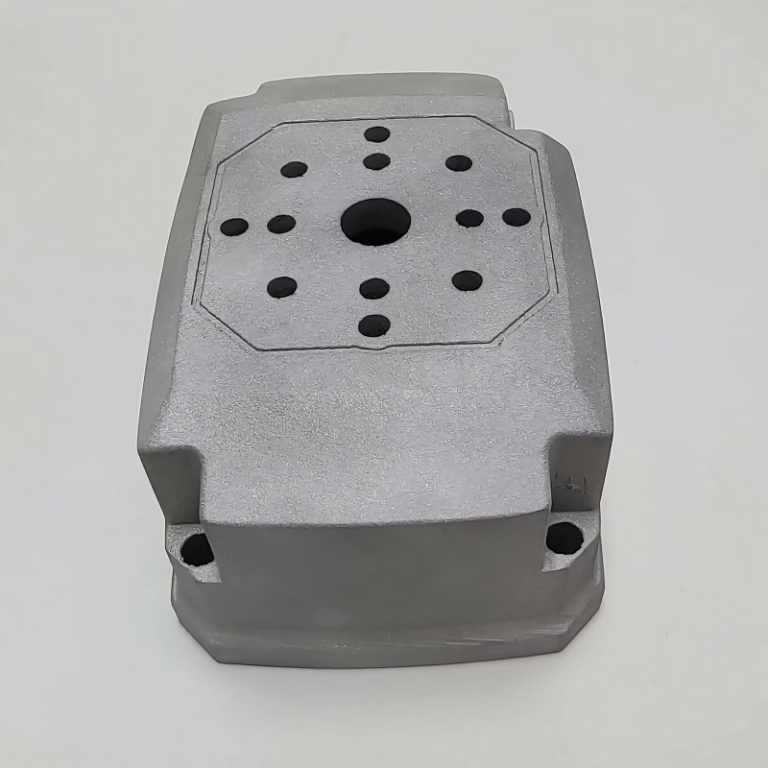
The third trap is a missing finish spec. A bare machined aluminium face starts to oxidize in handling, and a housing that ships without a finish can arrive with marks that look like defects. Anodizing, plating, powder coating, bead blasting or brushing should be named on the PO, not assumed.
The fourth trap is no inspection record. If the supplier cannot show dimensional data on the features you care about, you have no way to separate a good batch from a lucky one. That matters more in wholesale buying than in one-off work, because you will order again.
- 1Selective tolerance
- 2Material substitution
- 3Finish on the PO
Seven Steps to Qualify a Wholesale Supplier
Use this sequence on the first order. It costs one extra week and prevents a year of rework.
- 1Send the drawing with marked critical dimensionsIdentify the two or three features that set assembly position. Leave general tolerances for the rest. Ask for DFM feedback, not just a price.
- 2Ask which machine will run the partFor five-face or angled features, expect a 5-axis center. For plates, expect a 3-axis machine. If the answer is vague, ask again.
- 3Confirm the tolerance plan in writingGet the process limit for the critical features, not a generic statement. ±0.005 mm is the shop limit; the part may not need it.
- 4Check the certification scopeISO 9001:2015 for general work, IATF 16949:2016 for automotive, ISO 13485:2016 for medical, ISO 27001:2022 for file security.
- 5Agree the lead time in three partsQuote and DFM in 12 hours, production start within 24 hours of approval, shipping in 3–5 days. Flag any drawing question early.
- 6Set the inspection deliverables100% inspection before shipment. Request reports on critical features only, plus material certificates where the spec calls for them.
- 7Lock the repeat processBefore the second order, confirm the fixture, CAM file and inspection plan stay the same as the first run.
Questions Buyers Ask Before the First Order
Is ±0.005 mm realistic for every feature on a machined component?
No. It is a process limit for features that are set up to hold it, on stable materials and short enough to avoid thermal drift.
Long shafts, thin walls and deep pockets are harder. Mark the dimensions that carry function and let the rest sit at a general tolerance.
What does no minimum order quantity actually mean for a wholesale order?
It means you can order one prototype to verify geometry, then scale to 10,000+ parts without changing the process that made the sample.
The point is not the single unit. The point is that the first article still describes the production run.
Which certifications do I need for automotive or medical components?
Automotive and EV programs normally expect IATF 16949:2016. Medical device work typically calls for ISO 13485:2016.
ISO 9001:2015 covers general quality management, and ISO 27001:2022 covers how your drawings and files are protected.
How fast can a wholesale CNC machine components service start production?
Quotation and free DFM analysis are returned within 12 hours. Production can start within 24 hours of approval, and parts ship in 3–5 days.
The usual delay is not machining. It is an unanswered drawing question, so review the DFM notes the same day you receive them.
Can my files stay confidential during quoting?
Yes. Uploads are handled as secure and confidential, and an NDA is available on request before files are shared.
For products that are not public yet, ask about file retention and who inside the shop has access.
What part size can be machined in one setup?
The largest travel is 4,000 × 400 × 150 mm, which suits long rails and structural parts.
Medium travels of 750 × 1,150 × 550 mm and 600 × 600 × 600 mm cover most housings, and a Ø400 mm rotary table handles round parts needing circumferential features.
Send the Drawing, Get a Quote and DFM Notes in 12 Hours
Upload your files, mark the critical dimensions, and we will return a quote with process notes. No minimum order quantity, 100% inspection before shipment, and an NDA on request.
12-hour quoteNo MOQ100% inspectionNDA on request
Follow GreatLight
We publish setup notes, tooling trials and inspection data from the factory floor.











