
Wholesale Precision CNC Machining Services: A Sourcing Checklist
This page is for engineers and purchasing teams placing repeat production orders rather than one-off prototypes. It covers the numbers that decide whether a supplier can hold tolerance across 500 or 10,000 parts, and where wholesale machining quotes usually hide risk.
In this article
- 1
- 2
- 3
- 4
- 5
- 6
- 7
- 8
- 9
What matters most
Wholesale supplier scorecard
Score each supplier 1–5. Anything below 3 on two rows is a stop sign.
| Criterion | What to ask | Good answer looks like |
|---|---|---|
| Tolerance | Which machine holds your tightest feature? | Named 5-axis center, ±0.005 mm proven |
| MOQ | Smallest and largest run you accept | No minimum, one part to 10,000+ |
| Lead time | Quote turnaround and ship window | Quote in 12 h, parts in 3–5 days |
| Certifications | Which standards are current | ISO 9001, IATF 16949, ISO 13485 |
| Inspection | What is checked before shipment | 100% inspection, reports on request |
| Materials | Can you run my alloy or polymer? | Aluminium, stainless, titanium, PEEK |
| Finishing | In-house or subcontracted? | Anodizing, plating, laser marking in house |
| Confidentiality | Will you sign an NDA? | NDA on request, secure uploads |
How to read a tolerance claim on wholesale precision cnc machining services
Every supplier writes a tolerance on the homepage. The useful question is which feature, on which machine, in which setup. A shop can hold ±0.005 mm on a 40 mm aluminum bracket and struggle on a 900 mm steel frame, because thermal growth and tool deflection scale with part size.
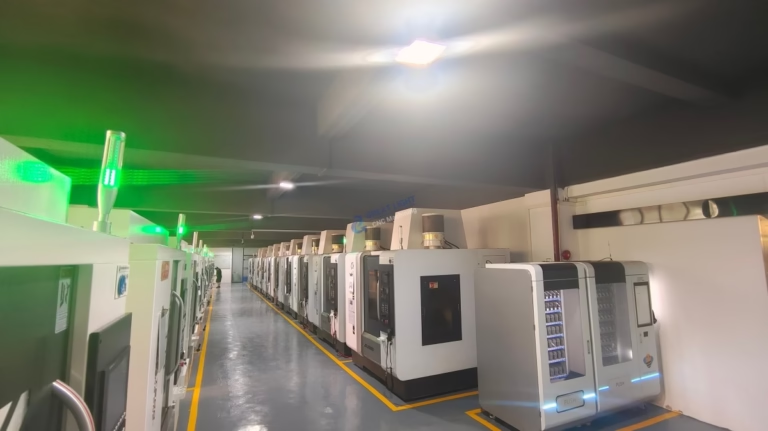
When you evaluate wholesale precision cnc machining services, send the drawing and ask for the specific machine. GreatLight runs 16 simultaneous 5-axis machining centers, 12 four-axis mills, 27 three-axis machines and 16 mill-turn centers. A mill-turn center holds concentricity on a turned diameter and a milled flat in one setup, which removes a re-fixturing error that shows up at volume.
Ask how the first article is approved. If the answer is a caliper and a printout, expect drift by part 300. In-process monitoring catches tool wear before it becomes a rejected lot.
One more check: which datum does the inspector use? If the drawing calls out A-B-C and the report uses a different origin, the numbers will not match your incoming inspection even when the part is good.
MOQ, run size and what changes between 1 and 10,000 parts
A supplier with no minimum order quantity is not automatically cheaper. It means the shop is willing to absorb setup cost on a single part, which usually shows up later in the unit price of the small run. That trade is normal and often worth taking for a design that is still moving.
The real break point is fixturing. Up to roughly a few hundred parts, a machined soft jaw or a modular vise plate is fine. Above that, dedicated fixtures and probing routines pay for themselves in cycle time and repeatability. Ask your supplier where they would switch approaches on your part.
Material buying also changes. A 10,000-part run in 6061-T6 is a mill order. A 20-part run is cut from stock the shop already has. Neither is wrong, but the quote should say which one you are getting, because it affects both price and the alloy certification you receive.
Finally, ask whether the process stays the same across the whole order. Switching from a 3-axis to a 5-axis machine halfway through a lot is a common cause of dimensional shift that no one notices until assembly.
- 11 to 50 partsSoft jaws, standard tooling, fast setup.
- 250 to 1,000 partsDedicated fixture, first-article approval, SPC sampling.
- 31,000 to 10,000+ partsHard fixtures, probing, cycle-time optimization.
Which certificate your order actually needs
Certifications are a filter, not a ranking. A shop holding ISO 9001:2015 has a documented quality system. That is the baseline for industrial machinery and electronics work. It says little about automotive traceability.
If the parts go into a vehicle or an EV platform, IATF 16949:2016 is the standard your customer will ask about, along with PPAP-style documentation and lot traceability. If the parts touch a patient, ISO 13485:2016 applies, and the supplier should already be used to controlled documentation and change notification.
ISO 27001:2022 is different. It covers information security, not part quality. For buyers sending proprietary CAD files to an overseas supplier, it is the certificate that answers the question your legal team will ask about how drawings are stored and who can open them.
Check the scope statement, not just the logo. A certificate can cover one plant or one process. GreatLight operates three wholly-owned plants across Dongguan and Singapore, so confirm which site will run your parts and that the certificate covers it.
- 1Industrial and electronicsISO 9001:2015 is the baseline.
- 2Automotive and EVIATF 16949:2016 with lot traceability.
- 3Medical devicesISO 13485:2016 plus change control.
- 4Any proprietary designISO 27001:2022 and an NDA.
Lead time, quote detail and the questions that expose a weak quote
A lead time without a failure rate is marketing. Ask what percentage of past orders shipped late. GreatLight reports historical late-delivery probability below 2%, which is a number you can plan a production schedule around. If a supplier cannot answer, treat the schedule as optimistic.
Quote speed also tells you something. A shop that returns a quotation and a free DFM analysis within 12 hours has its process planning already staffed. One that takes a week is often batching quotes between jobs.
Read the quote line by line. Wholesale precision cnc machining services should state material grade, finish specification, tolerance class, inspection level and shipping terms. A single lump-sum price hides which of those the supplier intends to control.
Production start matters too. If the shop can start within 24 hours of drawing release and material availability, your schedule has slack for a revision. Ask what happens to the price if the design changes after the first article.
- 1Material grade6061-T6, not just aluminium.
- 2Finish calloutRa 0.8–1.6 μm and a named process.
- 3Inspection levelFull or sampled, and which report.
- 4Change policyWhat a revision costs after first article.
Material and finish choices that decide the whole run
Material selection drives cycle time more than most buyers expect. Aluminum 6061 cuts fast and holds tolerance well. Stainless 316L work-hardens and needs lower feed rates and sharper tools, which raises cost per part. Titanium TC4 (Ti-6Al-4V) and Inconel are slower again and need more tool changes.
PEEK and carbon fibre behave differently from metals. PEEK needs controlled heat and sharp geometry to avoid delamination and dimensional movement after cooling. Carbon fibre parts often need the finish defined before machining, because edge quality is set by the cutter, not by a later polish.
Finishing is where lead time is most often added. Anodizing, electroless nickel, zinc plating, powder coating and black oxide each add their own queue. Laser marking needs a minimum character height of 1.5 mm to stay legible on a machined surface.
Ask whether finishing happens in house. Sending parts out adds a shipping step and a second quality gate where a scratch becomes a rejected lot. That is a real risk on large wholesale runs.
- 1Fast and stable6061-T6, 7075, brass C36000.
- 2Harder to cut316L, 17-4PH, TC4 titanium.
- 3PolymersPOM and ABS are forgiving; PEEK is not.
- 4Finish queueAnodizing and plating add days.
Where wholesale orders go wrong
The most common failure is not a bad part. It is a good part that no longer fits after the finish. Anodizing builds thickness, plating builds more, and a Ø10 mm bore specified before coating can close below its lower limit. Put the finish in the drawing note, not in an email.
Second is material substitution. A supplier swaps 6061 for a generic 6000-series alloy because it is on the shelf. It machines the same, and it fails the same salt-spray test three months later. Ask for mill certificates tied to the lot.
Third is silent process change. A job moves to a different machine or a different plant mid-order. Dimensions stay inside tolerance but the surface finish changes, and a mating part starts to show witness marks. Require notification before any process change on a running order.
Fourth is inspection coverage. Sampling is fine for a mature process. On a new part or a tight tolerance, the first lots should be fully inspected until the process proves stable.
Step by step: qualifying a wholesale machining supplier
Run these in order. Stop at step 4 if the answers do not line up.
- 1Send a real drawing, not a summaryInclude material, tolerance class, finish callout, quantity and any critical feature. Mark the datum scheme and the features you actually measure at incoming inspection.
- 2Ask for the machine and the setupRequest the machine model class and the number of setups. Fewer setups means fewer stacked errors. Mill-turn or 5-axis work should remove an operation, not add one.
- 3Request a first-article inspection planAsk what is measured, on what equipment, and whether reports come with the lot. Confirm in-process monitoring for runs above a few hundred parts.
- 4Confirm quantity range and MOQState your prototype count and your annual volume. A supplier with no minimum order quantity should quote both ends so you can see the unit price curve.
- 5Verify certification scopeAsk for the certificate and the scope statement, and confirm which plant will run the order. Match the standard to your industry: ISO 9001, IATF 16949 or ISO 13485.
- 6Lock the finishing chainGet mask areas and post-finish dimensions in writing. Recheck that plating thickness does not close a press-fit or a thread.
- 7Agree on inspection and paperworkDefine the report format, sampling level and what happens to non-conforming parts. 100% inspection before shipment with reports on request is a reasonable floor.
- 8Sign an NDA before releasing toolsIf the design is proprietary, get the NDA in place before STEP files or fixture designs leave your system.
Questions buyers ask before releasing a run
Can I get 10,000 parts from a supplier with no MOQ?
Yes. No minimum order quantity means the supplier accepts small runs, not that large runs are out of scope. Runs from one prototype to 10,000+ parts go through the same quoting path.
The difference is fixturing and material purchasing. Ask the supplier to quote your prototype quantity and your annual volume together so the unit price curve is visible.
How tight a tolerance can I actually specify?
GreatLight machines to ±0.005 mm (±0.0002 in), with surface finishes from Ra 0.2–0.8 μm on fine work up to Ra 1.6–3.2 μm as machined.
Tolerance and size interact. A tight callout on a small feature is routine. The same callout across a 4,000 mm part needs a different setup and a temperature-controlled environment, so bring it up early in the quote.
What lead time should I plan for?
Quotation and free DFM analysis come back within 12 hours. Production can start within 24 hours, and parts ship in 3–5 days.
Historical late-delivery probability at GreatLight is below 2%. That figure is more useful for planning than a best-case estimate, because it includes the orders that slipped.
Which certifications cover medical and automotive parts?
ISO 13485:2016 covers medical device manufacturing. IATF 16949:2016 covers automotive, and your customer will usually ask for lot traceability alongside it.
ISO 9001:2015 is the general baseline, and ISO 27001:2022 covers information security for your CAD data. Certificates list a scope, so confirm the plant running your order is inside it.
How do you protect my design?
Uploads are kept secure and confidential, and an NDA is available on request before any files move.
For a wholesale order, the design risk usually sits with the fixture and the CAM program as much as the part itself. Get the NDA signed before those are created, not after.
What happens if the design changes mid-run?
Ask the supplier for a change policy before you release the order. The real question is whether a revision means a new first article or a small programming edit.
If the change touches a datum, a critical feature or the finish, plan on a new first-article inspection. If it touches a non-critical radius, it is usually a quick edit.
Get a wholesale machining quote with the details filled in
Send your drawing and quantity. You get a quotation and a free DFM analysis within 12 hours, with material grade, finish, tolerance class and inspection level stated on the quote.
12-hour quoteNo MOQ100% inspectionNDA on request
More from the shop floor
We publish setup notes, tooling trials and inspection data from the factory floor.











