
Wholesale Price Prototype CNC Machining: A 7-Point Buyer Guide
This guide is for design engineers and purchasing teams comparing wholesale price prototype CNC machining quotes. It lists the checks that decide whether a low number holds up at the inspection bench. Read it before you send a drawing out.
In this article
- 1
- 2
- 3
- 4
- 5
- 6
- 7
- 8
Key takeaways
What separates a low quote from a real wholesale price
Compare the same part across four buying routes. The right column is the one that survives first article inspection.
| Check | Weak quote | Workable quote | Why it matters |
|---|---|---|---|
| Tolerance stated | “Precision machining” | ±0.005 mm on the drawing | Vague claims cannot be inspected |
| Machine assigned | Any available mill | 5-axis for angled features | Wrong machine adds setups and error |
| Setup count | Not mentioned | Listed per operation | Each setup is a new tolerance stack |
| Finishing | “As machined” | Ra 0.8–1.6 μm on sealing faces | Seal leaks start at surface finish |
| Inspection | Final visual check | 100% inspection before shipment | Catch scrap before it ships |
| MOQ | 1,000 pieces minimum | No minimum order quantity | Prototypes must run at quantity one |
| Lead time | 6-8 weeks | Quote in 12 hours, ship in 3-5 days | Iteration speed sets program cost |
Verdict: buy the route, not the rate
A wholesale price is only wholesale if the quote covers machining, finishing, and inspection from one plant. Compare routes line by line, and the lowest number stops being the cheapest one.
Why a wholesale price is not the same as a low price
A low number on a prototype order usually means something was left out. The three common omissions are setup time, finishing, and inspection. If the quote covers only spindle time, the missing work reappears later as a second invoice or as parts that fail at assembly.
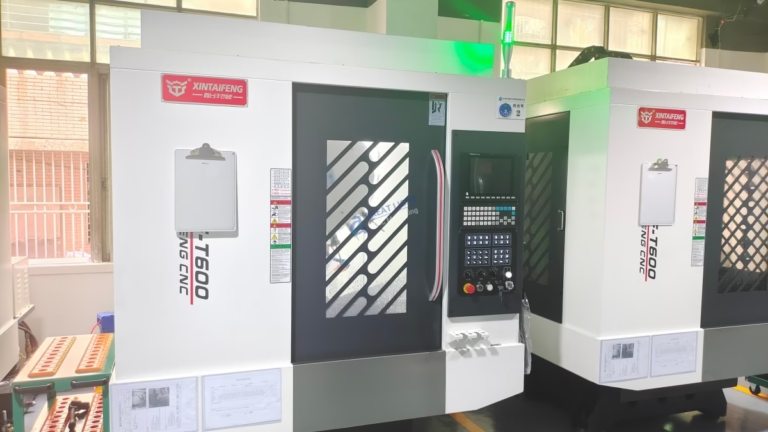
A wholesale price is different. It comes from a shop that already owns the machines, the finishing line, and the metrology lab, so nothing is subcontracted at retail rates. At GreatLight, 127 high-precision CNC machines and in-house surface finishing sit in the same 7,600 m² plant in Dongguan. That is the structural reason a wholesale number can be lower than a broker’s and still cover inspection.
Ask one question early: what is excluded. Laser marking, anodizing, bead blasting, and certificates are the usual exclusions. Get them listed in writing. A quote you can compare line by line beats a quote that is 20 percent cheaper and undefined.
Do not read this as a rule that cheap is bad. Some prototype parts genuinely need only three-axis milling and an as-machined finish. The point is to know which route you bought, so the price difference has a reason you can name.
- 1Spindle time is not the whole costSetup, fixturing, and inspection are real minutes on real machines.
- 2In-house finishing removes a margin layerAnodizing and plating done on site avoid outside vendor markup.
- 3List exclusions in the quoteMarking, certificates, and special packaging are the usual ones.
Tolerance and surface finish you can actually inspect
A tolerance claim is only useful if the shop can measure it. ±0.005 mm is about ±0.0002 in, which needs a temperature-stable room and a calibrated CMM or optical comparator, not a caliper on a bench. Ask what instrument will verify the tightest dimension on your drawing.
Surface finish matters more than most prototype buyers expect. A sealing face at Ra 3.2 μm may leak, while Ra 0.8–1.6 μm holds. For optical and fluid-handling parts, Ra 0.2–0.8 μm is reachable but adds polishing time and cost. Put the finish callout only where the function needs it, not on the whole part.
Geometric tolerances deserve the same treatment. Flatness and perpendicularity drive cost faster than linear dimensions because they force extra setups or a grinding step. If a datum is not functional, loosen it. Engineers who mark every face as critical pay for inspections that never change the outcome.
One practical test: send a drawing with a single tight feature and a loose rest, and see whether the shop asks which one matters. A shop that asks is reading the print. A shop that quotes without asking is guessing at the process.
Machine selection and what it does to your unit price
Three-axis machining is the cheapest route for prismatic parts with features on one or two faces. Add a deep cavity, an undercut, or a 45° port on the side, and the part needs repositioning. Every reposition is a new setup, a new fixture, and a new chance to lose position.
Four-axis and 5-axis centers cut that away. GreatLight runs 16 simultaneous 5-axis machining centers and 12 four-axis mills. A 5-axis machine reaches five faces in one setup, which usually beats three-axis machining on total cost once a part has more than three faces. The hourly rate is higher. The number of hours is lower.
Size decides the rest. The largest travel here is 4,000 × 400 × 150 mm for long parts, with 750 × 1,150 × 550 mm and 600 × 600 × 600 mm cells for mid-size work. A Ø400 mm rotary table handles round and indexed parts. If your part fits a 500 × 500 × 450 mm envelope, it can run on compact machines, which keeps the rate down.
Mill-turn centers matter for shafts and housings that need turning and milling in one cycle. Splitting those operations across two machines doubles the workholding error. For a prototype with a bearing bore and cross-drilled holes, one mill-turn cycle is usually the better buy.
- 1Count the facesThree or more machined faces usually favor 4-axis or 5-axis.
- 2Check the envelopeParts under 500 × 500 × 450 mm run on lower-rate machines.
- 3Shaft plus cross holesMill-turn keeps concentricity in one setup.
Lead time, order quantity, and certification fit
Prototype programs fail on calendar time more than on unit price. A quotation and free DFM analysis within 12 hours, production start within 24 hours, and parts shipping in 3–5 days change how many design iterations fit in a quarter. If a supplier quotes six weeks, the second iteration slips into the next budget cycle.
Order quantity is the other gate. No minimum order quantity means the same process runs at one piece and at 10,000+ pieces. That matters because a prototype made on a different route than production teaches you the wrong lessons about tolerance and cost.
Certifications should match your industry, not your ego. ISO 9001:2015 covers general quality systems. IATF 16949:2016 is what automotive and EV programs ask for. ISO 13485:2016 applies to medical devices. ISO 27001:2022 covers information security, which is the one customers notice when drawings are sensitive.
Confidentiality belongs in the same conversation. Uploads are secure and confidential, and an NDA is available on request. For unreleased products, sign the agreement before the first STEP file moves. It costs a day and removes a recurring argument.
- 112-hour quote turnaroundDFM feedback arrives with the number, not after it.
- 2One piece or 10,000+No minimum order quantity keeps prototype and production on one route.
- 3Pick the standard your buyer auditsAutomotive, medical, and IT security each map to a different certificate.
Material and finishing choices that move the price
Aluminium 6061-T6 is the default for prototypes: easy to cut, stable, and cheap to anodize. Switch to 7075 or 17-4PH stainless and the cutting time climbs, because the tool wears faster and speeds drop. Titanium TC4 (Ti-6Al-4V) and Inconel sit at the top of the range and are worth it only when the service condition demands them.
Plastics behave differently. POM and ABS machine cleanly at high removal rates. PEEK holds tolerance at temperature but costs far more per kilogram and needs sharp tooling to avoid melting. Carbon fibre and glass-filled grades eat cutters, so expect shorter tool life built into the price.
Finishing is where quotes diverge most. Anodizing in clear, colour, hardcoat, or conductive versions, plus electroless nickel, zinc, silver, and gold plating, are all in-house at GreatLight. Powder coating and black oxide cover the rougher industrial look. Bead blasting, tumbling, brushing, and polishing sit before those steps.
Laser marking closes the loop. Minimum character height is 1.5 mm, so a 0.8 mm part number will not reproduce. If traceability matters, size the marking area on the drawing rather than in a revision note.
- 1Start with 6061-T6Fast cutting and predictable anodizing for most prototypes.
- 2Hard alloys cost time, not just material7075, 17-4PH, TC4, and Inconel slow the spindle.
- 3Size your laser marking1.5 mm minimum character height on the finished surface.
Seven steps to place a prototype order that holds its price
Run these in order. Each one removes a reason for the invoice to change later.
- 1Send the 3D model and a 2D printSTEP plus a drawing with datum callouts. Mark the one or two features that are functional. Everything else can be general tolerance.
- 2Ask for DFM feedback with the priceQuotation and free DFM analysis within 12 hours. Read the feedback before you argue about the number; a wall thickness change often moves the price more than the shop rate does.
- 3Confirm the process route in writingWhich machine, how many setups, which fixture. On a part with angled ports, expect a 5-axis center and one setup instead of three.
- 4Lock the finish per faceRa 0.8–1.6 μm on sealing and sliding faces; Ra 1.6–3.2 μm as-machined elsewhere. Blanket finish specs overpay on cosmetic surfaces.
- 5Agree the inspection planRaw material check, in-process monitoring, final inspection. 100% inspection before shipment, with reports on request. Name the tightest dimension and the instrument that verifies it.
- 6Sign the NDA before files moveUploads are secure and confidential. For unreleased products, get the agreement signed first; it takes a day.
- 7Plan the iteration before the first runProduction can start within 24 hours and parts ship in 3–5 days. Book the second revision slot while the first article is on the machine.
Questions buyers ask before the first order
What does wholesale price actually cover on a prototype order?
It covers the full route: material, machining, finishing, inspection, and packing, priced from a shop that owns each step. When a quote names only machining, the rest arrives later as a separate line.
Ask for the exclusions list. Laser marking, certificates, and custom packaging are the usual items left out of a headline number.
Can one prototype really ship in 3–5 days?
Yes, when the machine is free and the drawing is complete. The clock starts after the DFM points are closed, not when the file lands.
Parts that need hard anodizing, plating, or heat treatment add days at the finishing stage. Plan the trade show or design review date around that, not around the machining time alone.
How do I know ±0.005 mm will be held on my part?
Ask which instrument verifies the tightest dimension and whether the shop measures at controlled temperature. ±0.005 mm is ±0.0002 in; a caliper cannot confirm it.
Geometry matters more than the number. A thin wall or an unsupported bore moves under cutting force, so the shop may need a different fixture or a stress-relief step.
Is a 5-axis machine always more expensive?
The hourly rate is higher, the total is often lower. Once a part has three or more machined faces, or features at an angle, the setups saved outweigh the rate.
For simple prismatic parts with two faces, three-axis milling is cheaper. Choose by face count and feature angle, not by machine prestige.
Which certification should I ask for?
Match it to your industry: ISO 9001:2015 for general quality, IATF 16949:2016 for automotive and EV, ISO 13485:2016 for medical devices, ISO 27001:2022 for information security.
If your customer audits your supply chain, ask for the certificate scope, not just the certificate number.
What causes a prototype quote to change after the order?
Three things: a drawing revision after cutting starts, a finish added mid-run, and material substitution when the specified grade is out of stock.
Fixing the route, the finish per face, and the material grade before the first chip is cut removes most of the movement.
Send a drawing and get a comparable number
Quotation and free DFM analysis within 12 hours. No minimum order quantity, from one prototype to 10,000+ parts.
12-hour quoteNo minimum order quantity100% inspection
More prototype machining notes
We publish setup notes, tooling trials and inspection data from the factory floor.











