
Widely Used Types and Models of CNC Machine Tools
This page explains how models of CNC machine tools are classified, what each type is good at, and where it stops working. It is written for engineers and buyers who need to match a part to a machine before they ask for a quote.
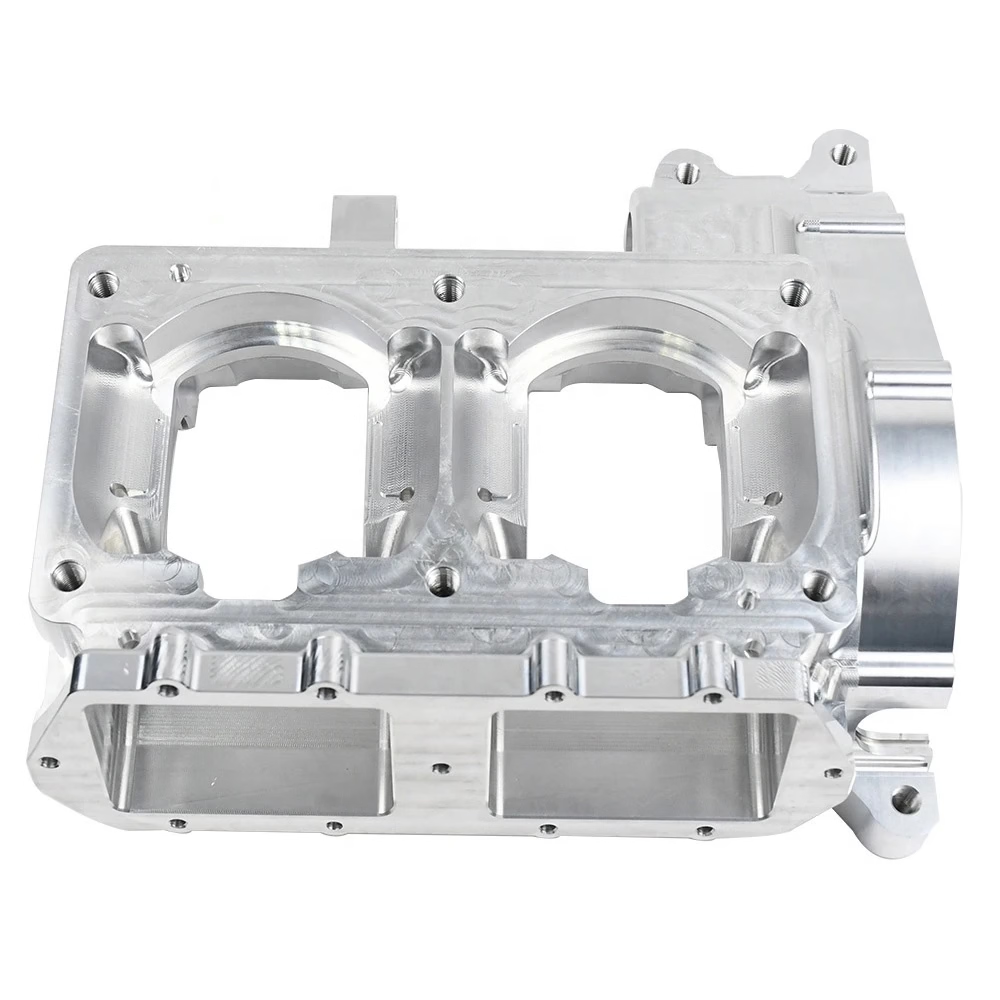
How models of CNC machine tools are classified
A CNC machine tool moves a cutting tool or a workpiece along axes under program control. The program comes from CAM, and the machine executes coordinates, feed rates, and spindle speeds without an operator turning handwheels. That part is the same on every model. The differences that matter are axis count, spindle orientation, and how the work is held.
Axis count is the first split. A 3-axis mill moves X, Y, and Z only, so the tool always approaches from one direction. A 4-axis machine adds rotation, usually around X, which lets you cut four sides of a part without re-fixturing. A 5-axis machine adds a second rotary axis, so the tool can tilt to reach undercuts and blend surfaces in one setup.
Spindle orientation is the second split. On a mill, the tool spins and the table moves. On a lathe, the workpiece spins and a single-point tool feeds along the profile. Mill-turn centers combine both: a turning spindle plus a milling spindle, which suits parts that need turned diameters and milled flats in the same cycle.
Structure decides the rest. Vertical machining centers are easier to load and cheaper per axis. Horizontal machining centers throw chips down and away, which helps on long runs with deep pockets. Gantry and bridge mills carry the spindle on a fixed frame, so they hold accuracy across large travels that a knee mill cannot.
- 1Axis countSets how many faces you can reach in one setup.
- 2Spindle orientationDecides whether the tool or the workpiece rotates.
- 3Travel envelopeSets the largest part the machine can physically hold.
3-axis, 4-axis, and 5-axis milling models
3-axis milling is the default for prismatic parts. Faces, pockets, slots, and drilled holes all cut cleanly when the tool can reach them from above. It is the cheapest way to remove material and the easiest to inspect. The limit is reach: any feature on a side wall or an internal corner that faces away from Z needs a second setup or a different machine.
4-axis milling adds a rotary table, typically Ø400 mm or smaller on a compact machine. That extra rotation lets you index the part to four sides and cut them without losing the datum. It is common for shaft-like parts, brackets, and housings with features on multiple faces. You still cannot tilt the tool, so undercuts and steep blend radii stay out of reach.
5-axis milling adds a trunnion or a swivel head, and the two rotary axes move at the same time as the linear axes. Simultaneous motion lets a ball nose tool stay normal to a curved surface, which keeps the stepover even and the finish consistent. It also lets a short, stiff tool reach deep features that a long 3-axis tool cannot, which raises accuracy on deep cavities.
The trade-off is cost and programming time. A 5-axis toolpath needs verification for gouges and collisions, and the machine itself costs more per hour. For a flat plate with holes, 5-axis adds nothing. For an impeller, a turbine blade, or a medical implant with compound curves, it is the only practical route.
- 13-axisFlat and prismatic parts, one approach direction.
- 24-axisMulti-face parts indexed around one rotary axis.
- 35-axisCompound curves, deep cavities, single-setup complex parts.
Turning models and mill-turn centers
A CNC lathe spins the workpiece against a single-point tool. It is the fastest way to make round parts: shafts, bushings, pins, and fittings. On a two-axis lathe the tool moves in X and Z only, so it cuts outside diameters, faces, and simple profiles. Add a Y axis and a live tool, and the same machine can drill cross holes and mill flats off-center.
Mill-turn centers push that further. They carry a turning spindle, a milling spindle, and often a second turret or a sub-spindle. A part can be turned, milled, drilled, and cut off in one cycle, then picked up by the sub-spindle and finished on the back side. That removes two or three setups and the datum shifts that come with them.
The boundary is part shape. Mill-turn pays off when a part is mostly round but has milled features, like a hydraulic manifold with cross ports or an aerospace actuator body. If the part is mostly prismatic with a few turned diameters, a mill with a rotary table is usually cheaper and easier to program. Bar stock diameter sets the ceiling: most mill-turn centers here run bar up to Ø65 mm, and larger work goes on a chuck.
Live tooling and sub-spindles add cost, so a shop does not buy them for simple shafts. The decision comes down to how many setups a part would need on a plain lathe. Two or more setups with tight concentricity between them is the signal to move to mill-turn.
- 12-axis latheRound parts, OD and face work, highest removal rate.
- 2Lathe with live toolingAdds cross holes and off-center milling.
- 3Mill-turn centerTurn and mill in one cycle, fewer datums.
Travel, frame size, and what fits on the table
Travel is the hard limit. A machine cannot cut a part wider than its envelope, no matter how good the toolpath is. Compact verticals run around 500 × 500 × 450 mm, which covers most brackets, covers, and small housings. Mid-size machines run 750 × 1,150 × 550 mm or 600 × 600 × 600 mm, which handles larger plates and molds. Large gantry and bridge mills reach 4,000 × 400 × 150 mm for long parts like rails and beams.
The envelope is not just the table. You also need room for the tool holder, the fixture, and the tool change. A part that is 5 mm under the travel limit in every direction may still not fit once it is clamped. When we quote, we check the actual stock size plus the fixture height, not just the finished part.
Accuracy changes with size. A small machine with a stiff frame holds ±0.005 mm more easily than a large one, because thermal growth and deflection scale with length. On a 4,000 mm part, the same tolerance takes temperature control and a slower finishing pass. If a large part carries a tight bore, it is often cheaper to machine it oversize and finish the bore on a smaller, stiffer machine.
Spindle taper matters here too. BT30 and HSK-E32 suit small tools and high speeds. BT40 and HSK-A63 cover most general work. BT50 and HSK-A100 carry large face mills and heavy cuts on big frames. Matching taper to the cut, not to the machine size, keeps chatter down.
- 1CompactAround 500 × 500 × 450 mm, small parts and prototypes.
- 2Mid-size750 × 1,150 × 550 mm, plates and molds.
- 3LargeUp to 4,000 × 400 × 150 mm, rails and beams.
How to pick a model before you request a quote
Start with the part, not the machine. Count the faces that carry toleranced features. If they all face one direction, 3-axis is enough. If they wrap around a cylinder, 4-axis or a lathe fits. If they sit on compound curves or inside deep cavities, 5-axis is likely. This one check removes most of the guesswork.
Next, look at size and weight. A part that needs a crane to load belongs on a machine with the right table and a way to index it. A part under 200 mm on a side rarely needs a large frame, and putting it on one wastes setup time and money. Travel and part size should be a close match, not a loose one.
Then check tolerance and finish. Standard machining holds ±0.005 mm and Ra 1.6–3.2 μm as-machined. Fine finishing reaches Ra 0.8–1.6 μm or Ra 0.2–0.8 μm on the right machine. If a bore needs a specific fit, say so up front, because it may change which machine runs the job and how many setups it takes.
Finally, weigh quantity. One prototype and a 10,000-part run do not use the same plan. Prototypes favor 3-axis and 5-axis mills where setup is fast. Long runs favor mill-turn and horizontal machines where cycle time and chip evacuation dominate. No minimum order quantity applies at GreatLight, so a single part and a full run go through the same process review.
- 1Count facesOne direction means 3-axis is enough.
- 2Match travelDo not put a small part on a large frame.
- 3State toleranceFit and finish may change the machine choice.
Model comparison by part type
Pick the row that matches your part geometry, then read across.
| Machine model | Best part type | Typical limit | When to avoid |
|---|---|---|---|
| 3-axis mill | Flat plates, pockets, drilled holes | One approach direction only | Features on side walls or undercuts |
| 4-axis mill | Multi-face brackets, shafts with flats | Tool still cannot tilt | Compound curves and deep internal blends |
| 5-axis mill | Impellers, blades, implants, deep cavities | Higher hourly rate and programming time | Simple flat parts with through holes |
| 2-axis lathe | Shafts, pins, bushings, fittings | Round features only | Parts needing milled flats or cross holes |
| Mill-turn center | Round parts with milled features | Bar up to about Ø65 mm | Mostly prismatic parts with few turns |
| Horizontal mill | Long runs with deep pockets | Less flexible for one-off work | Single prototypes with tight budget |
| Gantry / bridge mill | Rails, beams, long plates | Large footprint, slower finishing | Small parts that fit a compact vertical |
The short verdict
If your toleranced features all face one way, pick a 3-axis mill and save the money. If they wrap around a cylinder or sit on compound curves, pick 4-axis, 5-axis, or mill-turn and accept the higher rate. Match travel to part size, state the fit up front, and the model choice usually makes itself.
Common questions
How many axes do I actually need?
Count the faces that carry a tolerance. If every feature faces the spindle, 3-axis is enough. If features wrap around the part, you need a rotary axis.
4-axis indexes the part to reach those faces. 5-axis tilts the tool as well, which is what compound curves and deep cavities require.
Is 5-axis always more accurate than 3-axis?
No. Axis count does not set accuracy by itself. A stiff 3-axis machine with a short tool can hold ±0.005 mm just as well as a 5-axis machine.
5-axis helps accuracy when it lets you use a shorter tool or finish a curved surface in one setup. On flat parts it adds nothing.
When does mill-turn beat a lathe plus a mill?
When a part needs two or more setups and the features must stay concentric. Mill-turn removes the re-fixturing, so the datum does not shift between operations.
For a simple shaft with no milled features, a plain 2-axis lathe is faster and cheaper.
What is the largest part you can machine?
Maximum processing size is 4,000 mm, with a large travel of 4,000 × 400 × 150 mm on gantry and bridge mills.
Mid-size machines cover 750 × 1,150 × 550 mm and 600 × 600 × 600 mm. Send the stock size and fixture plan, because the finished part size alone is not the limit.
Does part quantity change which model runs my job?
Yes. One prototype favors a mill where setup is quick. A 10,000-part run favors mill-turn or a horizontal machine where cycle time and chip evacuation matter more.
GreatLight has no minimum order quantity, so both go through the same process review.
What tolerance and finish can I expect?
Standard machining holds ±0.005 mm (±0.0002 in). As-machined finish is Ra 1.6–3.2 μm. High finish reaches Ra 0.8–1.6 μm, and fine finishing reaches Ra 0.2–0.8 μm.
Every part is inspected before shipment, with raw material, in-process, and final checks. Reports are available on request.
Send your part, get a machine recommendation
Upload a STEP file and we will come back with a quotation and a free DFM analysis within 12 hours, including which machine model fits the job.
12-hour quote100% inspectionNo minimum order
More from the shop floor
We publish setup notes, tooling trials and inspection data from the factory floor.











