
Working CNC Machining Near Me: 5 Essential Checks Before You Order
Searching for working cnc machining near me usually means one of two things: you need a shop close enough to visit, or you need a supplier who answers fast and ships in days. This guide gives engineers and buyers five checks that separate a shop worth quoting from one that will stall your project.
In this article
- 1
- 2
- 3
- 4
- 5
- 6
- 7
- 8
Key takeaways
Local shop vs. remote supplier: what actually matters
Use this table when you are deciding whether to stay local or quote a supplier further away.
| Factor | Local shop | Remote supplier | What to ask |
|---|---|---|---|
| Travel time | Same-day visit possible | Video walkthrough only | Can I see the machine on a call? |
| Equipment range | Often 3-axis only | 16 five-axis centers | Which machine will run my part? |
| Lead time | Depends on their queue | Ship in 3–5 days | What is the real start date? |
| Minimum order | Often 50–100 pcs | No minimum order quantity | Will you run one prototype? |
| Certifications | May hold none | ISO 9001, IATF 16949, ISO 13485 | Send the current certificate |
| Inspection data | Rarely documented | 100% inspection, reports on request | Can I get a dimensional report? |
| Max part size | Limited by the building | Up to 4,000 mm | Will my part fit the travel? |
Pick the shop that fits the part, not the postcode
If your part is simple and the design is still moving, a nearby shop is the practical choice. If it needs 5-axis work, ±0.005 mm, ISO 13485 or IATF 16949, and a 3–5 day ship date, choose the supplier that can prove those numbers. Distance is a convenience. Capability is the deliverable.
Working CNC machining near me: what distance really buys you
A shop down the road is convenient. You can drive over, stand at the machine, and argue about a chamfer while the part is still clamped. That matters when a design is unsettled and you are cutting the first article. It matters less once the drawing is frozen and the process is proven.
The real question is not how far the shop is. It is whether the shop has the machine your part needs. A bracket with three holes can run on any 3-axis mill in any town. A turbine housing with undercuts on five faces needs a simultaneous 5-axis center, and those are not evenly spread across every industrial park.
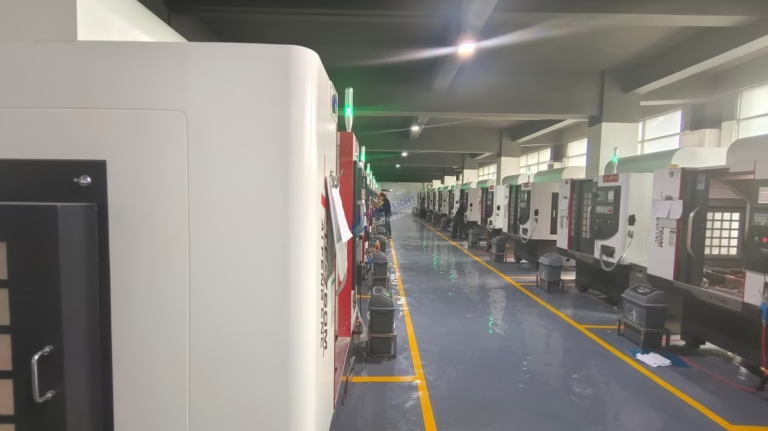
GreatLight runs 127 high-precision CNC machines across three wholly-owned plants, including 16 simultaneous 5-axis machining centers, 12 four-axis mills, 27 three-axis machines, and 16 mill-turn centers. The largest travel reaches 4,000 × 400 × 150 mm. That mix is the reason a part that stalls at a small local shop can still start production within 24 hours here.
If your parts are simple and your volumes are low, a nearby shop is fine. If your parts have tight geometry, mixed materials, or a deadline tied to a build schedule, compare capability first and distance second.
- 1Local wins whenThe design is still changing and you want hands on the part.
- 2Remote wins whenThe part needs 5-axis work, tight tolerance, or a fast ship date.
- 3Ask bothWhich machine will run my part, and what is its travel?
Tolerance and surface finish: get the number in writing
Every shop says they hold tight tolerance. Few put a number on it. Ask for the tolerance they can hold across the whole part, not just on one ground face. GreatLight works to ±0.005 mm (±0.0002 in) on qualified features, with surface finish from Ra 0.2–0.8 μm on fine work up to Ra 1.6–3.2 μm as-machined.
The number only counts if the shop can measure it. A ±0.005 mm callout needs a controlled temperature room, calibrated CMM or vision equipment, and a written inspection plan. If the shop measures with calipers and eyeballs the print, the tolerance claim is marketing.
Finish drives cost more than most engineers expect. Moving from Ra 1.6–3.2 μm to Ra 0.2–0.8 μm can add a finishing pass, a different tool, or a secondary operation. Decide which surfaces need the fine finish and which can stay as-machined. Mark them on the drawing.
For medical and aerospace parts, inspection records are not optional. GreatLight inspects 100% of parts before shipment, with raw material checks, in-process monitoring, and final inspection. Dimensional reports are available on request, which is what your quality team will ask for anyway.
- 1Tolerance±0.005 mm on qualified features, stated in the quote.
- 2Finish bandsRa 0.2–0.8 μm fine, Ra 0.8–1.6 μm high, Ra 1.6–3.2 μm as-machined.
- 3ProofAsk which instrument measures the tightest callout.
Lead time, MOQ and quote speed: three numbers to compare
Lead time is where a local shop can quietly lose. If the shop has one 5-axis machine and a full queue, your job sits behind three others. Ask when the spindle will actually start cutting your material, not when the order enters their system.
GreatLight sends a quotation and free DFM analysis within 12 hours, starts production within 24 hours, and ships parts in 3–5 days. Historical late-delivery probability is below 2%. Those are the numbers to hold a supplier to. If a shop cannot give you a start date, they are guessing.
MOQ is the second number. Shops that serve production lines set a minimum of 50 or 100 pieces because setup cost dominates. That is fine if you need 5,000 parts. It is a wall if you are validating a design. GreatLight has no minimum order quantity, so a single prototype and a 10,000+ part run go through the same process.
The third number is quote turnaround. A working shop reads your STEP file, finds the problem features, and tells you what will be hard to machine. A sales desk forwards the file and waits. The difference shows up in the first article, not in the email.
- 1Quote12 hours including DFM feedback.
- 2StartProduction within 24 hours of approval.
- 3Ship3–5 days, late-delivery probability below 2%.
- 4MOQNone. One prototype to 10,000+ parts.
Certifications and documents: match them to your industry
Certifications are a filter, not a badge. A shop with ISO 9001:2015 has a documented quality system. That covers general industrial work, robotics, electronics, and most machinery parts. It does not automatically qualify them for your implant housing.
Medical device work needs ISO 13485:2016. Automotive and EV programs need IATF 16949:2016. If your drawings or your customer's purchase order carry one of those requirements, a supplier without the matching certificate cannot be approved, no matter how good the parts look.
Data handling is the fourth certificate people forget. ISO 27001:2022 covers information security. If you are sending proprietary geometry, ask how files are stored and who can open them. GreatLight holds ISO 9001:2015, IATF 16949:2016, ISO 13485:2016, and ISO 27001:2022, and can sign an NDA on request.
Request the current certificate PDF, not a logo on a webpage. Check the scope statement. A certificate that covers machining but not the plating line means your anodized parts go out to a third party you have not audited.
- 1ISO 9001:2015General industrial, robotics, electronics, machinery.
- 2IATF 16949:2016Automotive and EV production parts.
- 3ISO 13485:2016Medical devices and instruments.
- 4ISO 27001:2022Information security for your drawings and files.
Materials and finishing: where hidden cost lives
A shop that stocks 6061 and 304 will quote almost anything, then source the rest. That adds days. Look at the material list they normally run. GreatLight machines aluminium 6061, 6061-T6, 2024, 5052, 5083, 6063, 6082, 7075, and ADC12; stainless 303, 304, 316, 316L, 420, 430, 431, 440C, and 17-4PH; steels including 1018, 1045, 4130, 4140, 4340, A36, and tool steel; copper and brass C101, C103, C110, C27400, C28000, and C36000; titanium TA1, TA2, TC4, Inconel, and magnesium AZ31B or AZ91D; plus plastics such as POM, PEEK, PC, PA, and carbon fibre.
Finishing is the second hidden cost. Anodizing, electroless nickel, zinc, silver and gold plating, powder coating, black oxide, bead blasting, tumbling, brushing, polishing, and laser marking all change the price and the lead time. Laser marking needs a minimum character height of 1.5 mm, so keep your part numbers readable.
Ask whether finishing happens in-house or at a partner. In-house means one schedule and one quality record. Outsourced finishing means your parts leave the building, and the ship date now depends on a second company.
One more trap: tolerance after coating. Hardcoat anodizing builds thickness. If a bore is held at ±0.005 mm before coating, it may not fit after. Tell the shop which surfaces are functional and which are cosmetic.
- 1Material rangeAluminium, stainless, steel, copper, brass, titanium, Inconel, plastics.
- 2FinishingAnodizing, plating, powder coat, blasting, laser marking.
- 3Laser markingMinimum character height 1.5 mm.
How to vet a CNC supplier in 6 steps
Run these in order. The first two steps remove most of the list.
- 1Match the machine to the partSend the STEP file and ask which machine will run it. Check travel: 4,000 × 400 × 150 mm, 750 × 1,150 × 550 mm, 600 × 600 × 600 mm, 500 × 500 × 450 mm, or 500 × 310 × 200 mm. If the part does not fit, stop.
- 2Ask for the tolerance and the measuring methodGet a written tolerance of ±0.005 mm where needed, and ask which instrument checks the tightest callout. Calipers cannot verify a 5 μm band.
- 3Confirm the certificate scopeRequest the current PDF for ISO 9001:2015, IATF 16949:2016, ISO 13485:2016, or ISO 27001:2022 as your industry requires. Check whether finishing is inside the scope.
- 4Compare lead time and MOQAsk for the production start date, not the order date. Confirm whether they will run one piece. A shop with no minimum order quantity can support both prototype and 10,000+ part runs.
- 5Send a test part before the full orderA first article exposes tool marks, burrs, and print misreads early. Inspect it against the drawing before releasing the batch.
- 6Settle the file and NDA termsConfirm how drawings are stored and who can open them. Sign an NDA before sending proprietary geometry.
Frequently asked questions
Is working CNC machining near me cheaper than an overseas supplier?
Not automatically. A local shop saves freight and travel, but if it lacks the right machine it may subcontract the hard features, which adds cost and time.
Compare the full route: machine hours, setup, finishing, inspection, and freight. A supplier that runs the part in one plant usually has fewer line items.
What tolerance should I expect from a CNC shop?
±0.005 mm (±0.0002 in) is achievable on qualified features when the shop has temperature control and proper metrology. Most general work sits at ±0.02 mm or looser.
State the tight tolerance only where the function needs it. Blanket tight tolerances on every dimension raise the price without improving the part.
Do I need to pay for a DFM review?
No. Ask for DFM feedback with the quote. GreatLight returns a quotation and free DFM analysis within 12 hours.
Read the notes carefully. Wall thickness, tool access, and deep pockets are the usual problems. Fixing them before cutting saves a second setup.
Can a supplier run one prototype and then 10,000 parts?
Yes, if they have no minimum order quantity and keep the same process for both. GreatLight runs from one prototype to 10,000+ part runs.
Ask whether the prototype and the production batch use the same machine family. A process change between them invalidates your first-article data.
How do I protect my design when I send files out?
Sign an NDA before you upload, and ask how files are stored and who can access them. ISO 27001:2022 covers information security management.
GreatLight keeps uploads secure and confidential and can sign an NDA on request.
What part size can be machined?
GreatLight handles parts up to 4,000 mm, with a largest travel of 4,000 × 400 × 150 mm and a Ø400 mm rotary table for round work.
Very long, thin parts need support or the vibration will show in the finish. Mention the aspect ratio when you request a quote.
Send your drawing and get a real answer in 12 hours
Upload a STEP file and we will return a quotation, a DFM review, and a production start date. No minimum order quantity, 100% inspection before shipment, and an NDA on request.
12-hour quoteFree DFM analysisNo MOQ100% inspection
More from GreatLight
We publish setup notes, tooling trials and inspection data from the factory floor.











