
Finding CNC Router Shops: Ten Checks That Actually Matter
This guide is for engineers and buyers who need a router shop that can hold a print, not just quote a low number. It covers machine travel, real tolerance, materials, finishing and inspection, so you can shortlist suppliers and ask better questions on the first call.
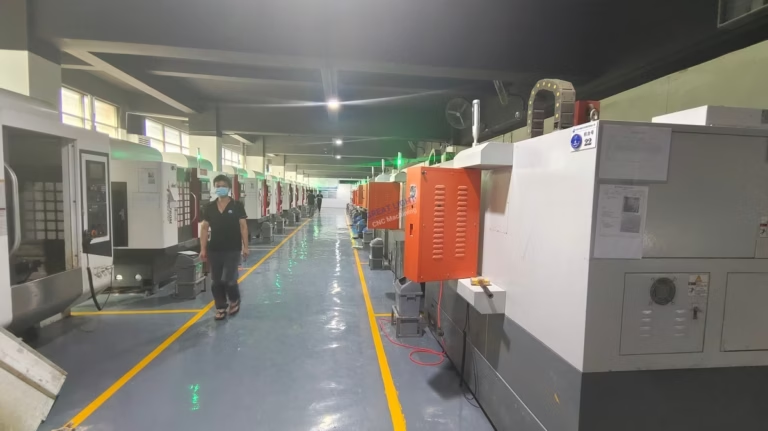
What separates a router shop from a manufacturing partner
Ten checks, ordered by how early they eliminate a supplier from your list.
Machine capability, real tolerance, and one-stop scope
Start with the work envelope. A shop that lists a 4,000 mm machine but cannot hold flatness across that length is not a large-part supplier. Confirm the actual travel of each machine and the rotary table size. At GreatLight the largest travel is 4,000 × 400 × 150 mm, with a Ø400 mm rotary table on the 5-axis side and 16 simultaneous 5-axis centers in the building. If your part needs one setup on five faces, that count matters more than the total machine list.
Tolerance claims are where most quotes fall apart. Many shops advertise ±0.001 mm and then send a first article that misses by 0.03 mm. Real precision is the sum of machine condition, thermal stability, fixturing and operator skill. A shop that holds ±0.005 mm in production will usually say so plainly and show you the data. At GreatLight we publish ±0.005 mm (±0.0002 in) and verify it with a first-article report against your CAD model.
One-stop scope saves you weeks of coordination. If the shop only mills, you still need a finisher, a plater and someone to chase both. Look for a supplier that can turn, mill, finish and inspect under one quality system. GreatLight runs 5-axis, 4-axis and 3-axis machining, mill-turn, sheet metal, die casting, vacuum casting and surface finishing, so the part does not leave the building between operations.
- 1Work envelopeAsk for travel per machine, not a single maximum.
- 2Tolerance proofRequest a first-article report against your CAD model.
- 3Setup countFewer setups usually means tighter positional accuracy.
- 4ScopeMachining plus finishing under one quality system.
Pricing language, certifications, and speed you can trust
Price per part is the least useful number on a router quote. What you want is the cost driver: material, setup time, tolerance band, finish and inspection level. A shop that explains why a Ra 0.8 μm finish adds cost is a shop that understands your print. When a supplier offers to relax a tolerance you do not need, that is a saving, not a shortcut. Ask for a breakdown by operation and you will see where the money goes.
Certifications are not decoration. ISO 9001:2015 tells you the quality system is audited. IATF 16949:2016 matters if the part goes into a vehicle. ISO 13485:2016 matters for medical devices. ISO 27001:2022 covers how your files are protected. GreatLight holds all four. For an engineer, the practical question is which certificate applies to your part, and whether the shop can show the scope statement, not just the logo.
Speed without quality control is just fast scrap. A quote in 12 hours is useful only if the DFM notes are real and the first article is inspected. GreatLight returns a quotation and a free DFM analysis within 12 hours, can start production within 24 hours, and ships parts in 3–5 days. The historical late-delivery probability is below 2%, which is the number to compare against a promise of overnight shipping.
- 1Cost driversMaterial, setup, tolerance, finish, inspection.
- 2Cert scopeMatch the certificate to your industry and part.
- 3Quote speed12 hours is only useful with real DFM notes.
- 4Delivery dataAsk for on-time history, not a guarantee.
Material knowledge and finishing control
Not every router shop knows its alloys. Aluminum 6061 machines cleanly, 7075 is stronger but galls if the feeds are wrong, and magnesium AZ31B needs different handling again. Stainless 304 work-hardens, 17-4PH needs the right heat treat condition, and Inconel will punish a light radial cut. A shop that stocks or regularly buys the alloy you need will quote it with confidence. GreatLight machines 6061, 2024, 5052, 6063, 6082, 7075, ADC12, 303, 304, 316L, 420, 440C, 17-4PH, 1018, 1045, 4130, 4140, 4340, titanium TC4 and plastics from ABS to PEEK.
Finishing is where a good part becomes a shippable part. Anodizing color match, hardcoat thickness, electroless nickel build-up and bead-blast texture all change dimensions if the shop does not plan for them. Masking decisions on threads and bores belong in the DFM review, not on the shop floor. GreatLight offers clear, color, hardcoat and conductive anodizing, electroless nickel, zinc, silver and gold plating, powder coating, black oxide, bead blasting, tumbling, brushing, polishing and laser marking down to 1.5 mm character height.
Ask what the shop measures after finishing, not just after machining. A plated bore can close by several microns, and a powder coat can fill a chamfer. If the final inspection happens before plating, your functional dimension is unverified. The fix is simple: specify the critical dimensions and let the shop confirm them after the finish operation.
- 1Alloy familiarity7075, 17-4PH and Inconel need tuned parameters.
- 2Finish planningThickness and texture affect final dimensions.
- 3MaskingThreads and bores need protection in the DFM stage.
- 4Post-finish checkMeasure critical features after coating or plating.
What to ask for by part type
Use this as a shortlist scorecard on your first supplier call.
| Part type | First question | Evidence to request |
|---|---|---|
| Large frame or panel | What is the travel of the machine? | Travel list and flatness data |
| 5-face housing | How many simultaneous 5-axis centers? | Setup sheet and first article |
| Tight bore, ±0.005 mm | How is thermal drift controlled? | In-process inspection record |
| Aerospace bracket | Which alloys do you run weekly? | Material certs and traceability |
| Medical instrument | Do you hold ISO 13485:2016? | Certificate scope statement |
| Anodized enclosure | Who masks threads and bores? | Finishing plan and post-finish check |
| Prototype, one piece | Is there a minimum order? | No-minimum policy in writing |
Engineering support and the long-term view
DFM support is the safety net. A shop that only reads the drawing will machine what you sent, including the mistake. A partner will flag a 0.2 mm wall, a deep pocket that needs a smaller tool, or a thread that cannot be cut without a second setup. GreatLight reviews every upload and returns DFM notes with the quote. That review is where cost comes out of a part before the first chip is cut.
Confidentiality belongs in the first conversation. If your design is not public, ask for an NDA before you upload. GreatLight treats uploads as secure and confidential and provides an NDA on request. For automotive and medical work, document control is part of the audit trail, not an extra.
The strongest signal is a shop that plans for your next revision. Ask how they store tooling, fixtures and inspection records from a previous run. If the answer is vague, the second order will cost as much as the first. A partner keeps the fixture, the setup sheet and the inspection data, so the next batch starts faster. That is the difference between a vendor and a manufacturing partner.
- 1DFM reviewLook for notes on walls, pockets and threads.
- 2NDA firstSign before uploading confidential geometry.
- 3Record keepingFixtures and inspection data should carry over.
- 4Second runA partner makes the next batch cheaper.
Common questions from engineers
How do I compare tolerance claims between router shops?
Do not compare the numbers on the website. Compare the evidence. A shop that holds ±0.005 mm can show a first-article report against your CAD model, with the measurement method and the environment noted.
Ask whether the tolerance applies to a single best case or to production parts. If the answer is production, ask how many parts were measured and over what period.
Is a local shop always better than an overseas one?
Not automatically. Local matters when you need to stand next to the machine or when freight time dominates. Overseas works when the shop has the right machine, the right alloy and a documented inspection process.
The deciding factor is usually the part. A 4,000 mm frame may be cheaper to make where the machine exists. A one-off bracket may be cheaper nearby.
What should I send with my first RFQ?
Send a 3D model and a 2D print with the critical dimensions called out. Add the material, the finish, the quantity and any industry requirement such as IATF 16949 or ISO 13485.
If the part is confidential, request an NDA before uploading. That keeps the review clean and avoids rework later.
How do I know a finish will not change my dimensions?
Specify the critical features and ask for confirmation after the finish operation. Anodizing, plating and powder coating all add or remove material, and threads and bores are the usual casualties.
A finishing plan that lists masking and post-finish measurement is a good sign. If the shop has no plan, put the critical dimensions in writing.
Can a router shop handle both prototypes and production?
Yes, if the process is the same. A shop that runs one prototype and a 10,000-piece order on the same machines, with the same inspection, will scale without a surprise.
GreatLight has no minimum order quantity and runs from one prototype to 10,000+ part runs, so the first article and the production part come off the same process.
What is the fastest realistic lead time?
A quote and DFM analysis in 12 hours is realistic. Production can start within 24 hours, and simple parts ship in 3–5 days.
Anything faster than that usually means the inspection step is being skipped. Treat a very short lead time as a question, not a benefit.
Send a drawing and get DFM notes with the quote
Upload your model and print. We return a quotation and a free DFM analysis within 12 hours, with the tolerance, finish and inspection plan stated in writing.
12-hour quoteFree DFM analysis100% inspectionNDA on request









