
Million Photos AI Activist Phone: How the Metal Parts Get Machined
The Activian V9 story is about a camera that counts images in the millions and AI that sorts them. This page looks at the hardware behind that pitch: lens rings, camera brackets, heat spreaders and housings. It is written for engineers and buyers who need those parts cut to tolerance, not for people shopping for a handset.
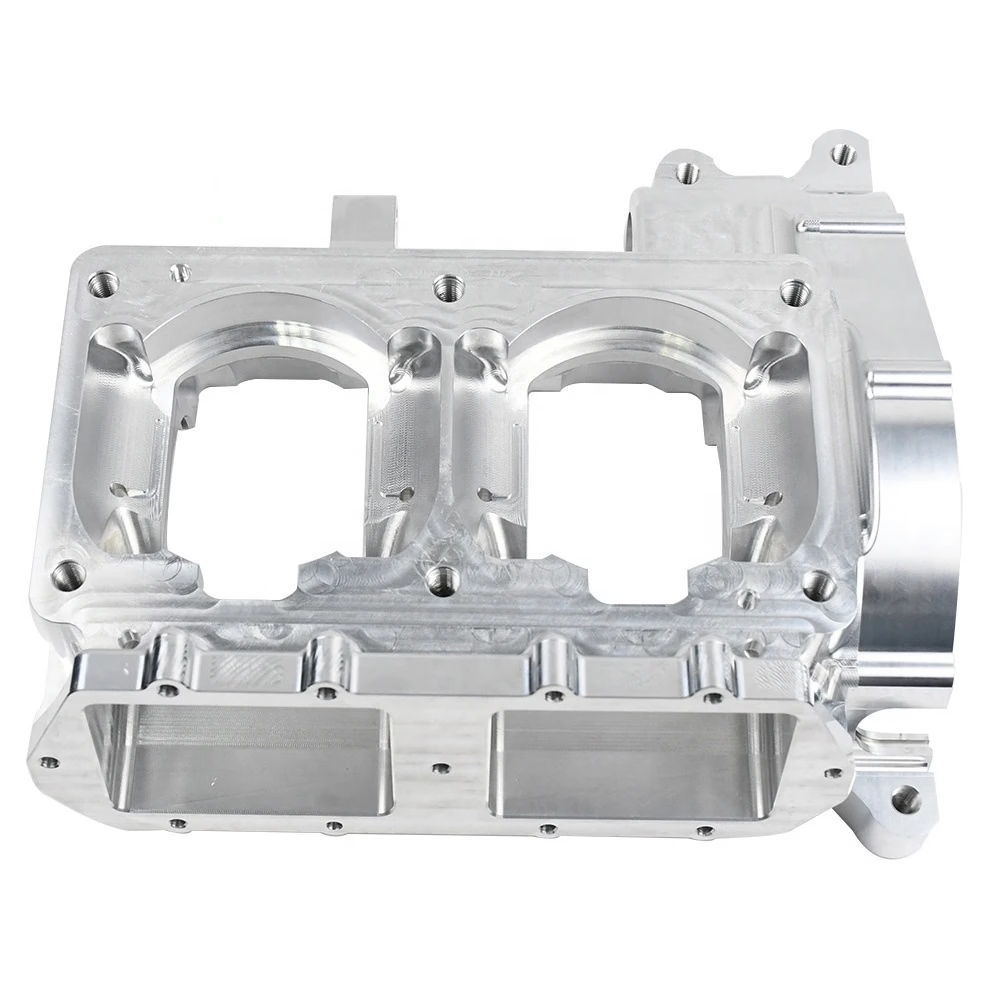
What This Page Covers
A camera phone is a stack of small precision parts. We machine the metal layers in that stack.
Why a Million-Photo Camera Needs Machined Metal
A phone that claims a million photos of AI-driven sorting is really a phone with a large sensor, a fast lens and a processor that never stops writing files. None of that works if the optical path drifts. The lens has to sit at a fixed distance from the sensor, and that distance has to survive a drop, a hot car and a pocket full of keys.
That is where metal parts earn their place. A stamped or molded carrier can move a few hundredths of a millimeter after a thermal cycle, and the image goes soft at the corners. An aluminum bracket machined in one setup holds its geometry because the datums are cut in the same operation that cuts the lens seat.
We see this pattern in the million photos AI activist conversations that reach our inbox: a camera module that looks like a software product until someone has to hold focus across a 20 MP sensor. The software is the easy half. The hard half is a ring that stays round after anodizing.
The parts are small, but the tolerance budget is not generous. A 0.01 mm shift at the lens ring becomes visible blur at the edge of the frame. Machining, not molding, is usually the way to hit that on the first article.
Which Parts We Cut and Which We Do Not
Not every part in a phone belongs on a CNC. A flat cosmetic back cover with no functional features is faster and cheaper as a die casting or a stamped shell. We say that to customers instead of quoting a machining job that should never have been one.
Lens rings, camera brackets, shutter plates, heat spreaders, hinge pins and RF shields are a different story. They carry fits, threads, optical seats or sealing grooves. Those features need a spindle, a tool and a probe, and that is the work we take.
A typical camera bracket starts as 6061-T6 or 7075 plate. The first side cuts the mounting bosses and the datum face. The second side opens the lens bore and the sensor window. Both sides run on one 5-axis center so the two faces stay parallel within ±0.005 mm.
When the part has a curved or angled lens seat, a 3-axis machine needs two or three fixtures and the stack-up grows. A simultaneous 5-axis cut removes that stack-up. That is the main reason we quote 5-axis on camera hardware even when the part looks simple on a drawing.
Part and Process Selection
Match the feature to the process before you ask for a price.
| Part | Typical Material | Process | Why |
|---|---|---|---|
| Lens ring | 6061-T6, 7075 | 5-axis mill, then anodize | Round bore, tight concentricity |
| Camera bracket | 6061-T6, 304 | 5-axis mill, two setups | Datum faces in one operation |
| Heat spreader | C110, 6063 | 3-axis mill, bead blast | Flatness and thermal contact |
| Hinge pin | 303, 17-4PH | CNC turning, then grind | Cylindricity under 0.01 mm |
| RF shield | 5052, C27400 | Sheet metal, laser mark | Thin walls, no heavy cuts |
| Cosmetic back cover | ADC12, ABS | Die casting or molding | Not a machining job |
Tolerances, Finishes and What They Cost
A lens ring usually lands at ±0.005 mm on the bore and ±0.01 mm on the flange thickness. We inspect on the machine with a touch probe, then again on a CMM before shipment. Reports go out with the parts on request.
Surface finish matters more on optical seats than on the outside of a housing. A seat at Ra 0.2–0.8 μm gives a clean contact face for the lens barrel. An exterior surface at Ra 1.6–3.2 μm is enough if the part only needs to look consistent after anodizing.
Anodizing adds a few micrometers and it is not always even. Threads and press fits should be masked, or the fit will change after coating. Bring that up at the DFM stage, not after the first batch. Hardcoat anodizing on 7075 is common for lens rings because it resists wear from repeated focus motion.
Cost drivers are straightforward: number of setups, number of tight features, material hardness and inspection level. A part with one tight bore is cheap. A part with six tight bores on four faces is not, and no machine changes that.
Material Choices for Camera Hardware
Aluminum is the default for brackets and rings. 6061-T6 machines cleanly and anodizes well. 7075 gives higher strength for thin walls but costs more and is harder on tools. 6063 is fine for heat spreaders where thermal path matters more than strength.
Stainless shows up where the part touches skin or needs corrosion resistance. 304 and 316L are common for frames and hinge parts. 17-4PH is used when a pin needs both hardness and corrosion resistance, and it can be heat treated after machining.
Copper and brass handle thermal and RF work. C110 copper carries heat away from a sensor. C27400 and C36000 machine fast for shields and small connectors. Titanium and Inconel are rare in phones but appear in rugged or industrial camera modules.
Plastics cover the non-structural layers. POM and PEEK work for internal insulators and sliding parts, ABS and PC for housings. Carbon fiber is an option when stiffness per gram is the deciding factor.
Common Questions
Can you machine a lens ring that stays round after anodizing?
Yes, within reason. We cut the ring with the coating thickness in mind and mask the bore when the fit is critical. The bore is inspected after coating, not before, so the number on the report matches the part you receive.
What is the smallest feature you can cut on a camera bracket?
Small bores and slots down to a few tenths of a millimeter are routine on our 5-axis centers. Very deep, narrow pockets are harder because the tool deflects. We review those at DFM and suggest a change if the feature cannot hold tolerance.
Do you machine prototypes before a full production run?
Yes. There is no minimum order quantity, so a single prototype is fine. Most camera hardware projects start with one or two parts to check fit, then move to a 10,000+ part run on the same program and fixtures.
How do you keep the design confidential?
Uploads are secure and confidential. If you need a signed agreement before sending drawings, we can put an NDA in place first. Files are not shared outside the project team.
Which materials do you keep in stock for camera parts?
Aluminum 6061, 6061-T6, 7075, 6063 and 5052, plus stainless 303, 304, 316L and 17-4PH, copper C110 and brass C36000. Other grades are ordered to the job, which adds a few days to the front end.
Can you match a finish across separate batches?
Anodized and plated finishes vary slightly between lots. We keep the process parameters on file and use the same supplier for repeat orders. If color match is critical, send a physical sample so we can compare against it.
Send Drawings for a 12-Hour Quote
Upload your STEP files and we return a quote with a free DFM review within 12 hours. Production can start within 24 hours of approval, and parts ship in 3–5 days.
12-hour quote100% inspectionNDA on request









