
3D CNC Milling Machine Services
This page explains how we cut three-dimensional geometry on 3-axis, 4-axis and 5-axis milling machines, which parts belong on which machine, and where the process stops making sense. It is written for design engineers and sourcing engineers who need to judge feasibility before they send a model.
What 3D CNC milling actually does
A rotating cutter removes material along three or more controlled axes until the solid in your CAD file becomes a metal or plastic part.
Three axes, then a fourth and a fifth
On a 3-axis mill the table moves in X and Y and the spindle moves in Z. The cutter can only approach the part from one direction, so every feature has to be reachable from the top. That covers a large share of real work: plates, housings, brackets, manifolds, pockets, slots, drilled hole patterns. If your part can be set up once and cut from above, a 3-axis machine is usually the cheapest and fastest route.
A 4-axis machine adds rotation around one axis, normally the X axis. The part indexes to a new face, the cut continues. You get features on four sides without re-fixturing, which removes the stacking error you would otherwise pick up from two or three separate setups. A 5-axis machine adds a second rotary axis, and the ones we run are simultaneous: the tool and the work piece move together through the cut.
That difference matters for geometry, not for prestige. Simultaneous motion lets a short, stiff cutter reach undercuts, blend compound surfaces and machine deep cavities from an angle instead of straight down. Tool overhang drops, chatter drops with it, and surface finish on curved walls improves without a second operation.
- 13-axisFlat plates, open pockets, hole patterns, one accessible face.
- 24-axisShafts, cams, cylinders and parts needing four machined sides.
- 35-axis simultaneousImpellers, turbine blades, organic surfaces, undercuts, deep cavities.
Machine capacity behind the service
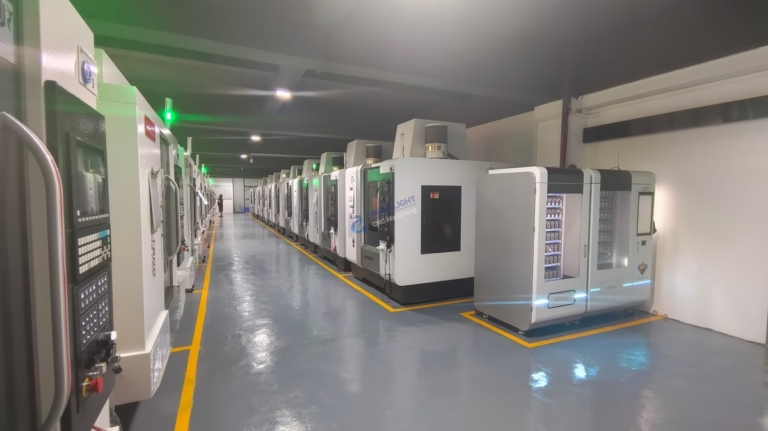
We run 127 high-precision CNC machines across three wholly-owned plants, including 16 simultaneous 5-axis machining centers, 12 four-axis mills, 27 three-axis machines and 16 mill-turn centers. The largest work envelope is 4,000 × 400 × 150 mm. Medium frames cover 750 × 1,150 × 550 mm and 600 × 600 × 600 mm, compact frames cover 500 × 500 × 450 mm and 500 × 310 × 200 mm, and rotary tables go up to Ø400 mm.
Those numbers decide where your part lands. A 1,200 mm aluminium extrusion bracket with pockets on two faces will run on a medium 4-axis machine. A Ø300 mm titanium impeller with twisted blades goes to a 5-axis center with a rotary table. A 900 mm long, thin stainless shaft is a mill-turn job, because turning and milling in one setup keeps concentricity in the same fixture.
Standard tolerance is ±0.005 mm (±0.0002 in), and we hold a 99.99% qualification rate with 100% inspection before shipment. Raw material is checked on arrival, cutting is monitored in process, and the final inspection report is available on request. If a feature needs tighter than that, say so on the drawing and we will tell you whether the geometry and material support it.
- 1Largest envelope4,000 × 400 × 150 mm on the big frame machines.
- 2Rotary capacityØ400 mm tables for round and index work.
- 3InspectionMaterial check, in-process monitoring, final report on request.
Which geometry fits which machine
Start with access. Can a cutter reach every surface without the holder hitting the part? If yes on one side, quote it on 3-axis. If the part needs four sides but the features are still prismatic, 4-axis is the right call. Only when surfaces are free-form, when walls lean, or when the feature sits behind a lip does 5-axis earn its cost.
Then look at aspect ratio. A pocket 4 mm wide and 40 mm deep is a 10:1 depth-to-width cut. A Ø4 mm cutter with that much stick-out will deflect and rub. On a 5-axis machine we can tilt the tool and shorten the effective overhang, or approach the wall at an angle, which is often the difference between a usable floor and a scrapped part.
Wall thickness matters too. Thin floors and tall unsupported walls will sing no matter how good the program is. If your design allows a thicker rib or a small fillet at the base, cutting forces drop and you get a better part at a lower price. When the wall has to stay thin, we plan the toolpath for low radial engagement and accept slower feed rates.
Finally, consider whether milling is the right process at all. Very deep holes, tight internal radii below the standard cutter corner, or parts where 70% of the block ends up as chips are usually better cast or printed first and then milled as a finishing operation.
Process and geometry quick reference
Use this to pick a starting machine before the quote comes back.
| Geometry | Typical machine | Why |
|---|---|---|
| Flat plate, open pockets | 3-axis | Single accessible face, one setup |
| Holes on 4 sides | 4-axis | Indexed rotation, no re-fixturing error |
| Curved blades and impellers | 5-axis simultaneous | Short tool, tilted approach, blended surfaces |
| Deep narrow pocket | 5-axis | Tool tilt cuts overhang and chatter |
| Long shaft with flats | Mill-turn | Turning and milling in one fixture |
| Very deep small holes | Not milling | Drilling or EDM is the better route |
Materials, finish and what changes the cost
Aluminium is the default for 3D milling. We cut 6061, 6061-T6, 2024, 5052, 5083, 6063, 6082, 7075 and ADC12. Aluminium machines fast, holds a good finish and rarely needs a second operation. Stainless 303, 304, 316, 316L, 420, 430, 431, 440C and 17-4PH are common in food, medical and marine hardware; they work-harden, so toolpaths have to keep the cutter moving and avoid rubbing.
Steel grades 1018, 1045, 4130, 4140, 4340, A36 and tool steel are run on the heavier frames. Copper and brass (C101, C103, C110, beryllium copper, C27400, C28000, C36000) cut cleanly and are often chosen for conductivity or bearing surfaces. Titanium TA1, TA2, TC4 (Ti-6Al-4V), Inconel and magnesium AZ31B / AZ91D need lower cutting speeds and more attention to heat. Plastics cover ABS, PC, PMMA, POM, PA, PEEK, PP, HDPE and carbon fibre.
As-machined finish sits at Ra 1.6–3.2 μm. A high finish is Ra 0.8–1.6 μm, and fine finishing reaches Ra 0.2–0.8 μm where the geometry allows. Post-processing includes anodizing in clear, colour, hardcoat and conductive types, electroless nickel, zinc, silver and gold plating, powder coating, black oxide, bead blasting, tumbling, brushing and polishing, plus laser marking down to 1.5 mm character height.
Cost moves with material removal, not with the number of axes alone. A part that fits in a 100 × 100 × 50 mm block and keeps its features on two sides will be cheaper on 3-axis even if a 5-axis machine could also cut it. Send a STEP file and we return a free DFM analysis with the quotation within 12 hours.
From file to finished part
The process starts with a STEP or IGES model and a 2D drawing that calls out critical dimensions and tolerances. If you only have a model, we work from that and flag anything ambiguous. DFM notes come back with the quote: thin walls, unreachable corners, tolerances that need a different process, and where a small design change saves machining time.
Production can start within 24 hours of approval, and parts ship in 3–5 days for most jobs. There is no minimum order quantity, so a single prototype and a 10,000+ part run use the same workflow. First articles are inspected and can be sent for your approval before the balance of the order runs.
Uploads stay confidential and an NDA is available on request. Our quality system is certified to ISO 9001:2015, with IATF 16949:2016 for automotive work, ISO 13485:2016 for medical hardware and ISO 27001:2022 for data security. GreatLight was founded in 2011 and now operates from Dongguan, China and a Singapore factory at No.3 Joo Koon Circle, Singapore 629032.
Questions engineers send with the model
Can you machine a part with undercuts on a 3-axis machine?
Usually not in one setup. An undercut by definition sits behind material that a straight Z approach cannot reach.
Options are a 5-axis machine with a tilted cutter, a flip to a second setup, or a change to the geometry. We will tell you which one costs less.
What is the smallest internal corner you can cut?
The corner radius is set by the cutter, not by the machine. A Ø6 mm end mill leaves a 3 mm radius; a Ø2 mm cutter leaves 1 mm.
Smaller cutters are available, but they are slower and deflect more. If the drawing allows a larger radius, the part gets cheaper and the finish improves.
How do you hold thin walls without distortion?
We control radial engagement rather than taking full-width cuts, use sharp tooling and often leave a finishing pass on both sides to balance stress.
For very thin floors, a support web or a soft-jaw fixture helps. If the geometry allows, adding a small fillet at the base makes the biggest difference.
Can I get one prototype before committing to a run?
Yes. There is no minimum order quantity, so a single part is a normal order.
We can send the first article for approval, then continue with the remaining quantity once you sign it off.
Do you provide inspection reports?
Yes, on request. We inspect raw material on arrival, monitor dimensions in process, and carry out final inspection before shipment.
Every part is checked against the drawing before it is packed. Reports can be issued for critical dimensions and for first articles.
What file formats do you need for a quote?
STEP and IGES for the solid model, plus a PDF or DXF drawing with tolerances, material and finish callouts.
If a critical feature is not dimensioned, note it. That is faster than a back-and-forth after the quote.
Send the model, get a milling plan back
Upload a STEP file and we return a quotation with free DFM analysis within 12 hours.
12-hour quote100% inspectionNo MOQ









