
3D Mini CNC Printing for Small, Detailed Parts
This page explains what the term 3d mini cnc printing covers, which small parts are worth machining rather than printing, and how to read a quote for them. It is written for design engineers and buyers who need plastic or metal parts in the 1–100 mm range. By the end you can pick a process, set a tolerance, and judge whether a shop can hold it.
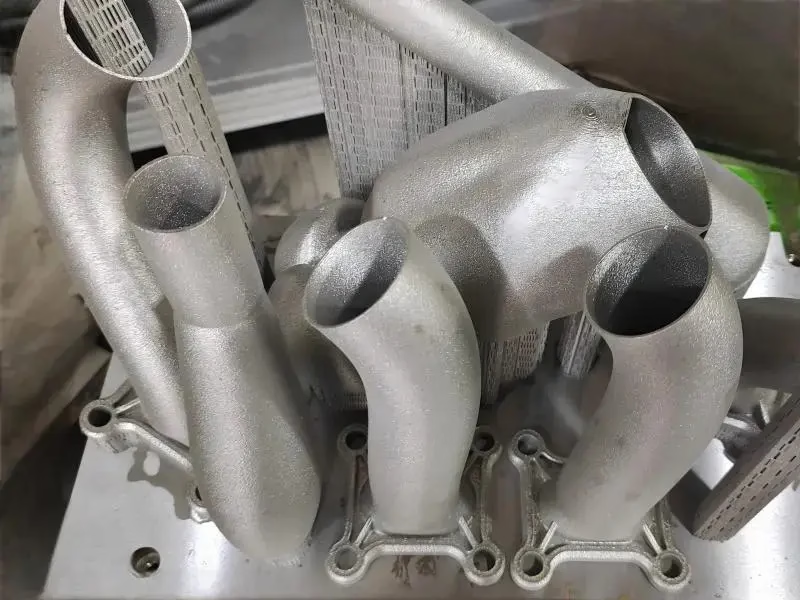
What 3d mini cnc printing actually means in a shop
The phrase mixes two processes, so it helps to separate them before choosing one.
Two processes behind one search term
Searches for 3d mini cnc printing usually come from one of two situations. Either an engineer has a small, detailed part that a desktop printer cannot hold to size, or a buyer needs a short run of miniature parts in metal or engineering plastic. Both land on the same question: which process gives a usable part at a sane cost?
Desktop printers build by adding material, layer by layer. Mini CNC machines cut material away with small-diameter end mills, drills and single-point tools. That difference decides everything downstream: surface texture, tolerance, material choice, and how the part behaves under load.
GreatLight runs both. Since 2011 the shop has grown to 127 high-precision CNC machines across 3 wholly-owned plants and 7,600 m² of floor space, with a Singapore factory at No.3 Joo Koon Circle. Small-part work often starts on a 3-axis or 4-axis mill, then moves to a 5-axis center when the geometry has undercuts or several faces.
- 1AdditiveGood for early form checks, light loading, and shapes a cutter cannot reach.
- 2SubtractiveBetter for tight tolerance, threads, bearing bores, and real engineering materials.
What a mini CNC can hold on a small part
Size is not the limit most people assume. The compact machines in the shop have travels of 500 × 500 × 450 mm and 500 × 310 × 200 mm, so a 5 mm housing or a 40 mm bracket sits well inside the envelope. The hard part is rigidity at small cutter diameters. A Ø1 mm end mill deflects easily, so feeds, stepover and tool stick-out all have to be managed.
Achievable tolerance depends on feature type, not on the machine alone. A flat face or a through hole on a rigid aluminum part can hold ±0.005 mm. A thin wall 0.4 mm thick, or a pocket 30 mm deep with a 2 mm cutter, will not. We quote the tolerance the geometry can actually take, not a number off a brochure.
Surface finish follows the same logic. Ra 0.2–0.8 μm is realistic on a turned or well-supported milled face. As-machined surfaces land at Ra 1.6–3.2 μm. For most miniature parts that is already smoother than any desktop print, and it comes with no layer lines to seal or sand.
- 1Feature sizeInternal corners are limited by cutter radius; a 1 mm radius needs a Ø2 mm tool.
- 2Wall thicknessBelow roughly 0.5 mm in metal, expect chatter and a looser tolerance band.
- 3Aspect ratioDeep narrow pockets past about 5:1 depth-to-width need EDM or a redesign.
Mini CNC versus resin and FDM printing
Use this to decide which process fits a small part before you send files.
| Criterion | Mini CNC | Resin printing | FDM printing |
|---|---|---|---|
| Typical tolerance | ±0.005 mm on rigid features | ±0.1 mm, worse on tall parts | ±0.3 mm or looser |
| Material range | Aluminum, stainless, steel, brass, titanium, PEEK, POM | Photopolymer resin only | PLA, ABS, PETG, nylon |
| Surface texture | Ra 0.8–1.6 μm typical | Layer lines, needs sanding | Visible layer lines |
| Threads and bores | Cut directly, ISO or UN | Must be added in CAD, weak | Must be added in CAD, weak |
| Load bearing | Yes, real engineering parts | Low, brittle over time | Low to moderate |
| Best use | Functional small parts, short runs | Fine detail, visual models | Rough form checks |
Materials that work at small scale
Aluminum is the default for miniature machined parts. 6061-T6 machines cleanly, holds thin walls, and takes anodizing in clear, color, hardcoat or conductive form. 7075 gives more strength when a small bracket has to survive vibration. 2024 is common in aerospace work but needs care with corrosion.
Stainless 303 and 304 cover most small shafts, housings and fittings. 17-4PH (SUS630) is worth the extra cost when a small part needs both strength and corrosion resistance, for example a medical or marine component. Brass C36000 machines fast and holds fine detail, which suits small fluid fittings and electrical contacts.
Plastics matter more at this scale than people expect. POM and PEEK hold tolerance and slide well, so they appear in small gears and insulators. HDPE is tough but moves under heat. Carbon fibre composites cut cleanly but dull tooling fast, which shows up in the price. Titanium TC4 (Ti-6Al-4V) is machinable at small size, though tool wear and cycle time push cost up sharply.
- 1Aluminum 6061-T6Best all-round choice for small housings, plates and brackets.
- 2Stainless 303 / 17-4PHPick 303 for easy machining, 17-4PH for strength plus corrosion resistance.
- 3POM / PEEKFor small moving parts, insulators and low-friction interfaces.
How a mini CNC job runs from file to part
A quote starts with the STEP or IGES file plus a drawing that states critical dimensions. Within 12 hours we return pricing and a free DFM analysis. That review flags features that will not cut cleanly, tolerances that are tighter than the geometry allows, and any dimension that needs a second operation. Fixing those in CAD is cheaper than fixing them in metal.
Production can start within 24 hours of approval. Small parts usually run on 3-axis or 4-axis mills, with 5-axis centers for parts that have features on several faces. The Ø400 mm rotary table handles small parts that need continuous indexing without re-fixturing, which protects position tolerance between faces.
Parts ship in 3–5 days for most jobs. Every order gets raw material verification, in-process monitoring and a final inspection before shipment, with reports on request. Historical late-delivery probability sits below 2%. There is no minimum order quantity, so a single prototype and a 10,000-part run use the same process route.
Design choices that keep small parts cheap
Most cost in miniature machining comes from setups, not from cutting time. A part that can be made in one orientation on one machine will beat a part that needs three fixtures, even if the second design is geometrically simpler. Add a flat datum face and you give the shop something to clamp.
Tolerances should be applied only where they matter. Calling out ±0.005 mm across an entire drawing forces extra passes and slower feeds on every feature. Mark the two or three dimensions that control fit and function, and leave the rest at a general tolerance. The part works the same. The price drops.
Sharp internal corners are the other common cost driver. A cutter has a radius, so a square corner needs either a larger tool radius in the design or EDM. If the corner is not sealing anything or locating anything, round it in CAD. Threads, chamfers and relief grooves at the bottom of a bore all help a small part cut cleanly and assemble without hand work.
- 1One setup if possibleFewer orientations mean fewer fixture costs and tighter feature-to-feature position.
- 2Tolerance where it countsTighten only the fit dimensions; keep the rest at general tolerance.
- 3Corner radiiMatch the radius to the smallest cutter you are willing to pay for.
Common questions
Is 3d mini cnc printing the same as 3D printing?
No. 3D printing adds material in layers. Mini CNC machining removes material with small cutting tools. The two are often compared for the same small part, but they produce different surfaces, tolerances and material properties.
If the part needs threads, a bearing bore or a real engineering material, machining is usually the right route. If it is a visual model with fine detail and no load, printing can be cheaper.
How small a part can you machine?
Feature size, not part size, is the real limit. Holes from Ø0.5 mm upward are routine in aluminum. Slots and pockets depend on depth: a 1 mm wide slot is fine at 2 mm deep and difficult at 15 mm deep.
Send the file and we will tell you which features are practical on the machines we have.
What tolerance can you hold on a small metal part?
±0.005 mm is achievable on rigid features with stable geometry. Thin walls, deep narrow pockets and long unsupported sections will need a wider band.
The DFM review names the dimensions that cannot hold the requested tolerance, so you can decide before production starts.
Do you have a minimum order quantity?
No minimum. A single prototype and a 10,000+ part run go through the same process route.
For one-off parts the setup cost dominates the price. For larger runs the per-part cost falls as fixturing is amortized.
Which finishes are available on miniature parts?
Anodizing in clear, color, hardcoat and conductive types; electroless nickel, zinc, silver and gold plating; powder coating and black oxide; bead blasting, tumbling, brushing and polishing.
Laser marking is available down to 1.5 mm character height. Smaller text tends to fill in and lose legibility.
How do you handle confidentiality?
Uploads are secure and confidential. An NDA is available on request before you send files.
Drawings, CAD data and inspection reports stay with the project team and are not shared outside the order.
Send a small part and get a real answer
Upload your STEP file and drawing. We return pricing and a free DFM analysis within 12 hours, with the tolerances your geometry can actually hold.
12-hour quote100% inspectionNo MOQNDA on request









