
5 Affordable 5 Axis CNC Machines and Routes That Cut Cost Without Losing Precision
For engineers and sourcing teams who need simultaneous 5-axis geometry but cannot justify a new top-tier machine. This page compares five realistic paths to affordable 5 axis capability, the tolerance each one holds, and the part shapes where each path stops making sense.
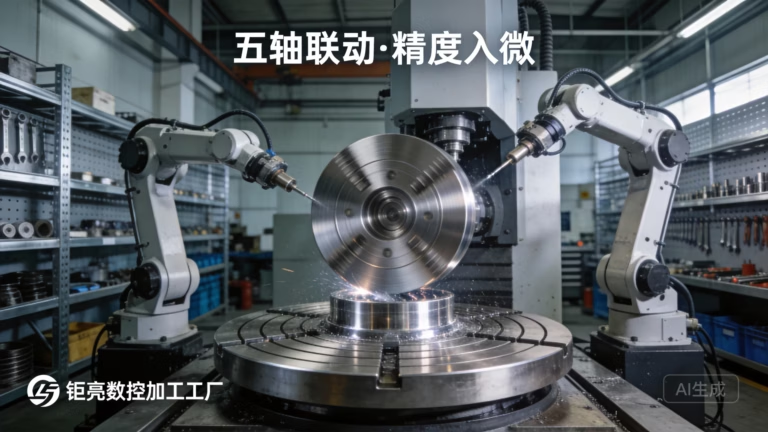
What "affordable 5 axis" means on a shop floor
Five routes to simultaneous 5-axis capability, ranked by what they cost and what they give up.
Used simultaneous 5-axis iron
A ten-year-old simultaneous 5-axis machining center still removes metal the same way it did when new. The rotary axes may have backlash, the spindle may need a rebuild, and the control may not accept modern toolpaths. None of that stops you from holding ±0.005 mm on a well-fixtured part, provided you measure before you cut and verify the rotary centers after any crash.
The real cost is not the machine. It is the inspection equipment, the tooling package, and the engineer who can program five axes. Budget for a calibration service and a spare spindle before you budget for the iron. A used machine with no local service network becomes a monument within a year.
Used iron suits job shops with steady 5-axis work and in-house maintenance. It does not suit a team that needs the machine running next week with no one to call. When you need capacity now and geometry is still changing, buying a partner's spindle time is cheaper than buying your own spindle.
Light-frame 5-axis machines and their real limits
Entry-level 5-axis machines from Asian and European builders cost a fraction of a premium cell. They reach the same rotary positions. The difference shows up in stiffness, thermal stability, and how long the machine holds a tenth.
Aluminum brackets, enclosures, and prototype housings run fine on a light frame. So do plastics, brass, and thin-wall parts under 150 mm. The moment you move to 17-4PH, Inconel, or a 300 mm steel block, the frame deflects under load and the finish turns inconsistent across the part. You can slow the feed and take lighter passes. Cycle time climbs and the cost advantage evaporates.
A light machine also struggles with long tools and deep cavities. Tool deflection multiplies with reach. If your part has a 5:1 depth-to-diameter pocket in steel, the finish will chatter no matter how carefully you program it.
Treat these machines as aluminum and prototype tools. That is an honest description, not a limitation to apologize for. A 500 × 500 × 450 mm work envelope covers a large share of brackets, manifolds, and test fixtures.
Five routes compared by cost driver and best-fit part
Use this to narrow the choice before you request pricing.
| Route | Main cost driver | Best-fit parts | Where it stops working |
|---|---|---|---|
| Used simultaneous 5-axis | Rebuild and calibration | Steady production geometry | No local service or programmer |
| Light-frame 5-axis | Frame stiffness | Aluminum brackets and housings | Steel over 300 mm, deep pockets |
| Job-shop capacity | Per-part price | Prototypes to 10,000+ runs | When you need full control of the schedule |
| Hybrid print plus mill | Setup and programming | Complex undercuts, low volume | High-volume simple parts |
| Fixture and toolpath strategy | Engineering time | Undercuts on 3-axis iron | True simultaneous surfacing |
Renting capacity from a 5-axis job shop
For most teams, the cheapest path to affordable 5 axis is not ownership. A shop with 16 simultaneous 5-axis centers, a Ø400 mm rotary table, and 4,000 mm of travel has already paid the depreciation, the calibration, and the programmer's salary.
You pay for parts, not for idle spindle hours. That matters when your design changes every two weeks. You also skip the learning curve. A shop that runs five axes daily knows which surfaces to leave stock on, where to place tabs, and how to probe a casting so the second operation lines up.
Check the shop's inspection story before you send a drawing. A tolerance claim without an inspection report is a marketing line. Ask what they measure, on what machine, and whether the report ships with the parts.
Volume matters less than you expect. A partner running from one prototype to 10,000+ part runs spreads setup cost across the batch without charging you for a machine you do not own.
- 1Fixed per-part priceNo depreciation, no tooling inventory, no idle time on your books.
- 2Proven processThe shop already knows the material and the tolerance band it holds.
- 3Scales both waysOne prototype and a 10,000-part run use the same approval path.
Hybrid builds: print the undercut, mill the mating face
Additive and subtractive processes solve different halves of the same problem. A metal print handles the internal channel, the undercut, or the organic rib that no cutter can reach. Five-axis milling then brings the critical faces, bores, and sealing surfaces into tolerance.
This split works well on low-volume parts with one hard feature and several precise ones. A manifold with an internal lattice and two machined ports is a textbook case. You print the body in a near-net shape, then machine only what touches another part.
The cost logic is simple. Machining time falls because the cutter no longer has to clear the whole volume. You pay for the print instead, which is cheap at low volume and expensive at high volume. Once annual demand climbs past a few hundred units, a casting plus 5-axis trim usually wins.
This route needs a partner who runs both processes under one roof. Splitting the work across two vendors adds shipping, re-fixturing, and a tolerance stack that eats the savings.
Fixture and toolpath strategy on 3-axis iron
Not every part needs simultaneous motion. A tombstone fixture, a trunnion table, or a set of angled blocks lets a 3-axis machine reach five faces in multiple setups. The result is often indistinguishable from true 5-axis work on simple geometry.
A trunnion on a 3-axis mill gives you indexed positioning, not simultaneous motion. For parts with flat faces at odd angles, that is enough. For a turbine blade or a sculpted housing, it is not. The distinction matters when you quote the job.
Setup count drives cost here. Each additional orientation adds a re-fixture, a re-datum, and a chance for stack-up error. If the part needs four orientations, the fixture cost may exceed the savings from skipping a 5-axis machine.
This route pays off on small, hard parts with tight features on several faces. It also works as a bridge while you qualify a 5-axis process for full production.
- 1Indexed positioningGood for flat faces at angles, not for continuous surfacing.
- 2Fixture cost is realThree or more setups can erase the machine-hour savings.
- 3Use it as a bridgeQualify the 5-axis process before you commit production volume.
Choosing between the five routes
Start with the part, not the machine. Count the faces that need machining, note the tightest tolerance, and list the materials. Those three facts eliminate most routes before pricing enters the conversation.
A single aluminum bracket with two angled faces does not need simultaneous 5-axis. A titanium impeller with continuous curvature does. A stainless manifold with cross-drilled ports sits in between, and that is where a job shop earns its fee.
Then check your volume and your schedule. Low volume and a moving design favor a partner. High volume with stable geometry justifies capital equipment or a casting tool. Anything in between depends on how much process knowledge you already have in-house.
Finish matters too. A Ra 0.8–1.6 μm requirement on a curved sealing surface needs a machine and a toolpath that can hold it. A Ra 1.6–3.2 μm as-machined finish opens up cheaper routes.
Questions engineers ask about affordable 5 axis work
What tolerance can a 5-axis partner hold on a complex part?
At GreatLight, five-axis work is quoted at ±0.005 mm (±0.0002 in) on critical features. That figure depends on part size, material, and how many setups the geometry forces.
Every part is inspected before shipment. Raw material check, in-process monitoring, and final inspection run as standard, and reports ship on request.
Which materials can be machined on a 5-axis center?
Aluminum grades including 6061, 7075, and ADC12; stainless 303 through 17-4PH; steels 1018 to 4340 and tool steel; copper and brass; titanium TA1, TA2, and TC4; Inconel; and magnesium AZ31B or AZ91D.
Plastics such as POM, PEEK, and carbon fibre also run on these machines. Harder alloys mean lighter passes and longer cycle times, not a different process.
Do I need simultaneous 5-axis, or is indexed 3+2 enough?
Indexed 3+2 handles flat faces at odd angles and keeps the tool axis still during the cut. It is faster and easier to verify.
Simultaneous motion is needed for continuous curvature, undercuts, and surfaces where the tool must follow a changing normal. If your part has no such feature, indexed work is cheaper.
How large a part can be machined?
The largest travel at GreatLight is 4,000 × 400 × 150 mm. Medium envelopes cover 750 × 1,150 × 550 mm and 600 × 600 × 600 mm.
Compact cells run 500 × 500 × 450 mm and 500 × 310 × 200 mm, with a Ø400 mm rotary table. Size and rotary clearance together decide what fits.
What is the minimum order quantity?
There is no minimum order quantity. Runs go from a single prototype to 10,000+ parts using the same approval and inspection path.
Uploads are handled as confidential, and an NDA is available on request before drawings are shared.
How fast can a quote and a first run come back?
Quotation and free DFM analysis return within 12 hours. Production can start within 24 hours of approval, and parts ship in 3–5 days.
Historical late-delivery probability sits below 2%. Exact dates are confirmed with the quote, not assumed.
Send a drawing and get a 5-axis quote
Upload your model for a quotation and free DFM analysis within 12 hours. Tell us the tolerance and the material, and we will tell you which route fits.
12-hour quote100% inspection±0.005 mmNDA on request









