
7 Affordable 5-Axis CNC Mills That Slash Costs Without Sacrificing Precision
Five-axis work used to mean a big quote and a long wait. That changed. This guide compares seven sourcing routes by machine setup, tolerance, volume fit, and where each one quietly adds cost. Written for engineers and buyers who need to pick a partner, not a slogan.
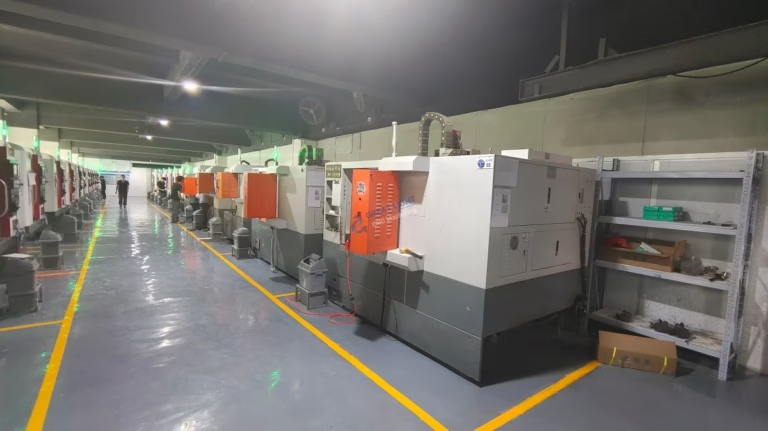
Cheap 5-Axis Is Usually a Setup Problem, Not a Machine Problem
Price differences between five-axis suppliers come from how many times a part is re-fixtured, not from the spindle.
Where the Money Actually Goes in 5-Axis Work
A five-axis quote is mostly a fixturing and programming quote. The machine hour is one line. The other lines are the soft jaws, the workholding, the CAM programmer's time, the setup on the table, and the inspection after the last cut. A shop that can reach five faces in one setup removes several of those lines at once.
That is why two suppliers can quote the same part 40% apart and both be honest. One is running a true simultaneous five-axis cycle with a Ø400 mm rotary table. The other is running three-axis jobs and repositioning the part four times, then blending the witness marks by hand.
Setup count drives the price more than spindle speed. Count the faces on your drawing that need machining. Count how many of them can be reached without unclamping. That ratio tells you more about your quote than any machine spec sheet.
Volume changes the answer. Ten parts absorb setup easily. Five hundred parts spread the same setup across a smaller per-part number, so the machining cycle dominates again. Ask a supplier which cost driver they are optimizing before you compare numbers.
Seven Affordable 5-Axis Routes and Who Each One Fits
The list below is not a ranking. Each option solves a different problem, and the right pick depends on part complexity, quantity, material, and how much process control you need to see.
Marketplace and network models win on speed for prototypes and simple geometry. They aggregate capacity from many shops, so quoting is fast and capacity is elastic. What you give up is a fixed process: the shop that runs your part may change between orders, and the second run may not match the first.
A single integrated plant wins when the same part must repeat at the same tolerance across months, or when the geometry needs five-axis roughing followed by precision turning, finishing, and inspection under one roof.
For tight-tolerance work, the deciding question is not who is cheapest. It is who can hold ±0.005 mm on the features that matter and prove it with an inspection report. Ask for that report before you award anything.
- 1Complex geometry, low to medium volumeIntegrated five-axis shop with in-house finishing and inspection.
- 2Prototype, simple geometryMarketplace or network for fast quoting and elastic capacity.
- 3High-volume simple partsRegional volume shop; setup cost is irrelevant at that quantity.
- 4Regulated industriesLook for IATF 16949, ISO 13485, or ISO 9001 depending on your sector.
How the Seven Routes Compare on the Factors That Move Cost
Use this as a filter, not a scorecard. Match the row to your part, then ask for a quote.
| Route | Best fit | Setup approach | Watch for |
|---|---|---|---|
| Integrated 5-axis plant | Complex parts, repeat orders | One setup, 5 faces, Ø400 mm table | Longer quote cycle than a marketplace |
| Large partner marketplace | Prototypes, simple geometry | Varies by assigned shop | Process can shift between orders |
| Standardized network | Speed on known geometry | Fixed process templates | Less freedom on unusual features |
| Software-driven ecosystem | Design-stage iteration | Digital DFM before cutting | Quotes depend on partner availability |
| Volume-focused shop | High quantity, simple parts | Dedicated fixture and cycle time | Weak fit for one-off complex work |
| Budget online service | Simple 5-axis parts | Standard fixturing | Limited material and finish range |
| Online sheet and plate | Flat, simple geometry | Cut-and-form, not full 5-axis | Not for contoured 3D surfaces |
Which Parts Actually Need Simultaneous 5-Axis
Not every part needs five axes. A bracket with holes on two perpendicular faces runs fine on a three-axis mill with two setups. Paying five-axis rates for it wastes money.
Simultaneous five-axis earns its cost on contoured surfaces, deep pockets with undercuts, impellers and bladed features, and parts where the datum must survive several operations. It also helps when the part is large and heavy enough that repositioning it risks losing the tolerance you just cut.
Material matters here. Titanium TC4 and Inconel cut slowly and move when the tool leaves. Aluminum 6061 and 7075 cut clean but can deflect on thin walls. The same geometry in 17-4PH stainless behaves differently again. A shop that quotes all three at the same cycle time is guessing.
If your part fits in 500 × 500 × 450 mm, a compact five-axis center handles it. Beyond that, travel and rigidity decide the machine, and the count of shops that can take it drops fast.
What to Verify Before You Send the PO
Ask three questions. Which machine will run the part. How many setups. What inspection data comes with the shipment. The answers separate a real five-axis supplier from a broker with a website.
Certification tells you what systems exist, not what happened on your job. IATF 16949:2016 matters for automotive and EV work. ISO 13485:2016 matters for medical devices. ISO 9001:2015 is the baseline for everything else. ISO 27001:2022 covers how your files are handled.
Request the inspection report with the first article. Raw material check, in-process monitoring, final inspection, and a dimensional report on the critical features. If a supplier treats that as an extra, the tolerance claim is a marketing line.
Finishing is a second cost trap. Anodizing, electroless nickel, and bead blasting are separate operations. A shop that owns those steps avoids the shipping and re-inspection that come with subcontracting them out.
Questions Engineers Ask Before Awarding 5-Axis Work
Is ±0.005 mm realistic on a five-axis part?
Yes, on critical features, when the machine, tooling, and thermal conditions are controlled. It is not a blanket tolerance for every dimension on the drawing.
Pick the features that matter and call them out. A part with five tight dimensions and twenty loose ones costs far less than a drawing where everything is tight.
How do I know if my part needs simultaneous 5-axis or 3+2?
Look at the surface continuity. If two faces must meet on a contoured blend with no witness line, simultaneous motion is the safer route.
If the features are flat and reachable from a few fixed angles, 3+2 positioning does the same job with less machine time.
What is the real difference between a marketplace and a single plant?
A marketplace assigns your job to a partner shop. Quoting is fast and capacity is flexible, but the shop can change between orders.
A single plant keeps the same machines and process on repeat orders. That matters when the second batch must match the first.
Which materials are hardest to keep on tolerance?
Titanium Ti-6Al-4V and Inconel move during and after cutting, so they need slower passes and sometimes a stress-relief step.
Thin-wall aluminum deflects under tool pressure. PMMA and PEEK move with temperature. Each needs a different cutting strategy, not just a different speed.
Can I start with one prototype and scale later?
Yes. A run can start at one part and grow to 10,000 or more without changing suppliers, which avoids a second qualification cycle.
Keeping the same shop across prototype and production preserves the fixture, the CAM file, and the inspection baseline.
How fast can a quote come back?
A quotation with DFM feedback can come back within 12 hours when the drawing and 3D model are complete.
Production can begin within 24 hours after that. Parts typically ship in 3–5 days depending on geometry, material, and finish.
Send the Drawing, Get a Real Number
Upload your 3D model and drawing. We review the setup, flag DFM issues, and return a quote with the tolerance plan attached.
Quote within 12 hours100% inspection before shipmentNDA on request









