
5 axis CNC machine sales: what engineers should check before ordering
This page is for engineers and buyers who are specifying a 5 axis CNC machine, or deciding whether to send parts out instead of buying one. It covers the machine configurations we stock, the travel and rotary table limits that decide whether your part fits, and the cases where a 3-axis mill or a mill-turn center is the better buy. Read it and you can shortlist a machine size and spindle package from your own part drawings.
What the five axes actually do
Two extra rotary axes let the tool reach five faces in one setup. That is the whole point.
Three-plus-two, simultaneous, and mill-turn: pick by part geometry
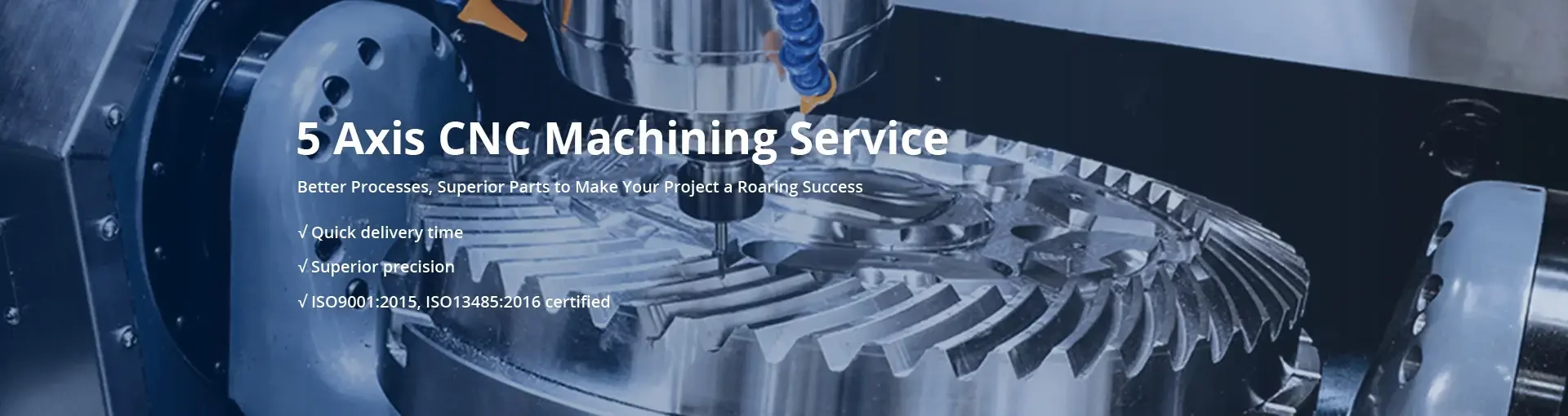
A 5 axis CNC machine adds two rotary axes to the three linear ones. On a trunnion table, A tilts the part and C spins it. On a swivel-head machine, B and C move the spindle instead. The difference matters for part weight: a heavy block on a trunnion needs a table rated for that load, while a swivel head carries the mass on the column.
Simultaneous five-axis motion means all five axes move at once while the tool is in the cut. This is what you need for a contoured impeller blade or a port with a continuously changing surface normal. Three-plus-two, sometimes called positional five-axis, locks the rotary axes at an angle and then machines with the three linear axes. It covers angled holes, cross-drilled flanges and pockets on five faces, and the toolpath is simpler to verify.
For parts with a lot of turning plus off-axis holes, a mill-turn center removes a second setup. A shaft with radial ports can be turned and drilled in one program. The trade-off is that mill-turn centers usually have less Y-axis travel than a dedicated five-axis mill, so wide prismatic parts still belong on a trunnion machine.
If you are buying rather than outsourcing, start from the part envelope. Measure the largest diagonal, not just length times width. A part that fits a 500 × 500 × 450 mm cube at zero tilt will not fit once you rotate it 45° to reach an undercut.
- 1Simultaneous 5-axisBlades, impellers, complex contoured surfaces, one setup.
- 23+2 positionalAngled holes, five-face pockets, easier toolpath checks.
- 3Mill-turnShafts with radial features, turning plus milling in one program.
- 43-axisFlat plates and simple blocks. Do not overbuy.
Travel, rotary table size, and how much stock you can hold
Travel figures are quoted as X × Y × Z. We run four envelope classes: 4,000 × 400 × 150 mm for long extrusions and rails, 750 × 1,150 × 550 mm and 600 × 600 × 600 mm for general prismatic work, and 500 × 500 × 450 mm or 500 × 310 × 200 mm for compact parts. The long 4,000 mm machine is narrow in Y and Z, so it suits profiles and beams, not tall blocks.
The rotary table is the second limit. A Ø400 mm table sets the swing diameter, and the part plus fixture must clear the table edge through the full tilt range. Add the fixture height to the part height before you compare against Z travel. A part that looks fine on paper can lose 80 mm of usable Z to a vise and a riser block.
Check the load rating too. Trunnion tables lose stiffness as the part moves away from the center of rotation. For long parts, support the overhang with a tailstock or a steady, or split the operation. If a feature sits beyond the table swing, the machine cannot reach it no matter how good the CAM is.
On the 4,000 mm class, thermal growth over a long cut is real. We run warm-up cycles and probe datums in-process on long parts rather than trusting a single setup measurement.
- 1Measure the diagonalThe rotated part envelope, not the flat footprint.
- 2Add fixture heightVise plus riser eats usable Z travel.
- 3Watch table swingØ400 mm table limits the tilted part diameter.
- 4Long parts driftWarm up the machine and probe datums in-process.
Machine size classes and the parts they suit
Pick the smallest class that clears your part with the fixture installed.
| Travel class | Typical work | Best for |
|---|---|---|
| 4,000 × 400 × 150 mm | Long extrusions, rails, beams | Low-profile parts, one long setup |
| 750 × 1,150 × 550 mm | General prismatic housings | Mid-size blocks with five-face work |
| 600 × 600 × 600 mm | Compact housings, manifolds | Cube-like parts, tight access |
| 500 × 500 × 450 mm | Small brackets, plates | High-mix, small-batch runs |
| 500 × 310 × 200 mm | Small precision parts | Fine finishing, short cycle times |
Spindle, tolerance, and surface finish you can hold
Spindle speed and torque pull in opposite directions. A 15,000 rpm spindle with a small tool is right for finishing a thin rib in aluminium. A lower-speed, high-torque spindle is right for roughing 4140 or 17-4PH. If one machine has to do both, accept that roughing will be slower and plan a separate finishing pass with a smaller stepover.
We hold ±0.005 mm (±0.0002 in) on production parts, given a stable setup and a material that behaves. That number is not automatic on every feature. Deep bores, thin walls and long tools all add error. On a 4,000 mm part, the tolerance applies to the feature relative to its own datum, not across the whole length.
Surface finish follows the same logic. As-machined is Ra 1.6–3.2 μm. A careful finishing strategy gets Ra 0.8–1.6 μm. Fine finishing with a small stepover and a fresh tool reaches Ra 0.2–0.8 μm on aluminium, brass and some steels. Hardened tool steel and titanium are harder to bring below Ra 0.8 μm without a secondary process.
Coolant choice matters more on five-axis work because the tool approaches from many directions. Through-spindle coolant clears chips from deep pockets. On titanium and Inconel, high-pressure coolant also controls heat at the cutting edge, which extends tool life and holds size.
- 1Rough and finish separatelyOne spindle rarely does both well on hard alloys.
- 2Tolerance is per featureNot across the full length of a long part.
- 3Finish depends on materialRa 0.2 μm is realistic on aluminium, not on tool steel.
- 4Coolant routingThrough-spindle pressure clears deep pockets.
Materials that behave, and materials that fight back
Aluminium is the easy case. 6061, 6061-T6, 2024, 5052, 5083, 6063, 6082 and 7075 all cut cleanly at high spindle speed. 7075 holds a better finish on thin walls but is less weldable and more expensive. ADC12 is a die-casting alloy, so it appears as a casting rather than bar stock.
Stainless needs a different approach. 303 and 304 are common, 316 and 316L resist corrosion better but work-harden faster. 17-4PH (SUS630) can be machined in the solution-treated state and then aged to final hardness, which avoids cutting a hard part. 440C is for wear surfaces and is usually finished by grinding after heat treatment.
Steel grades 1018, 1045, 4130, 4140, 4340, A36 and tool steel cover most structural and mold work. 4130 and 4340 are used where strength-to-weight matters. Pre-hardened 4140 is machinable but will not take a mirror finish without extra passes.
Titanium and nickel alloys are where the machine earns its price. TC4 (Ti-6Al-4V), Inconel, and magnesium AZ31B or AZ91D need lower surface speed, rigid setups and plenty of coolant. Magnesium adds a fire-risk rule: chips must be managed, not left in the tray. Plastics such as PEEK, POM and carbon fibre cut fast but need sharp tooling, because a dull edge melts POM and frays carbon fibre.
- 1AluminiumHigh speed, clean finish. 7075 for thin walls.
- 2Stainless316L work-hardens. Keep the tool moving.
- 3Titanium and InconelLow surface speed, rigid setup, high coolant pressure.
- 4MagnesiumChip management is a safety rule, not a preference.
When buying a machine is the wrong move
A 5 axis CNC machine earns its cost when you have a steady stream of parts that need five-face access or contoured surfaces, and when the setup time you save is larger than the machine payment. If your parts are mostly flat plates with a few holes, a 3-axis mill with a good vise is faster to program and cheaper to run.
Outsourcing makes sense when the part count is low, the geometry is still changing, or the material is one you do not want in your shop. Titanium and magnesium are the usual examples. So is a part that needs four different processes: machining, anodizing, laser marking and inspection. Sending it to one supplier avoids four freight legs and four sets of paperwork.
Another signal is tolerance capability. If your print calls for ±0.005 mm on a feature and your current machine cannot hold it, buying a new machine to fix one part is a hard case to make. Run the part on a supplier's machine first and measure the result.
We run 16 simultaneous 5-axis machining centers among 127 high-precision CNC machines across three wholly-owned plants, 7,600 m² in total, with 150 technicians. That capacity is available for one-off prototypes and 10,000+ part runs, with no minimum order quantity.
- 1BuySteady five-face work, high part count, setup time dominates.
- 2OutsourceLow volume, changing geometry, difficult materials.
- 3Measure firstProve the tolerance on a supplier machine before buying.
- 4Mixed processesOne supplier beats four freight legs.
Questions engineers ask before ordering
How do I know whether my part needs simultaneous 5-axis or 3+2?
Look at the surface normals. If the tool has to stay perpendicular to a continuously curving surface, you need simultaneous motion. Blades, impellers and sculpted housings are the common cases.
If the features are flat or cylindrical but sit on different faces, 3+2 is enough. The rotary axes move to an angle, lock, and the three linear axes cut. Toolpaths are easier to verify and cycle times are often shorter.
What size part can a 5 axis CNC machine handle?
On our machines, the largest travel is 4,000 × 400 × 150 mm. That class suits long extrusions and rails. For general prismatic parts, we run 750 × 1,150 × 550 mm and 600 × 600 × 600 mm envelopes.
Fit is not just travel. The part must clear the rotary table through the full tilt range, and the fixture height counts against Z travel. Measure the rotated diagonal, then add the workholding.
Can a 5 axis machine hold ±0.005 mm on every feature?
No. ±0.005 mm (±0.0002 in) is a capability we hold on production parts when the setup is stable and the material behaves. Deep bores, thin walls and long tools add error.
On very long parts, treat the tolerance as per feature relative to its own datum rather than across the whole part length. We probe datums in-process on long cuts.
Which materials are a poor fit for five-axis machining?
Very soft plastics and pure copper can be cut, but they tend to burr and deflect, so the five-axis advantage is small. Magnesium can be machined, but chip management is a safety requirement.
Hardened tool steel above roughly 45 HRC is usually ground after heat treatment rather than milled to final size. If the geometry is complex, machine it soft and then harden.
Do I need a 5 axis machine for a one-off prototype?
Rarely. For a single part with simple geometry, a 3-axis setup or a mill-turn center is cheaper. Five-axis pays off when the part has features on five faces or a contoured surface that cannot be reached otherwise.
We quote from one prototype to 10,000+ part runs with no minimum order quantity, so you can test the geometry before committing to a machine purchase.
How is part quality checked before shipment?
We check raw material on receipt, monitor in-process dimensions, and run a final inspection on 100% of parts before shipment. Inspection reports are available on request.
Our quality system is certified to ISO 9001:2015, IATF 16949:2016, ISO 13485:2016 and ISO 27001:2022. Uploads are kept confidential and an NDA is available on request.
Send your drawing and get a machine recommendation
Tell us the part envelope, material and tolerance. We will reply with a DFM note and a quotation, and say plainly whether five-axis is the right process for it.
Quote and DFM in 12 hours100% inspectionNo minimum order quantityNDA on request









