GreatLight CNC Machining Factory logo
CNC Machining
Rapid Prototyping
Materials
Industries
News
About GL

Get Instant Quote

GreatLight · Five-Axis Machining

5 Axis CNC Machining Center for Your Project

Sixteen simultaneous five-axis centers in Dongguan and Singapore, running parts up to 4,000 mm from a single datum. Send a STEP file and a drawing: price, lead time and DFM notes come back within 12 hours.

±0.005 mm tolerance4,000 mm max partØ400 mm rotary tableRa 0.2–0.8 μm available
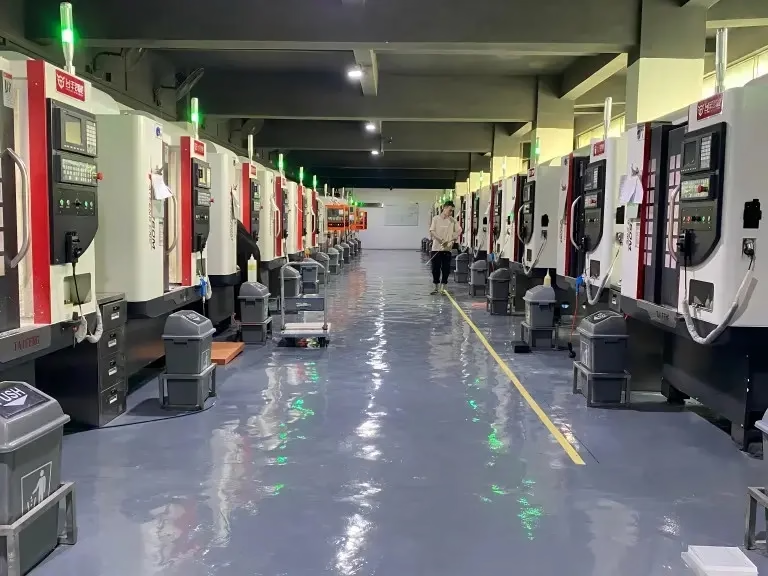
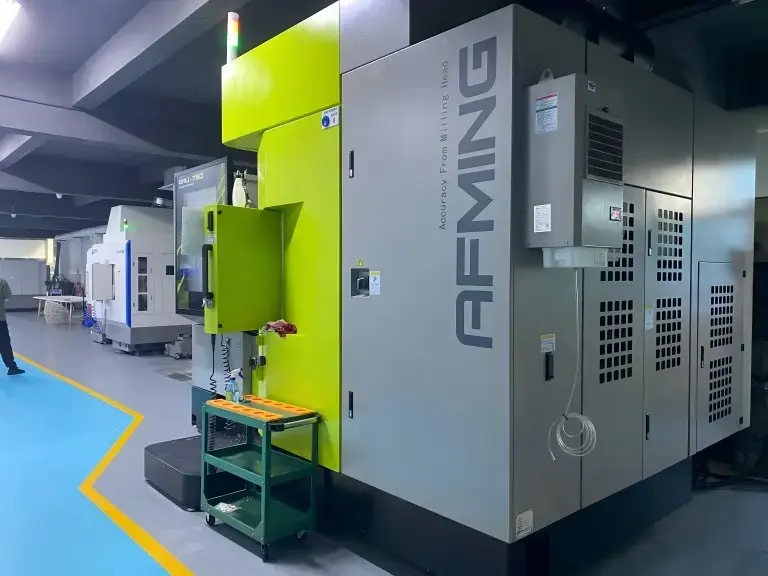
Five axis CNC machining center cutting a multi-face part at the GreatLight factory
16Simultaneous five-axis centers
127CNC machines across three plants
4,000 mmMaximum processing size
3–5 DaysFrom drawing to parts
Sound familiar?

Four ways a five-axis quote goes wrong before the first cut

None of these are machining problems. They are quoting and process-planning problems, and they are cheapest to settle before anyone programs a toolpath.

01

The quote covers two faces and your part has four

Extra faces mean extra fixtures and extra datums, and the tolerance stack grows with each one. Ask which faces come off the same setup. If that answer is vague, the price will move after the first article.

02

Big enough is not the same as right sized

A 600 × 600 × 600 mm housing does not belong on a large-format center. Booking the biggest machine because the part happens to fit pays for travel you never use, and it queues the customers who genuinely need 4,000 mm.

03

Free-form surfaces priced like flat plates

Blades, impellers and organic housings need the tool to stay close to normal to the surface. Three-axis ball milling leaves witness lines that somebody polishes by hand, and that labour is the line item nobody quoted.

04

Walls that relax once the clamps come off

Thin ribs and deep pockets move after the last fixture change. A supplier who measures the part while it is still clamped is measuring the clamp, and the error appears at assembly, not on the inspection sheet.

How we solve it

Three decisions that turn a drawing into a process

Each one removes a specific way a five-axis job loses money: the wrong process, too many setups, or a tool that is too long to hold the surface it cuts.

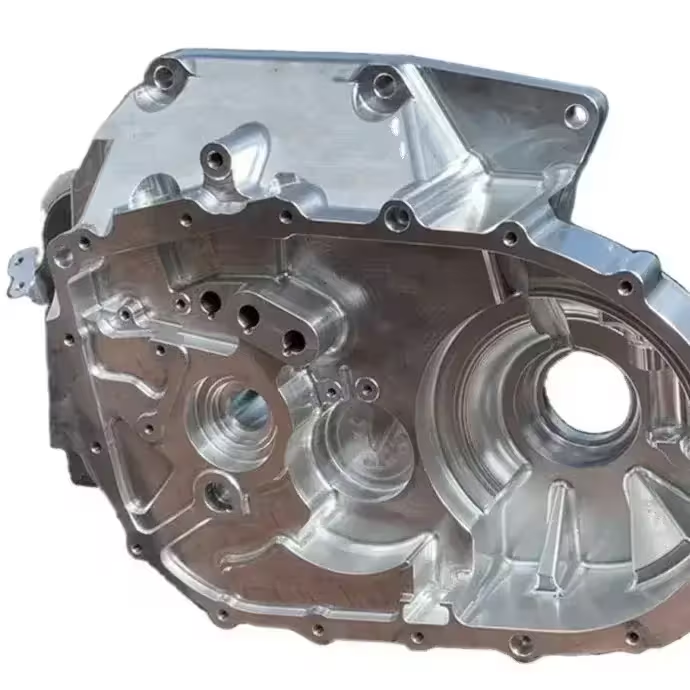
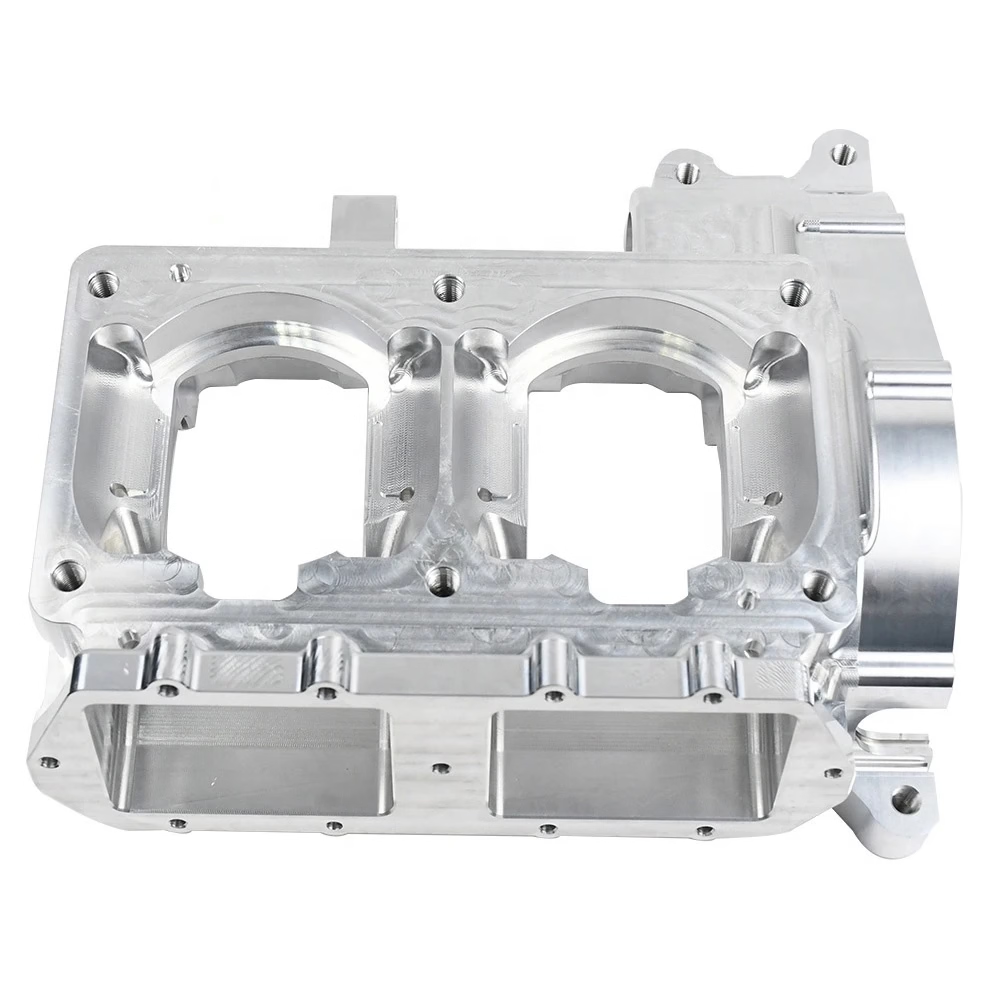
Aluminium inner housing and bell housing machined in one setup on a five axis machining center
Process choice

The part is quoted on the machine its geometry needs

Three questions decide the process. How many faces carry features that must relate to each other, is the surface itself curved, and can the part be held while every face is cut. The answers point at three-axis, four-axis, 3+2 indexed or simultaneous five-axis, and the cheapest of those is usually the one that actually fits.

That decision is written into the quotation instead of being left to the shop floor. If the geometry changes the answer after the review, you hear about it before the order is released rather than after the material is cut.

  • 1
    One datum, one spindle axisBores that must line up are cut without the part being re-clamped, so the relationship comes from the machine rather than from a fixture.
  • 2
    Rigid cutting where it countsIndexed axes lock for flat faces and bore work; the rotary axes are used only where the geometry needs them.
  • 3
    No hidden polishing lineCurved surfaces are finished on the machine, so the price does not carry hand-polishing hours that nobody mentioned.

Get Instant Quote

Aerospace structural parts machined to a single datum on five axis centers
Setup count

One datum for the whole part, not one per face

A part cut in four operations inherits the error of four fixtures. That error stays invisible on the finished part until the assembly refuses to go together, and by then the lot has already been machined.

Cutting the critical faces from a single datum also changes the inspection problem. The report describes the relationships the designer cares about instead of a list of dimensions that were each true on their own.

  • 1
    Bores stay concentricA pilot bore and its outside diameter machined in one pass share an axis by construction, not by adjustment.
  • 2
    Faces stay squareA flange faced in the same setup as the bore stays perpendicular to the axis of rotation.
  • 3
    Cosmetic faces stay untouchedWe plan which faces the jaws touch before the first cut, so visible surfaces are only ever touched by the cutter.

Talk to an Engineer

Five axis machining center with trunnion rotary table set up for a multi-face job
Tooling

Short tools in a tilting spindle, not long tools reaching in

Long tools are the enemy of surface finish. On a tilting spindle you rotate the part towards the cutter instead of reaching further with a thin tool, which raises rigidity and lets the same program run through titanium without chatter.

Holder, stock and fixture are modelled and simulated before the first cut. A collision found on screen costs an afternoon; a collision found at the machine costs a delivery date.

  • 1
    Simulated before cuttingTool holder, stock and fixture are modelled so reach limits and collisions are found on screen.
  • 2
    Shortest tool that reachesTool length is traded against workpiece orientation, which is exactly what the two rotary axes are for.
  • 3
    In-process checks where they matterCritical features are verified between operations, while a re-cut is still cheap compared with a scrapped part.

Talk to an Engineer

Comparison

3-axis, 3+2 indexed and simultaneous 5-axis on the same job

The same part can often be made three ways. This is how the three processes compare on the work we quote every week.

ProcessTypical partsSetupsWhere it saves moneyWhere it costs more
3-axis millingPlates, brackets, heat sinks, pockets on one faceOne or twoShort programming, fastest metal removal, lowest machine rateEvery extra machined face needs a new fixture and a new datum
3+2 indexed (positional)Housings, frames, manifolds, prismatic parts with bores on several sidesOneFive faces reached without manual re-clamping; rigid cutting while the axes are lockedRotary axes must be positioned and locked, and curved surfaces still take multiple passes
Simultaneous 5-axisImpellers, blades, aerospace structures, organic housings, undercutsOneFree-form surfaces finished in one pass; short stiff tools in titanium and hard alloysHighest machine rate, and programming plus simulation time is longer than for three-axis work
Capabilities

Five-axis machining and the services around it

Most projects need more than one process. These run in-house, so a part moves between them without a new supplier onboarding.

5X

Simultaneous five-axis milling

Continuous five-axis contouring for impellers, blades, complex housings and any geometry with undercuts or blended surfaces.

3+2

Indexed five-axis and four-axis

Positional multi-face machining for prisms, frames, plates and housings, and the economical route to several machined faces in one setup.

3X

Three-axis precision milling

27 three-axis machines for flat, square and pocketed parts where extra axes add cost without adding capability.

M+T

CNC turning and mill-turn

Turned shafts, fittings and motor parts, including mill-turn cycles that combine turning and milling in a single program.

SF

Surface finishing

Anodizing, hard anodizing, plating, bead blasting, brushing and polishing to match the callout on your drawing.

QA

DFM analysis and inspection

Manufacturability review before cutting, in-process checks, and dimensional or first-article documentation on request.

Machine allocation

Which envelope your part belongs in, and what runs it

Machine groupWorking envelopePart families that belong hereWhat decides it
Large-format five-axis4,000 × 400 × 150 mmLong frames, rail sections, extrusion-based structuresThe envelope decides: no smaller machine reaches both ends
Medium-format five-axis750 × 1,150 × 550 mm and 600 × 600 × 600 mmHousings, manifolds, brackets with bores on several facesFace count and bore relationships, not part length
Compact five-axis500 × 500 × 450 mm and 500 × 310 × 200 mmSmall precise hardware, robot joints, medical componentsTighter tolerances and shorter tools suit a smaller, faster machine
Trunnion rotary tableØ400 mm swingParts that must be turned and milled without re-clampingSingle-setup machining up to the table diameter
Three-axis and four-axis27 three-axis and 12 four-axis machinesPlates, pockets, shafts and turned parts with cross featuresExtra axes add cost where the geometry does not need them
Why GreatLight

Why engineers keep sending us the difficult parts

The equipment list is only half of it. The other half is who answers the phone when the drawing is ambiguous.

15Y

Fifteen years on precision work

Founded in 2011 and focused on precision CNC machining since, with prototypes, bridge tooling and production running through the same plants and the same quality system.

127

The machines are ours

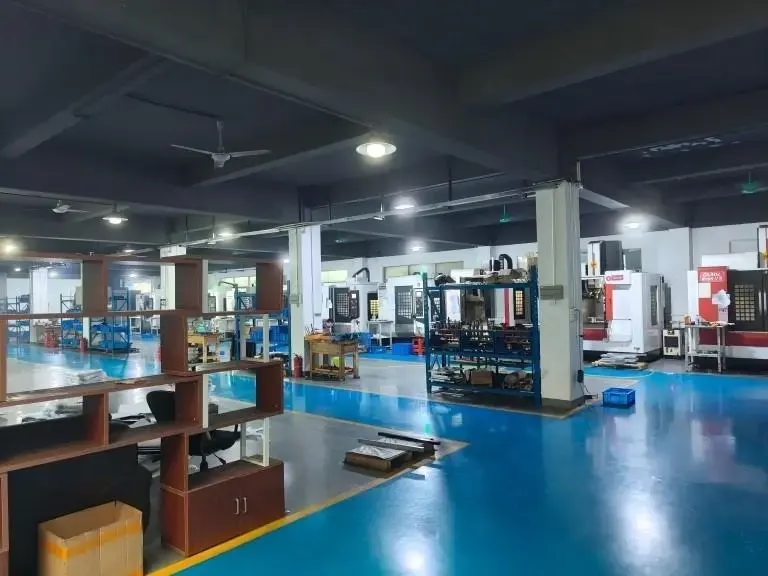
16 simultaneous five-axis centers, 12 four-axis mills, 27 three-axis machines and 16 mill-turn centers, supported by in-house finishing and inspection lines.

0

No minimum order quantity

One part or ten thousand. A single prototype gets the same engineering review, the same equipment and the same inspection as a production release.

12h

Quotation inside twelve hours

Upload a STEP file and a drawing and you get pricing with a free DFM analysis back within 12 hours. Production can start within 24 hours of approval.

2%

Delivery risk held below two per cent

Our own equipment and our own finishing lines leave fewer external dependencies, so the historical late-delivery probability stays under 2%.

4

Audited quality systems

ISO 9001:2015 for quality, IATF 16949:2016 for automotive programmes, ISO 13485:2016 for medical hardware and ISO 27001:2022 for your data.

7,600 m²Manufacturing space
150Technicians and engineers
3Wholly-owned plants
10,000+Part production runs supported
Where it is used

Part families that only pay off on a five-axis center

Automotive and EV engine parts machined on five axis machining centers

Automotive and EV powertrain

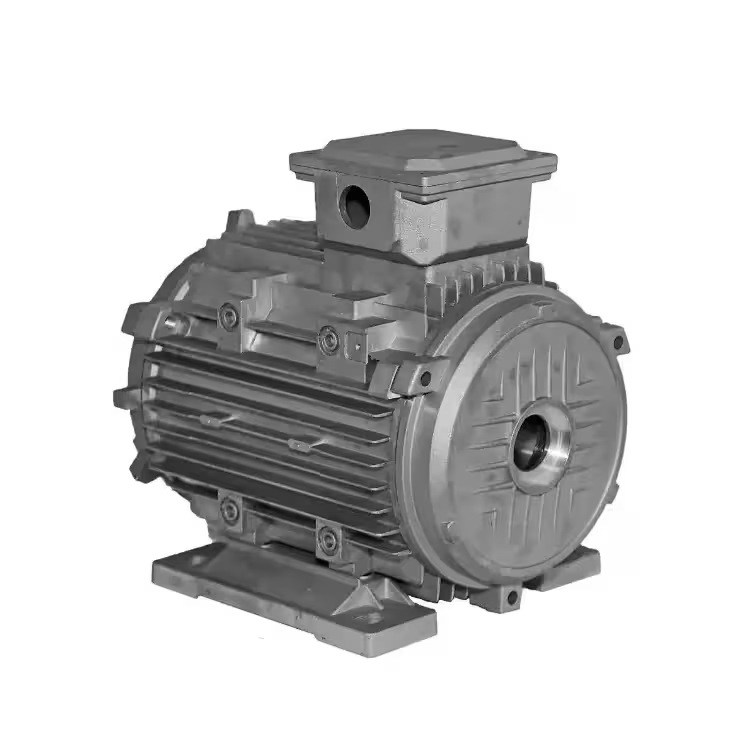
Motor housings, bell housings and stator or rotor components produced under IATF 16949 process control.

  • IATF 16949
  • Volume runs
  • 100% inspection
Precision engine hardware and machined assemblies produced in-house

Robotics and precision hardware

Joint housings and drive parts where bore alignment and seat finish decide how smoothly the assembly runs.

  • Single setup
  • Ra 0.2–0.8 μm
  • Small batches
Medical components machined on precision five axis machining centers

Medical and instrumentation

Small precise parts machined under ISO 13485 process control, with inspection documentation available.

  • ISO 13485
  • Reports on request
  • Bead blasting
Production CNC milling line running structural parts for machine builders

Industrial machinery and frames

Frames, brackets and structural parts for machine builders, machined in-house with the rest of the assembly.

  • Long parts
  • 3+2 indexed
  • Repeat orders
FAQs

Questions engineers ask before placing a five-axis job

How do I know whether my part needs five axes at all?

Count the faces that carry features relating to each other, then look at the surfaces. Two or three related faces without free-form geometry usually run on four axes or 3+2 positioning for less money.

Continuous five-axis work earns its rate when the surface is curved, when there are undercuts, or when the tool has to stay normal to the geometry. Send the model either way; we quote the process the part needs, not the most impressive one we own.

What is the largest part you can machine on a five-axis center?

Maximum processing size is 4,000 mm. Large-format travel is 4,000 × 400 × 150 mm, medium format covers 750 × 1,150 × 550 mm and 600 × 600 × 600 mm, and compact machines cover 500 × 500 × 450 mm with a Ø400 mm rotary table.

If the bounding box sits close to a limit, send it and we will confirm the machine and the fixturing before quoting rather than after.

Can you hold ±0.005 mm across the whole part?

±0.005 mm / ±0.0002 in is our stated machining tolerance, held on the features you call out and on dimensions the drawing leaves open. On a long part, temperature matters as much as the machine: a 500 mm aluminium part grows roughly 12 µm for every degree it warms.

Where a dimension is critical we agree the measuring temperature before production, and we say so in the quotation if a tolerance needs extra passes or extra inspection.

Which file formats do you accept?

STEP, STP, IGS, IGES, STL or X_T for the model, plus DWG, DXF or PDF for the drawing. If the model and the drawing carry different revisions, tell us which one governs. A five-axis program built from the wrong revision is an expensive way to find out.

Do you machine prototypes and production quantities?

Both, on the same machines. There is no minimum order quantity, so a single part is a normal order, and the same program scales to a production release of 10,000+ parts once the design is frozen.

What lead time should I expect?

Quotation and a free DFM analysis within 12 hours of upload, production starting within 24 hours of approval, and parts normally shipping in 3–5 days. Complex five-axis work with special material or finishing is quoted with its own schedule, stated up front rather than adjusted later.

How do you inspect a multi-face part?

Critical features are checked between operations and again at the end. Raw material, in-process and final checks are recorded, and dimensional reports are issued on request.

Because the critical faces come off one datum, the report describes the relationships that matter in the assembly instead of a set of unrelated dimensions.

Can you work from a drawing alone?

For prismatic parts, often yes. Free-form geometry cannot be defined by views alone, so those parts need a solid model. If you only have a drawing, send it and we will say what is missing instead of guessing at the surface.

Tell us the part, we will tell you which machine runs it

Send the model and the drawing. You get a price, a lead time and a straight answer on whether five axes are needed, plus the details that would cost more if nobody mentioned them first.

12-hour quotation24-hour production start100% inspectionNDA on request

Trusted by engineers and manufacturers worldwide

Tesla Ford Motor Company BYD Auto Denso Magna International Boeing Airbus Medtronic KUKA FANUC