
7 Essential Facts About ISO 30 ER32 Collet Chucks for CNC Precision
This page is for machinists, process engineers and buyers who specify tool holders for 3-axis and multi-axis work. It covers how the ISO 30 taper seats, what an ER32 collet can and cannot grip, how much torque the nut needs, and which jobs should use a different holder.
What These Seven Facts Cover
Facts about ISO 30 holders that change the way you set up a job, not brochure numbers.
The ISO 30 Taper Is a 7:24 Interface, Not a Brand
ISO 30 describes a steep taper shank with a 7:24 ratio and a nominal gauge diameter of 31.75 mm. The angle is self-releasing, so the spindle needs a retention knob and drawbar to hold the holder in place. That is the whole point of the interface: any compliant holder from any compliant maker should seat the same way in the same spindle.
Taper contact is what carries radial load. When the shank is ground correctly, contact sits near the large end of the taper and the holder repeats its position after every tool change. A worn or blued taper spreads contact toward the small end, and the holder starts to sit deeper. On a machine running 20 tool changes an hour, that error adds up over a shift.
Keep in mind what ISO 30 is not. It is not a dual-contact interface, and it does not have the taper-plus-flange contact of HSK or the hollow shank of a Capto system. It trades some stiffness for wide compatibility with older and mid-size machining centers. If your spindle accepts ISO 30, the interface is fixed. Your choices are in the holder body and the collet.
- 17:24 steep taperSelf-releasing, retention knob required
- 231.75 mm gauge diameterMeasure taper contact with bluing
- 3Not dual contactFlange face does not seat on the spindle
An ER32 Collet Has a Range, and the Range Is Narrow
ER32 is a double-angle collet with a nominal capacity of 2–20 mm. One chuck body accepts many shank sizes, which is why it ends up in job shops and prototype cells. The catch is that each individual collet covers about 1 mm. A collet marked 5–6 mm is meant for shanks between those two numbers, not for anything smaller or larger.
Clamping a 6 mm shank in a 5–7 mm collet works, but the collet closes unevenly. Contact concentrates on a few slits instead of wrapping the shank, and runout grows. In production we prefer collet sets in 0.5 mm steps for finishing work. The extra collets cost less than the scrap from one bad batch.
ER32 also has a depth limit. The collet grips a short length of shank, so a tool with a long flute section and a short shank can flex. For tools under Ø3 mm, the shank is small relative to the nut bore and the assembly loses stiffness quickly. That is a geometry problem, not a tightening problem.
- 1Ø2–20 mm nominalOne body, many collet sizes
- 2~1 mm per colletStay inside the marked range
- 30.5 mm stepsBetter runout on finishing tools
ER32 Collet Chuck Quick Reference
Typical values for a standard ER32 nut on an ISO 30 shank. Confirm against your holder maker's data before setting torque.
| Item | Typical value | Notes |
|---|---|---|
| Clamping range | Ø2–20 mm | Whole ER32 family |
| Per-collet range | About 1 mm | Use 0.5 mm steps for finishing |
| Nut tightening torque | 50–70 Nm | Depends on nut design |
| Runout target | ≤0.010 mm at 3×D | Measure with a test bar |
| Max spindle speed | Limited by holder balance | Balance grade matters above 10,000 rpm |
| Taper angle | 7:24 | ISO 30 / steep taper |
Clamping Force: Tighter Is Not Better
The nut drives the collet into the body taper and squeezes it onto the shank. A common mistake on the floor is to lean on the wrench until it feels tight. Over-torque deforms the shank, and on small carbide tools it can micro-crack the shank near the collet face. The tool then fails mid-cut, usually on a part that was nearly finished.
For ER32 the usual torque window is 50–70 Nm, and the exact figure depends on whether the nut is a standard design or a bearing nut with a multiplier. A bearing nut reaches the same clamping force with lower input torque, so do not carry the number from one nut type to the other.
Use a calibrated torque wrench and record the value for critical operations. It takes a few seconds per tool change. Under-torque lets the tool pull out under load, which is worse than a broken tool because the cutter walks into the part first. Both failure modes disappear when the number is written down and followed.
- 150–70 Nm windowStandard ER32 nut, verify with maker
- 2Bearing nuts differLower input torque, same grip
- 3Record torqueUseful on high-value parts
Runout Is the Metric That Decides Your Surface Finish
Runout at the cutting edge sets the effective chip load. A holder with 0.020 mm runout makes one flute cut more than the others. On a Ø6 mm end mill at 12,000 rpm, that uneven load shows up as chatter and short tool life even when the feeds and speeds are right on paper.
Measure runout on a test bar at three times the tool diameter, not right at the nut. The number near the nut looks good and hides the error that matters. For parts held to ±0.005 mm, we check holders before a long run and set aside anything that drifts.
Cleanliness is half of runout. A chip or a film of dried coolant on the taper or inside the collet bore pushes the tool off axis. Wipe the taper and blow out the collet seat at every change. This costs nothing and fixes more runout complaints than any adjustment to the machine.
- 1Measure at 3×DNot at the nut face
- 2Target ≤0.010 mmTypical floor limit for finishing
- 3Clean taper and seatChips cause most sudden runout
Maintenance: Small Habits, Fewer Failures
ER collets are consumable. They wear at the slits and the taper surface, and a worn collet no longer closes concentrically. The symptom is gradual: runout creeps up, finish gets worse, and operators start blaming the machine. A collet that has been run for years in the same size is usually the cause.
Inspect the taper for fretting, the nut threads for galling, and the collet slits for cracks. Store collets in their slots, not loose in a drawer where they knock against each other. Light oil on the nut threads is fine. Grease packed into the collet bore is not, because it collects chips.
Torque the nut with the collet seated correctly in the body. If the collet is cocked, the nut will pull it in at an angle and the taper can seize. If a nut starts to feel gritty, replace it. Threads are cheap compared with a scrapped batch.
- 1Collets wear outReplace when runout drifts
- 2Check threads and slitsGalling and cracks are common
- 3No grease in the boreIt traps chips
When an ISO 30 ER32 Chuck Is the Wrong Choice
ER32 is a flexible general-purpose holder. It is not the best holder for every cut. For heavy roughing in steel with a Ø16 mm cutter, the collet's grip length and the ISO 30 taper together limit how much side load the assembly handles. A dedicated end mill holder or a shrink-fit holder moves the tool closer to the spindle nose and cuts vibration.
High-speed finishing is another case. Above roughly 10,000 rpm, balance becomes the limiting factor, and a collet nut with an unbalanced body is not the tool to use. Slim hydraulic holders or balanced shrink holders hold runout tighter and stay stable at speed.
For small drills and reamers, an ER32 chuck with a good collet is fine and quick to set. For diameter-critical bores where roundness matters, a collet may not hold the tool concentrically enough. The decision rule is simple: match the holder to the load and the tolerance, not to what is already on the shelf.
- 1Heavy roughingUse a solid or shrink holder
- 2Above ~10,000 rpmBalance becomes the limit
- 3Tight boresCheck runout before committing
Certification and Traceability on the Shop Side
A tool holder is a purchased item, but the parts made with it still need traceability. If a customer audits a lot of medical or automotive parts, the inspection record has to show the machine, the tool, and the measurement used. That record starts with knowing which holder ran the job and when it was last checked.
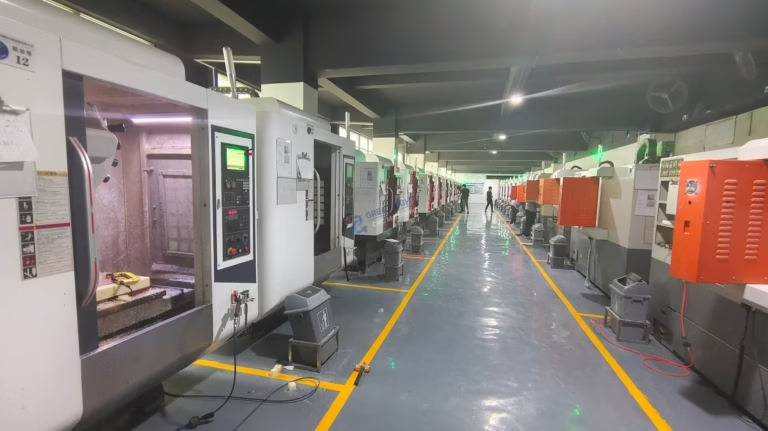
GreatLight holds ISO 9001:2015, IATF 16949:2016, ISO 13485:2016 and ISO 27001:2022. Inspections cover incoming material, in-process checks and a final check before shipment, and reports are available on request. We run 127 high-precision CNC machines, including 16 simultaneous 5-axis centers, with a 4,000 mm maximum processing size.
Process control is not paperwork for its own sake. When runout is measured and torque is recorded, a tolerance drift is traceable to a holder, a collet or an operator step. That is what makes a fix possible instead of a guess.
- 1ISO 9001, IATF 16949Quality and automotive systems
- 2ISO 13485, ISO 27001Medical devices and data security
- 3Reports on requestInspection records for audit
Questions Engineers Ask About ISO 30 ER32
Can one ER32 collet hold any shank from 2 mm to 20 mm?
No. The ER32 family covers that range, but each individual collet is marked with a narrow band, usually about 1 mm wide. A 5–6 mm collet should only hold shanks in that band. Using it outside the band reduces contact and increases runout.
How often should I check runout on an ISO 30 holder?
Check after any crash or heavy interrupted cut, and before a long production run. Measure on a test bar at three times the tool diameter. If the reading drifts past your limit, inspect the taper and the collet before touching the machine.
Is 70 Nm always the right torque for an ER32 nut?
Not always. The common window is 50–70 Nm, but the correct value depends on the nut design. Bearing nuts need less input torque for the same clamping force. Follow the holder maker's number and use a calibrated wrench.
Can I use an ISO 30 ER32 chuck for high-speed finishing?
It depends on the balance grade and the spindle speed. The collet nut is an unbalanced feature, so above roughly 10,000 rpm a balanced shrink or hydraulic holder is usually the safer choice. Below that, a clean assembly with good runout works well.
What causes a tool to pull out during a cut?
Under-torqued nut, a worn collet, or oil and chips on the shank. Check the torque value first, then look at the collet slits and the shank surface. A shank that measures under nominal size also reduces grip.
Does a collet chuck suit prototype work as well as production?
Yes, for most milling and drilling setups. Its value is fast changeover across many tool sizes. For a long run on one tool diameter, a dedicated holder gives better stiffness and repeatability.
Send Us Your Drawing and Tool List
Tell us the material, the tolerance and the features that matter. We will review the setup and come back with a quotation and a DFM note within 12 hours.
12-hour quote±0.005 mm tolerance100% inspection before shipment









