
5 Essential Facts About the Deckel Maho DMU 50 Every CNC Machinist Must Know
This article is for machinists and process engineers who run, quote, or buy time on a DMU 50. We cover five facts about Deckel Maho that change how you program and fixture the machine: the monoblock base, the two control families, trunnion torque limits, thermal behavior, and where the platform fits in a production chain. Read it before you promise a tolerance or a cycle time.
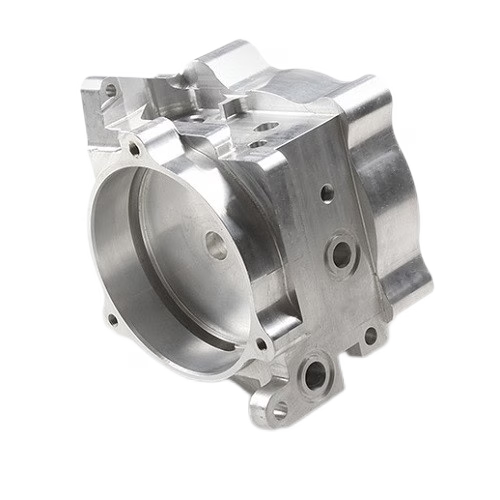
Five things the spec sheet does not tell you
The DMU 50 is a gantry-style 5-axis machining center with a swiveling trunnion table. Most of what decides whether a job runs well on it never appears in the brochure.
The monoblock base decides your surface finish
The DMU 50 sits on a single-piece base made from mineral casting or polymer concrete, depending on the variant. That is not a marketing phrase. Polymer concrete damps vibration at a different rate than cast iron, and the difference shows up in the cut, not in the specification table.
Rigidity from one casting means the trunnion and spindle stay aligned under load. When you push a 16 mm carbide end mill through 17-4PH at 0.1 mm radial engagement, the base absorbs the chatter that a bolted-frame machine would pass into the part. Surface finish holds, and tool life stops being a lottery.
Where this matters most is thin-wall and deep-pocket work. A wall that rings on a cast-iron bed often cuts clean on a damped base. If your finish requirement sits at Ra 0.8–1.6 μm and your current machine fights you, the problem may be the bed, not the toolpath.
- 1Best fitThin-wall brackets, deep pockets, hard alloys where chatter limits feed rate.
- 2Not the fix forA weak setup. Damping helps, but a loose vise still ruins the cut.
Heidenhain and Siemens controls are two different jobs
Both control families were shipped on the DMU 50. They run the same iron, but they reward different habits. A machinist who is fast on one is not automatically fast on the other.
Heidenhain shines when you edit at the machine. Setup time on one-offs drops because you can adjust cycles and datums at the console without a trip back to CAM. Shops that quote frequent prototypes usually prefer it for that reason.
Siemens handles long simultaneous toolpaths differently. Look-ahead and smoothing on complex 5-axis paths tend to hold more consistent cycle times in high-volume work. If your parts repeat and the paths are dense, that consistency is worth more than the faster setup.
The practical test is your part mix. Count how many jobs repeat more than twenty times a year against how many are one-offs. The answer usually points at one control.
- 1Frequent one-offsHeidenhain, for fast edits at the console.
- 2High-volume simultaneousSiemens, for toolpath smoothing and cycle consistency.
Which control matches your work
Match the control family to how your shop actually runs jobs, not to which one you learned first.
| Factor | Heidenhain | Siemens |
|---|---|---|
| Typical job mix | One-offs, prototypes, repairs | Repeating production runs |
| Setup editing | Direct at the control | Usually through CAM |
| 5-axis simultaneous | Capable | Strong look-ahead |
| Cycle consistency | Depends on operator edits | More repeatable |
| Learning curve | Shorter for manual edit habits | Shorter for CAM-driven shops |
Trunnion limits are about torque, not just angle
The trunnion table looks like it can reach any angle, and it nearly can. The real limit is torque. A part that is light at 0° becomes a lever arm once the table swings 90°, and the rotary axes have to hold it against cutting force.
Offset matters more than mass. A 10 kg block clamped 150 mm off the table center loads the swivel axis like a much heavier part. This is where machinists get surprised. The part fits, the angles are reachable, and the finish still drifts.
Keep the center of mass close to the table center. Add counterweight only when you can mount it symmetrically. When in doubt, drop the feed on the outer reaches and check the first part before running the batch.
- 1Check firstCenter of mass distance, not part weight alone.
- 2Watch forFinish drift at extreme tilt angles, not alarms.
Thermal drift sets your real tolerance floor
A cold DMU 50 and a warm one do not hold the same tolerance. Spindle and axis growth push the tool point as the machine heats through the first hours of a shift. For work at ±0.005 mm, this is the variable people forget.
The usual routine works. Run a warm-up cycle before the first tight part. Keep the shop temperature stable rather than chasing it. Let the machine idle between heavy roughing and finishing so the structure settles.
Sub-micron accuracy is a process, not a purchase. The machine can hold it, but only when the thermal state is controlled. If the first part of the morning is always the outlier, the schedule is the problem.
- 1Do thisWarm-up cycle, stable shop temperature, settle time before finishing.
- 2Do notChase tolerance with offsets while the machine is still growing.
The real strength is process integration
One 5-axis setup can do what three 3-axis setups used to do. That is the DMU 50 argument. Fewer setups mean fewer datums to stack, and datum stack-up is where most tight-tolerance error comes from.
We run 16 simultaneous 5-axis machining centers alongside 4-axis, 3-axis, and mill-turn capacity, so we see where the DMU 50 earns its place. It wins on parts with features on five faces and a tolerance callout that punishes re-clamping.
It loses on simple prismatic parts with one critical face. A 3-axis machine with a good fixture is faster and cheaper there. Choosing the platform is a job-by-job decision, not a shop-wide one.
When the geometry is genuinely 5-axis, integration pays back. When it is not, the extra axes just add setup time.
- 1Good fitFeatures on five faces, tight positional callouts between them.
- 2Poor fitFlat plates with one machined face and no angular features.
Questions engineers ask next
Can a DMU 50 hold ±0.005 mm in production?
Yes, when the process supports it. That means a warm-up cycle, a temperature-stable shop, and finishing passes after the structure settles.
The machine is capable. Holding the number across a full shift is a scheduling and thermal-control question, not a machine-spec question.
Is the DMU 50 a good choice for titanium and Inconel?
It handles them, and the damped base helps. Hard alloys cut with more vibration, and a base that absorbs it protects both the finish and the tool edge.
Expect to slow down anyway. Titanium and Inconel limit feed rates by tool life, not by machine rigidity.
How do I know if a part should run on 5 axes or 3?
Count the setup directions. If the part needs machining on three or more faces, or has angular features with tight position between them, 5-axis wins after you account for setup.
If one face carries the critical tolerance and the rest is clearance, a 3-axis setup with a solid fixture is usually faster.
What causes finish drift at high tilt angles?
Usually the center of mass moving away from the table center. The further the part sits from center, the more torque the swivel axes must resist.
Move the part closer to center, or reduce feed at the extreme angles, and check the first article.
Does the control choice affect part quality?
Not directly. Both controls drive the same iron, and both can produce the same tolerance.
The control affects setup time and cycle consistency, which is why part mix should drive the decision.
Send us your 5-axis parts
Upload your CAD and get a quotation plus a free DFM analysis within 12 hours. We run the DMU 50 class of work every day, from one prototype to 10,000+ part runs.
12-hour quote±0.005 mm100% inspection









