
Upgrades CNC 3018 Pro: 7 Mods That Hold Tolerance
The 3018 Pro is a light gantry router with a die-cast frame and a brushed spindle. This guide covers seven upgrades CNC 3018 Pro owners actually finish: spindle mounting, frame stiffening, linear motion, chip control, tool setting, drive train, and dust extraction. Each section says what the mod fixes, which materials to machine the parts from, and when the money is better spent on a different machine.
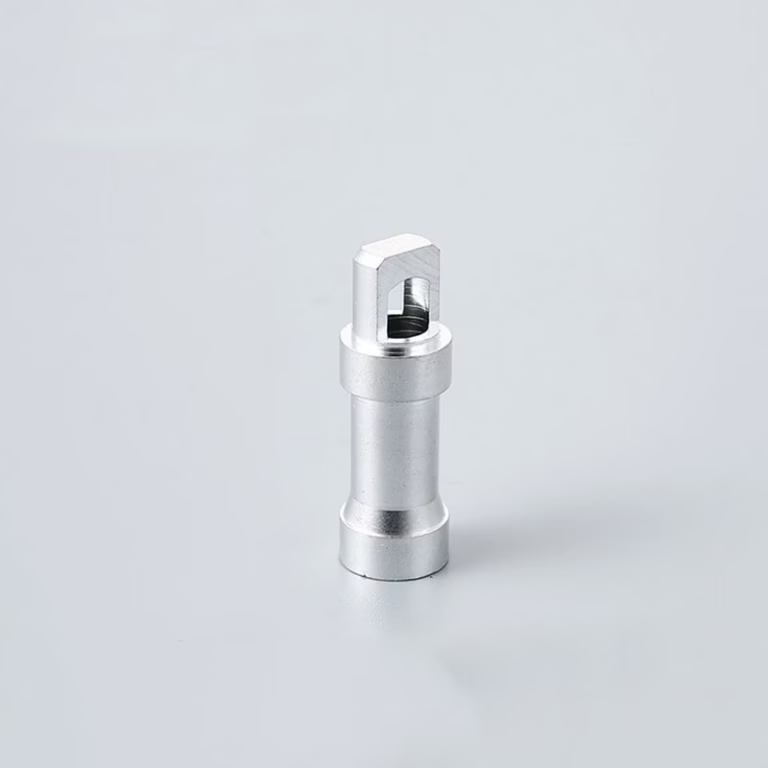
What the Stock Machine Actually Gives You
A stock 3018 Pro runs on 12 mm or 16 mm linear rod, a 775 brushed motor, and a die-cast Z plate. Measured runout at the collet is commonly 0.05 mm or worse, and the gantry deflects under light side load. That is fine for engraving softwood and acrylic at shallow depth. It is not fine for aluminum pockets, where deflection turns into chatter and broken 3 mm end mills.
Before buying anything, measure. Indicate the spindle body, then the collet taper, then push the tool tip by hand with a dial indicator on the frame. The dial tells you where the error lives. If runout is in the collet, a new collet nut costs less than a spindle. If the frame moves, no spindle swap will fix it.
The order below is deliberate. Stiffness first, then motion, then everything that saves setup time. Doing the spindle upgrade on a flexing frame just moves the chatter to a different frequency.
- 1Measure firstDial indicator on the collet and on the tool tip, not on the housing.
- 2Stiffness before powerA stronger spindle on a soft frame cuts worse, not better.
- 3Machined beats castBillet aluminum mounts hold flatness that die-cast brackets do not.
Spindle Mount and Frame Stiffening
The aftermarket spindle brackets sold with 500 W to 800 W air-cooled spindles are usually die-cast. Flatness drifts, the bore is off-center, and you end up shimming with beer-can stock. A machined replacement from 6061-T6, bored concentric to the spindle OD and faced flat on both sides, removes the tilt error that makes depth of cut vary across the table. We hold ±0.005 mm on the bore and shoulder, which is far tighter than the machine can resolve, so all the remaining error comes from the frame.
Frame stiffening is the cheapest real gain. Two 6 mm aluminum plates bolted to the gantry sides, plus a rear rib connecting the Y rails, cut visible flex on a push test. Counterbore the bolt holes so heads sit flush and do not foul the Z travel. If you can only do one thing to a 3018 Pro, do this.
Do not overbuild. Plates thick enough to resist a firm hand push are enough. Past that you are adding mass the NEMA 17 motors have to accelerate, and you lose speed without gaining accuracy.
- 1Bore concentricityTurn the bore and the mounting face in one setup to keep them square.
- 2Flush fastenersCounterbore every stiffening plate so bolt heads clear the moving parts.
- 3Match plate to load6 mm 6061-T6 handles gantry ribs; 10 mm is usually wasted mass.
Upgrade Parts: Material and Tolerance Guide
Typical choices for the machined parts in this list. Tolerance is what the part is made to, not what the assembled machine will hold.
| Part | Recommended material | Machined tolerance | Why |
|---|---|---|---|
| Spindle mount | 6061-T6 | ±0.005 mm bore | Light, stable, easy to anodize |
| Gantry stiffener | 6061-T6 or 6082 | ±0.05 mm | Stiff enough, low added mass |
| Motor plate | 6061-T6 | ±0.02 mm slot | Keeps belt path parallel |
| Z probe body | POM or 6061 | ±0.05 mm | Insulates the contact face |
| Dust shoe body | POM | ±0.1 mm | Chips slide, bristles grip |
| Linear rail spacer | 7075 or steel | ±0.01 mm | Sets rail height repeatably |
Linear Motion, Cooling, and Chip Control
Rod-and-bushing axes on the 3018 Pro wear into an oval and start to bind. MGN12 linear rails with preloaded carriages remove that play, and ball screws replace the lead screws that develop backlash after a few hundred hours. The catch is mounting height. Rails sit taller than the original rods, so you need a machined spacer or a redesigned carriage plate to keep the tool over the work area. Measure the stack height before you order rails.
On the spindle side, an ER11 or ER16 collet chuck with a proper nut reduces runout far more than a new motor does. If you move to a 500 W air-cooled spindle, add a chip shield and a directed air blast. Aluminum chips weld to a hot spindle nose and get dragged back into the cut. A simple machined nozzle aimed at the cutter keeps the flutes clear.
Skip flood coolant on this class of machine. The frame is not sealed, the bed is not enclosed, and the mess costs more time than the cooling saves. Directed air plus a shop vac is the practical answer.
- 1Check stack heightRails change the Z zero position; spacers bring it back.
- 2Preload mattersA loose carriage is no better than a worn bushing.
- 3Air, not floodDirected air clears chips without soaking the electronics.
Tool Setting, Drive Train, and Dust Extraction
A tool length sensor turns a two-minute manual touch-off into a five-second automatic one, and it removes the operator error that ruins the first part of a run. The sensor body is a small insulated block machined from POM, with a hardened contact face and a ground lead. Wire it to the probe input and set the thickness in your control software. Repeatability of the contact face is what matters; ±0.05 mm on the block thickness is plenty.
Stepper upgrades are the most over-bought item on this list. NEMA 17 motors with more torque help only if the drivers can deliver the current and the mechanics can use it. Replace the stock drivers with a board that supports at least 1/16 microstepping, then add machined couplers. A rigid coupler with a proper clamp bore beats a flexible one that twists under load. Check that the coupler bore matches the motor and screw shafts exactly; a 0.05 mm slip becomes visible backlash.
Dust is the quiet killer. A machined dust shoe with a replaceable brush ring and a 32 mm vacuum port keeps chips off the rails. Chips on a rail act like grinding paste. Cut the shoe body from POM so it does not wear against the bit if you set the brush too low. The brush ring is a consumable; plan to replace it.
- 1Probe repeatabilityThe contact face, not the block thickness, sets your Z accuracy.
- 2Rigid couplersClamp-style couplers with matched bores, not flexible spiders.
- 3Replaceable bristlesTreat the brush ring as a wear item and keep spares.
When the Upgrades Stop Being Worth It
Add up the parts. Rails, ball screws, a 500 W spindle, machined mounts, drivers, and a dust shoe can run past the cost of a used benchtop mill that already has a cast iron column. If your goal is cutting aluminum brackets all day, buy the mill. If your goal is learning, cutting wood and plastic, and occasional light aluminum, the upgrades make sense.
The 3018 Pro also has a hard ceiling on work envelope and spindle power. No upgrade changes the fact that a 300 W cut in 6061 at a reasonable feed needs more rigidity than the frame can provide. Know the ceiling before you spend.
Where upgrades pay off is repeatability on small parts. A stiffened frame with linear rails and a machined spindle mount will hold a few hundredths on a 50 mm part, run after run, without an operator chasing it. That is a real gain for a small shop making short runs of plastic and aluminum parts under 100 mm.
- 1Budget checkA full upgrade list can approach the price of a used benchtop mill.
- 2Know the ceilingFrame stiffness caps what any spindle can cut in aluminum.
- 3Repeatability winsSmall parts, short runs, no operator chasing the first article.
Questions Engineers Ask About 3018 Pro Upgrades
Which upgrade gives the biggest accuracy gain for the money?
Frame stiffening. A pair of 6 mm 6061-T6 side plates and a rear rib cost little and remove the deflection that shows up as chatter and varying depth of cut.
A machined spindle mount is second. It removes tilt error, which no amount of tuning can compensate for.
Can I machine the upgrade parts myself on the 3018 Pro?
For POM dust shoes and probe bodies, yes. The machine can hold a few hundredths on plastic with light passes.
For the spindle mount and stiffening plates, no. The bore concentricity and face flatness you need are finer than the machine can produce. Those parts are better ordered machined.
What material should the spindle mount be made from?
6061-T6 is the default. It is stiff enough, machines cleanly, and anodizes well if you want a durable surface.
7075 is stiffer but costs more and is less forgiving to machine. Use it only if you need the extra modulus in a thin section.
Do I need ball screws, or are new lead screws enough?
New lead screws delay the problem. Ball screws remove backlash instead of hiding it, and they hold preload as they wear.
If you only cut wood and plastic at moderate feeds, fresh lead screws with anti-backlash nuts are a reasonable middle step.
Is a 500 W spindle worth it on this frame?
Only after the frame is stiffened. On a stock frame the extra power shows up as chatter, not as faster cutting.
With rails and stiffening in place, a 500 W air-cooled spindle with an ER11 collet makes light aluminum work practical.
Can you make a one-off set of these parts?
Yes. There is no minimum order quantity, and single prototypes are quoted the same way as short runs.
Send a drawing or a step file and we return a quote with a DFM note within 12 hours. Uploads stay confidential, and an NDA is available on request.
Need the Machined Parts for Your 3018 Pro Upgrades?
Send drawings or step files for spindle mounts, stiffening plates, couplers, and dust shoes. We machine them to ±0.005 mm, anodize or bead blast on request, and ship in 3–5 days with no minimum order quantity.
12-hour quote and DFMNo MOQ100% inspection before shipmentNDA on request









