
Safety Operation Procedures for the 855 Vertical Machining Center
This page explains how a vertical machining center is built to keep an operator alive, and what the operator has to do in return. It is written for setup people, programmers and shop engineers who sign off on the process. After reading it you can judge whether a given job belongs on an 855 frame or needs a different machine.
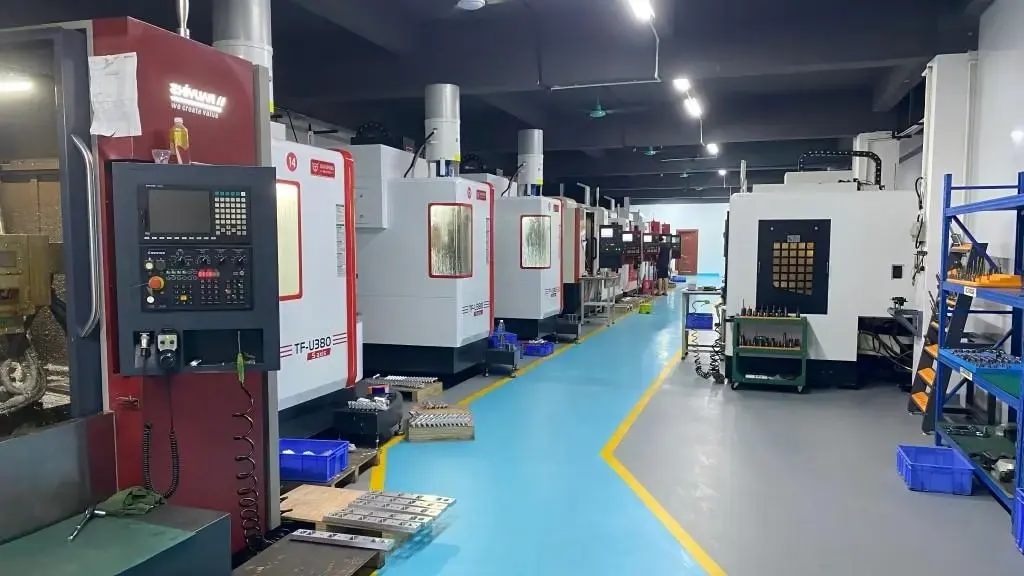
Why the 855 Vertical Machining Center Behaves the Way It Does
An 855 vertical machining center is a C-frame machine. The column is fixed to the base and the table travels in X and Y under a spindle that moves in Z. That layout is stiff and cheap to build, and it is why the 855 class holds ±0.005 mm positioning and ±0.003 mm repeat positioning without a thermal compensation system. The same layout sets the safety logic. Everything dangerous moves in a small box around the table, so the enclosure is the primary barrier.
The table on this class of machine travels roughly 800 mm in X, 500 mm in Y and 500 mm in Z. A part that fits inside that envelope at the start of the cycle can still swing out of it once you add a vise, a rotary table or a tombstone. The enclosure is sized for the machine, not for your fixture. That is the single most common reason a door interlock gets defeated on a shop floor, and it is the wrong fix.
Spindle speed matters too. At 8,000 rpm a 100 mm face mill carries enough stored energy that a loose insert becomes a projectile. The polycarbonate or laminated glass in the door is rated for that, a sheet of acrylic from the hardware store is not. When a panel is scratched to the point you cannot read a part number through it, replace it. Scratches are where cracks start.
None of this is about the control. The control only knows what the drives and the switches tell it. If a limit switch is jumped out, the control will happily command a rapid into a fixture and the machine will obey.
- 1Mechanical stop comes firstInterlocks, hard limits and the E-stop chain act before software limits.
- 2Enclosure is a wear partInspect door glass and switches at every shift change, not once a quarter.
- 3Fixture envelope is your jobThe machine cannot know that your vise is taller than the last one.
Pre-Start Checks That Actually Catch Failures
A pre-start check is not a checklist for its own sake. Each item maps to a failure mode that has taken fingers or spindles. Air pressure at 0.5 MPa or above keeps the tool clamp and the door cylinder working; below that, a tool can release mid-cut. Lubrication oil level and way lube pressure tell you whether the linear guides are being fed. Dry guides wear fast and then lose the accuracy you paid for.
Walk the table through its full travel in jog with the door closed and the feed override at zero before the first rapid. Listen for the sound of a chip pack or a loose way cover. Look for coolant pooling where it should not be. Two minutes here saves a crashed tool and sometimes a spindle.
Clamp force is the quiet one. A vise that is tight enough for a 20 mm end mill in aluminium is not tight enough for the same cutter in 4140 steel. Check that the part sits flat on parallels and that the movable jaw is not lifting the work. If the part moves 0.05 mm under load, you will hear it as chatter long before you see it as a scrapped feature.
- 1Air 0.5 MPa minimumTool clamp and door cylinder both depend on it.
- 2Lube and pressureWay lube level and pressure before the first rapid.
- 3Full travel jogCatch chip packs and loose covers at low feed.
- 4Clamp for the materialSteel needs more clamp force than aluminium.
Running the Cycle Without Opening the Door
The rule is simple and it is written on almost every machine: no adjustments while the spindle turns. Reaching in to brush away a chip or nudge a coolant nozzle is how operators lose fingers. If you must get in, stop the spindle, wait for it to reach zero rpm, then open the door. On most controls a spindle-orientation command keeps the tool in a known position so you can restart cleanly.
Coolant flow deserves a real check, not a glance. Low flow on a deep pocket means chips recut, heat builds and a 12 mm carbide end mill fails at the corner radius. Watch the return flow and the chip conveyor. If the conveyor stops, the sump fills and the pump starts pulling chips. That is a ten-minute fix or a two-day spindle rebuild, depending on when you notice.
Sound and load are your instruments. A spindle load that climbs 15% on the same program with the same material means the tool is dull or the chip evacuation has changed. Abnormal vibration at a known speed is usually a loose insert or a part that has started to move. Stop the machine, note the alarm and the axis position, and check before restarting.
- 1Spindle to zeroNo hands in the enclosure until rpm reads zero.
- 2Watch coolant returnReturn flow and conveyor are leading indicators.
- 3Record the loadA 15% load rise on the same job means something changed.
Step by Step: From Power-On to First Cut
Follow the order. Each step assumes the previous one passed.
- 11. Power up and referenceClose the door, release the E-stop, reference all axes at reduced rapid, typically 25% override.
- 22. Check air and lubeConfirm 0.5–0.6 MPa at the regulator and way lube above the low mark. Top up if needed.
- 33. Verify the offsetsCompare the work offset and tool length offsets against the setup sheet. One wrong digit here is the classic crash.
- 44. Dry run above the partRun the program with the Z offset raised 50 mm and rapid override at 25%. Watch every tool change.
- 55. Single block the first partCut the first part in single block with the door closed. Listen for a change in pitch.
- 66. Measure, then runCheck the first article against the drawing, then switch to continuous run with the door locked.
- 77. Log the shiftNote spindle load, alarm codes and any tool that chipped. The next shift inherits your notes.
When an 855 Vertical Machining Center Fits and When It Does Not
Use this before you promise a job to the 855 class.
| Job condition | Good fit for 855 | Move to another machine |
|---|---|---|
| Part envelope | Fits 800 × 500 × 500 mm with fixture | Long parts needing 4,000 mm travel |
| Part count | One prototype to 10,000+ parts | Very high volume, single feature |
| Faces to machine | 3 faces plus one indexed face | 5 faces in one setup, tight true position |
| Material | Aluminium, stainless, steel, titanium | Parts needing mill-turn in one cycle |
| Fixture height | Under 300 mm above the table | Tall tombstones near the enclosure roof |
| Accuracy target | ±0.005 mm positioning | Sub-micron roundness on a bearing bore |
| Cycle time | Runs of minutes, not seconds | Cycle under 20 seconds per part |
A clear call
If your part fits the 855 envelope with the fixture installed and needs three faces plus one index, keep it on the vertical machining center and never open the door mid-cycle. If it needs five faces in one setup, long travel or a mill-turn cycle, move it to a simultaneous 5-axis or mill-turn machine. The safety procedures cannot fix a layout mismatch.
Questions operators and engineers ask
Can the door interlock be bypassed for setup?
No. If a setup needs the door open with the spindle running, the setup is wrong. Move the fixture, change the tool, or use a machine with a pallet changer so the work happens outside the cutting zone.
Every bypass we have seen ended with either a scrapped spindle or an injury report. The interlock is not an obstacle to production, it is the reason the shop still has operators.
What air pressure does the machine need to run safely?
0.5 MPa is the floor, and 0.5–0.6 MPa is the working band on this class of machine. Below that the tool clamp and the door cylinder lose force.
Fit a pressure switch that alarms the control instead of a gauge nobody reads. A regulator that drifts down over a weekend will be found by the next shift as a dropped tool.
How often should way lube and filters be checked?
Way lube level every shift, filters and lubricator operation monthly, and the full manual schedule once a year. Dry linear guides lose accuracy before they seize.
Keep a written log. A machine with a lube log is easier to sell, easier to audit and cheaper to run.
Is 8,000 rpm safe with a large face mill?
Only with tooling rated for that speed and a spindle taper in good condition. Check insert screw torque and look for fretting on the taper.
Balance the assembly. An unbalanced 100 mm cutter at 8,000 rpm loads the spindle bearings and can loosen the retention knob over time.
What training do operators need before running the machine?
Formal training on machine structure, parameters, offsets and emergency response. The old page quoted a 40-hour minimum; treat that as a floor, not a target.
Then supervised running for the first week on real parts, with a sign-off on the dry-run and single-block procedure.
Does maintenance need the machine powered down?
Yes for anything inside the enclosure or the electrical cabinet. Isolate, lock out, and hang a warning tag at the disconnect.
For a spindle or axis repair, follow the manual and keep the tag in place until the person who fitted it removes it.
Send us the drawing and the fixture plan
We machine the parts and we can also review whether your design suits a 3-axis vertical machining center, a 4-axis or a simultaneous 5-axis setup. Uploads are secure and confidential, and an NDA is available on request.
Quotation and free DFM analysis within 12 hoursProduction can start within 24 hours100% inspection before shipment
More machining notes from our shop floor
We publish setup notes, tooling trials and inspection data from the factory floor.











