
Is a Robot Actually a CNC Machine?
Both run on servo motors and closed-loop feedback, so the question keeps coming up on the shop floor. This guide separates the shared control theory from the real mechanical and programming differences, written for engineers specifying robot arms, end effectors and machined structural parts.
What This Question Really Asks
A short answer first, then the mechanical detail that decides which machine cuts which part.
The Control DNA Robots and CNC Machines Share
Strip the sheet metal off a machining center and a six-axis arm and you find similar electronics. Servo drives with encoder feedback sit at the heart of both. Each one interpolates a path from a program and corrects position thousands of times per second. That shared skeleton is why people ask whether the two are the same machine.
The overlap is real. A CNC controller and a robot controller both run kinematic math, both watch following error, and both fault out when a tool or payload pushes past a torque limit. Programming languages differ, but the underlying idea does not: define points in space, then hold them under load.
Where the comparison breaks down is stiffness. A machining center carries a spindle through a rigid column and box ways. The arm reaches out on serial joints, so every joint adds compliance to the tool tip.
Droop under cutting force is the practical consequence. A CNC machine holds ±0.005 mm on a boring pass because the structure resists deflection. The same cut on a robot arm is limited by joint stiffness and encoder resolution, not by the controller.
Where Robots and CNC Machines Diverge
Work envelope shape separates the two more than any spec sheet. A machining center covers a fixed box, say 750 × 1,150 × 550 mm or 600 × 600 × 600 mm. The arm sweeps a sphere and can be bolted to a rail to extend reach.
That reach comes at a cost. Stiffness drops as the arm extends, so a robot that holds 0.1 mm near its base may drift to 0.5 mm at full stretch. A CNC machine keeps the same stiffness across its whole travel because the load path barely changes.
Programming models differ too. CAM software posts G-code for a known tool and stock. Robot programming works in joint space or Cartesian space, and the same path can be reached by many joint configurations. Singularities and wrist flips are real problems a CNC programmer never sees.
Tooling tells the same story. A machining center spins a cutter at 10,000 rpm or more and floods it with coolant. An arm carries a gripper, a welding torch, or a spindle unit that is often an afterthought.
For engineers choosing between the two, the question is not which is better. It is which error budget you can live with, and whether the part moves or the tool moves.
Robot Arm vs CNC Machining Center
How the two compare on the parameters that decide part routing.
| Parameter | Robot arm | CNC machine |
|---|---|---|
| Motion | Serial joints, spherical reach | Rigid frame, box travel |
| Stiffness | Falls as arm extends | Constant across travel |
| Typical accuracy | Varies with pose and load | ±0.005 mm on rigid setups |
| Work envelope | Flexible, rail-mounted | Fixed, up to 4,000 mm |
| Programming | Joint or Cartesian, offline | CAM to G-code |
| Best for | Handling, welding, tending | Cutting to tight tolerance |
| Changeover | Reprogram the path | New fixture and program |
Why the Two Are Often On the Same Cell
Most robot cells still need a CNC machine nearby. The arm loads and unloads blanks, flips a part between operations, and moves finished work to a conveyor. The machining center does the metal removal.
This split works because each machine does what it is good at. The arm tolerates a 0.2 mm grab error and survives a crash. The spindle cannot.
Machine tending is the classic case. A robot picks a casting from a pallet, loads it into a vise, and waits for the cycle to finish. The CNC machine cuts to ±0.005 mm. Neither machine could do the other's job at that tolerance.
Robotic finishing is the newer use. An arm with a spindle or sander can blend a weld or polish a surface where ±0.1 mm is fine. Push that same arm to hold ±0.005 mm and the compliance in its joints will show up in the part.
The practical rule: if the feature tolerance is tighter than the arm can hold across its full reach, cut it on a CNC machine. Use the arm to move the part, not to make the cut.
Machined Parts That Go Into Robot Arms
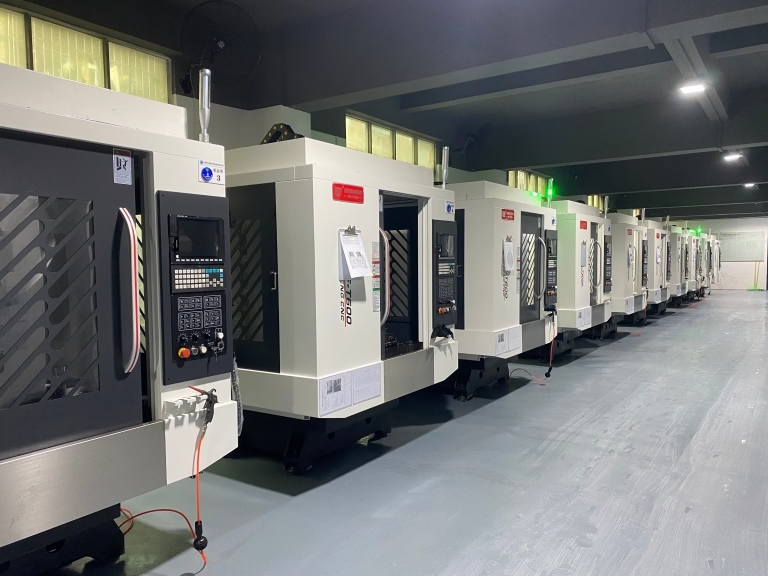
GreatLight machines the structural and motion parts that sit inside robot arms and humanoid joints. That work runs on 16 simultaneous 5-axis machining centers, 12 four-axis mills, 27 three-axis machines, and 16 mill-turn centers. Maximum processing size is 4,000 mm.
Typical parts include aluminum joint housings, harmonic drive brackets, wrist plates, end effector bodies, and camera mounts. Materials range from 6061-T6 and 7075 aluminum to 17-4PH stainless and Ti-6Al-4V for weight-critical joints.
Tolerance is held to ±0.005 mm, with surface finish from Ra 0.2–0.8 μm on bearing bores up to Ra 1.6–3.2 μm on non-critical faces. Every part is inspected before shipment, and reports are available on request.
Prototype quantities start at one piece. There is no minimum order quantity, and runs scale to 10,000+ parts. Uploads stay confidential, and an NDA is available on request.
Quotation and free DFM analysis come back within 12 hours. Production can start within 24 hours, and parts ship in 3–5 days.
Common Questions
Can a robot arm hold the same tolerance as a CNC machine?
Not across its full reach. A six-axis arm may hold ±0.1 mm near the base and drift to ±0.5 mm at full extension as joint compliance adds up.
A rigid CNC machine holds ±0.005 mm across its travel because the load path barely changes. Use the arm for handling and the CNC machine for tight features.
When should a robot do the cutting instead of a CNC machine?
When the tolerance is loose, typically ±0.2 mm or wider, and the part is large or awkward to fixture. Robotic deburring, weld blending, and polishing fit here.
If the feature needs ±0.005 mm, route it to a machining center. The arm cannot hold that under cutting load.
What materials do you machine for robot components?
Aluminum 6061, 6061-T6, 2024, 5052, 5083, 6063, 6082, 7075 and ADC12. Stainless 303, 304, 316, 316L, 420, 430, 431, 440C and 17-4PH.
Steel 1018, 1045, 4130, 4140, 4340, A36 and tool steel. Copper and brass grades, titanium TA1, TA2 and TC4, plus Inconel and magnesium AZ31B and AZ91D. Plastics include POM, PEEK, PA, PC and carbon fibre.
Do you produce parts for both industrial and humanoid robots?
Yes. The same shop machines arm housings, joint brackets and end effector bodies for industrial cells and for humanoid platforms.
The parts differ in weight targets and joint geometry, not in the machining process. Both run on the same 5-axis and mill-turn capacity.
How do you protect proprietary robot designs?
Uploads are secure and confidential. We can sign an NDA before drawings are shared.
Files are used only for quoting and production. No design data is shared outside the project.
What is the lead time for custom robot parts?
Quotation and free DFM analysis come back within 12 hours. Production can start within 24 hours of order confirmation.
Parts ship in 3–5 days. Historical late-delivery probability is below 2%.
Send Drawings, Get a Quote in 12 Hours
Upload your robot arm or end effector parts and we will return pricing and a free DFM review within 12 hours.
12-hour quote100% inspectionNo MOQNDA on request









