
Is a CNC Machine a Robot?
A CNC machine moves a tool along programmed coordinates. A robot moves a tool through a workspace that changes shape as the task changes. This article breaks the difference down by axis count, feedback type, autonomy and safety standard, so you can classify a machine on a shop floor in about five minutes.
In this article
- 1
- 2
- 3
- 4
- 5
- 6
- 7
- 8
Key takeaways
What the question is really asking
People ask is a cnc machine a robot because both machines share a lot of hardware. Both use servo motors, ball screws, linear guides and a controller that reads a program. Both repeat a movement thousands of times without fatigue. On a shop floor visit, the cabinets and the motion hardware can look almost identical.
The confusion usually comes from a video. A 5-axis machining center swings a spindle through a compound angle and the motion looks organic. A robot arm picks a part off a conveyor with the same smooth arc. Two different machines, two different control problems.
The useful way to answer the question is not a dictionary definition. It is a set of tests you can apply on the floor. Axis count, feedback type, whether the path is pre-planned, and which safety standard governs the installation. Each test gives a clear answer for most machines, and the combination settles the hard cases.
This article is written for engineers and buyers who need to specify equipment, not to win an argument. If you are sourcing machined parts for a robot arm joint, the practical question is which process holds the tolerance, and that answer is usually CNC.
How a CNC machine decides where to move
A CNC machine works from a pre-computed toolpath. A CAM programmer takes the part model, picks tools and cutting parameters, and posts G-code. The controller reads that code and interpolates between points. The machine does not need to know what the part is. It only needs to follow the coordinates.
The feedback loop is closed at the axis. Glass scales or encoders report position, and the drive corrects any lag within milliseconds. That is servo control, and it is very good at holding a commanded position under cutting force. What it does not do is decide that the part has shifted and re-plan the cut.
That single fact explains most of the behavior differences. A CNC machine cannot tell that a casting is 0.3 mm oversize on one side and adjust the path to suit. The programmer either accounts for that variation in the setup or the part is scrapped. The machine repeats, it does not negotiate.
Typical numbers from our shop: a 5-axis machining center holds ±0.005 mm on a 750 × 1,150 × 550 mm envelope, with surface finish down to Ra 0.2–0.8 μm when the tool and coolant are right. Those are path-following results, not adaptive ones.
- 1InputG-code posted from CAM, fixed before the cycle starts.
- 2FeedbackAxis-level position and velocity, corrected every servo cycle.
- 3Decision scopeNone about the workpiece. The path is taken as given.
- 4StrengthVery high stiffness and repeatability on a known geometry.
How a robot arm decides where to move
A robot arm starts from a task, not a toolpath. An integrator defines a target pose in space, and the controller solves the inverse kinematics to find joint angles. When the target moves, the joint angles change. That re-planning step is the core of what makes a robot a robot.
The mechanism is usually a serial chain: base, shoulder, elbow, wrist. Each joint adds a degree of freedom, and the arm reaches into a large working volume. The trade-off is stiffness. A cantilevered arm deflects more under load than a gantry or a column, so absolute accuracy on a robot is typically looser than on a machining center.
Robots compensate with sensing. Machine vision finds the part, force-torque sensors detect contact, and the controller adjusts. A welding robot tracks a seam that varies from part to part. A palletizing robot picks a box wherever it landed. None of that requires the position to be known in advance.
That is also why robot safety standards differ. A CNC machine encloses the cutting zone and stops if the door opens. A collaborative robot may work next to a person, so the standard has to address speed, force and separation monitoring instead of a fence.
- 1InputA task or target pose, evaluated at run time.
- 2FeedbackJoint encoders plus external sensors such as vision or force.
- 3Decision scopeRe-plans the path when the target or environment changes.
- 4StrengthReach and flexibility across many different tasks.
Where the line gets blurry
The clean split above breaks down in three places. The first is automated part handling. A 5-axis machining center with a pallet pool and a robot loader can run unattended for hours. The machining center is still not a robot, but the cell as a whole performs tasks that used to need a person.
The second is mill-turn and multi-spindle equipment. A mill-turn center with a Ø400 mm rotary table and a sub-spindle can turn one face, index the part, mill a slot, and part it off in one cycle. The number of setups drops to one. The machine is more capable, but the path is still posted in advance.
The third is the machine-tending arm itself. If you are building a robot cell, the arm is the robot and the machining center is the process. We machine the joint housings, wrist brackets and gearbox plates that go into those arms. The arm moves; the parts we cut hold the geometry that lets it move accurately.
So the honest answer is that the categories overlap at the cell level. Judge the machine by its control architecture, and judge the cell by what it can do without human intervention.
- 1Pallet-fed 5-axis cellUnattended cutting, but a fixed toolpath per pallet.
- 2Mill-turn centerFewer setups, still a pre-planned cycle.
- 3Machine-tending armA true robot feeding a true CNC machine.
- 4Collaborative cellRobot and operator share space under a safety-rated controller.
Why the distinction changes your design choices
If you are designing a part, the classification decides which process to quote. A CNC machine is the right choice when the geometry is fixed, the tolerance is tight and the quantity justifies a fixture. That covers most brackets, housings, manifolds, impellers and structural nodes.
A robot is the right choice when the task varies. Pick-and-place, welding, deburring, inspection and assembly all involve a target that moves or a batch that changes. Trying to do those jobs on a machining center means writing a new program for every variation, which rarely pays off.
There is a cost angle too. A CNC machine with a dedicated fixture usually beats a robot arm on cycle time for a single fixed operation. A robot arm beats a CNC machine when the same cell has to handle a family of parts with different shapes.
For robot builders, the practical split is that the arm is bought and the machined parts are made. We produce joint housings, wrist flanges, harmonic drive mounts and end-effector plates in aluminum 6061-T6, 7075 and 17-4PH stainless. Tolerances sit at ±0.005 mm with 100% inspection before shipment.
- 1Fixed geometry, tight toleranceCNC machining center with a dedicated fixture.
- 2Varying target or taskRobot arm with sensing and re-planning.
- 3Mixed family, low volumeRobot cell is usually more flexible.
- 4High volume, one shapeCNC with pallet automation wins on cycle time.
Five tests that settle the question
Test one: where does the next position come from? If it comes from a file written before the cycle, you are looking at a CNC machine. If the controller computes it at run time from a target pose, you are looking at a robot.
Test two: can the machine react to the part moving? A CNC machine will keep cutting the same coordinates even if the stock shifted, which is why probes and setup sheets exist. A robot with vision will re-find the part and adjust.
Test three: what does the safety system protect against? A machining center uses an enclosure and an interlocked door. An industrial robot uses a fence and a safety-rated motion stop, or in a collaborative setup, speed and force limits.
Test four: how many degrees of freedom, and are they serial or parallel? A 5-axis machining center has two rotary axes on a stiff structure. A 6-axis robot has a serial chain with a long reach and lower stiffness.
Test five: what happens when the task changes? Re-post the G-code, or re-teach the pose. The first answer points to CNC, the second to a robot. Apply all five and most machines classify cleanly.
CNC machine vs robot arm: the engineering differences
Use this table to classify a machine or to pick a process for a new part.
| Criterion | CNC machine | Robot arm | Why it matters |
|---|---|---|---|
| Path source | G-code posted in advance | Pose solved at run time | Decides whether the machine can adapt |
| Feedback | Axis position and velocity | Joint encoders plus vision or force | Drives accuracy and error recovery |
| Stiffness | High, closed frame | Lower, cantilevered chain | Sets achievable tolerance |
| Typical tolerance | ±0.005 mm on 5-axis work | Looser absolute accuracy | Pick CNC for tight fits |
| Degrees of freedom | 3 to 5, sometimes 6 | Usually 6, up to 7 | Reach vs rigidity trade-off |
| Safety standard | Enclosure and door interlock | ISO 10218 / ISO TS 15066 | Changes cell layout and cost |
| Best for | Fixed geometry, tight tolerance | Varying tasks and targets | Match process to part family |
| Changeover | New program and fixture | Re-teach or re-plan | Affects low-volume economics |
The short answer
A CNC machine is not a robot. It follows a toolpath that was fixed before the cut. A robot re-plans its path at run time from a target pose. If your part geometry is fixed and the tolerance is tight, choose CNC. If the task or the target moves, choose a robot. For robot builders, we machine the joint housings and brackets that make the arm accurate.
Frequently asked questions
Is a CNC machine a robot under ISO 10218?
No. ISO 10218 covers industrial robot systems, which are defined by a manipulator that can be reprogrammed to perform multiple tasks and moves in more than one axis under automatic control.
A CNC machine can be reprogrammed to cut a different part, but the motion is tied to a toolpath and the machine is not designed to sense and adapt to a changing target. It falls under machine tool safety standards instead.
Can a 5-axis CNC machine be called a robot?
Not by control architecture. The two rotary axes add reach and let the tool approach a part from more directions, but the path is still posted in advance.
The motion can look similar to a robot arm, especially on a compound cut. The difference is that a robot re-solves its joints when the target moves, while the machining center repeats the same coordinates.
What is the main practical difference for a buyer?
A CNC machine is bought for accuracy on a known geometry. A robot is bought for flexibility across changing tasks.
If you need ±0.005 mm on a housing that will not change, a machining center is the right tool. If the same cell has to handle a family of parts with different shapes, a robot arm usually pays back faster.
Do you machine parts for robot arms?
Yes. We produce joint housings, wrist flanges, harmonic drive mounts, gearbox plates and end-effector brackets for robotics and automation customers.
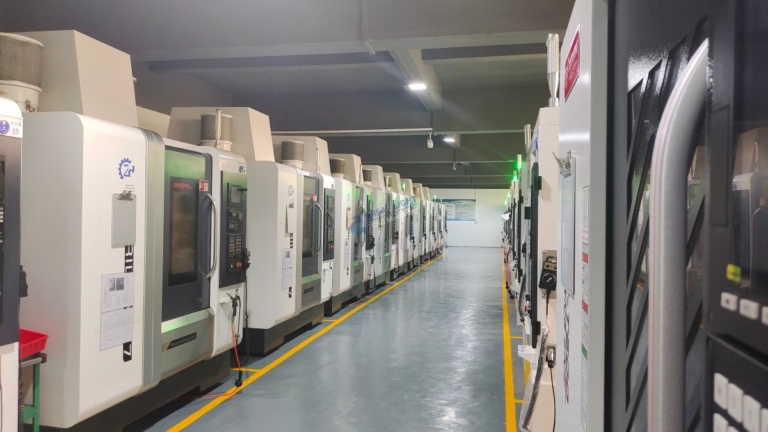
Typical materials are 6061-T6, 7075 aluminum, 17-4PH stainless and titanium TC4. We run 16 simultaneous 5-axis machining centers and inspect 100% of parts before shipment.
How fast can I get a quote for machined robot parts?
Quotation and free DFM analysis come back within 12 hours. Production can start within 24 hours after the drawing and material are confirmed.
Parts usually ship in 3–5 days. There is no minimum order quantity, so a single prototype and a 10,000-part run go through the same process.
Which materials and finishes do you recommend for robot joints?
For a lightweight link, 7075 aluminum machined to ±0.005 mm then hardcoat anodized works well. For a wear surface, 17-4PH stainless in the H900 condition holds up better.
We also offer electroless nickel, black oxide, bead blasting and laser marking, with a minimum character height of 1.5 mm for part IDs.
Need machined parts for a robot cell?
Upload your drawings and get a quote with free DFM analysis within 12 hours. Files stay confidential, and an NDA is available on request.
12-hour quote100% inspectionNo minimum order±0.005 mm
More from GreatLight
We publish setup notes, tooling trials and inspection data from the factory floor.











