
Advantages and Disadvantages of CNC Machining
This page is for design engineers and buyers deciding whether a part belongs on a CNC machine. We list where the process wins, where it costs you time or money, and the part features that decide it.
How to read this comparison
Every advantage has a matching cost. The useful question is not whether CNC is good, but whether it fits your part, your quantity, and your tolerance callouts.
Tolerance and repeatability
A CNC machine holds ±0.005 mm on a well-fixtured part. That number is not a marketing figure; it comes from rigid setups, thermal control, and in-process probing. Once the program and fixture are proven, part 500 measures like part 5.
Repeatability matters more than the headline tolerance. A mold insert with ten identical pockets, or a batch of 2,000 brackets, lives or dies on whether every unit lands in the same place. Manual machining depends on the operator's attention at 3 p.m. on a Friday. CNC does not.
The trade-off is that this precision needs a clean setup. Thin walls, poorly supported overhangs, and soft fixturing will move under cutting force no matter how good the machine is. If your part is floppy, no controller setting saves it.
Complex geometry in one setup
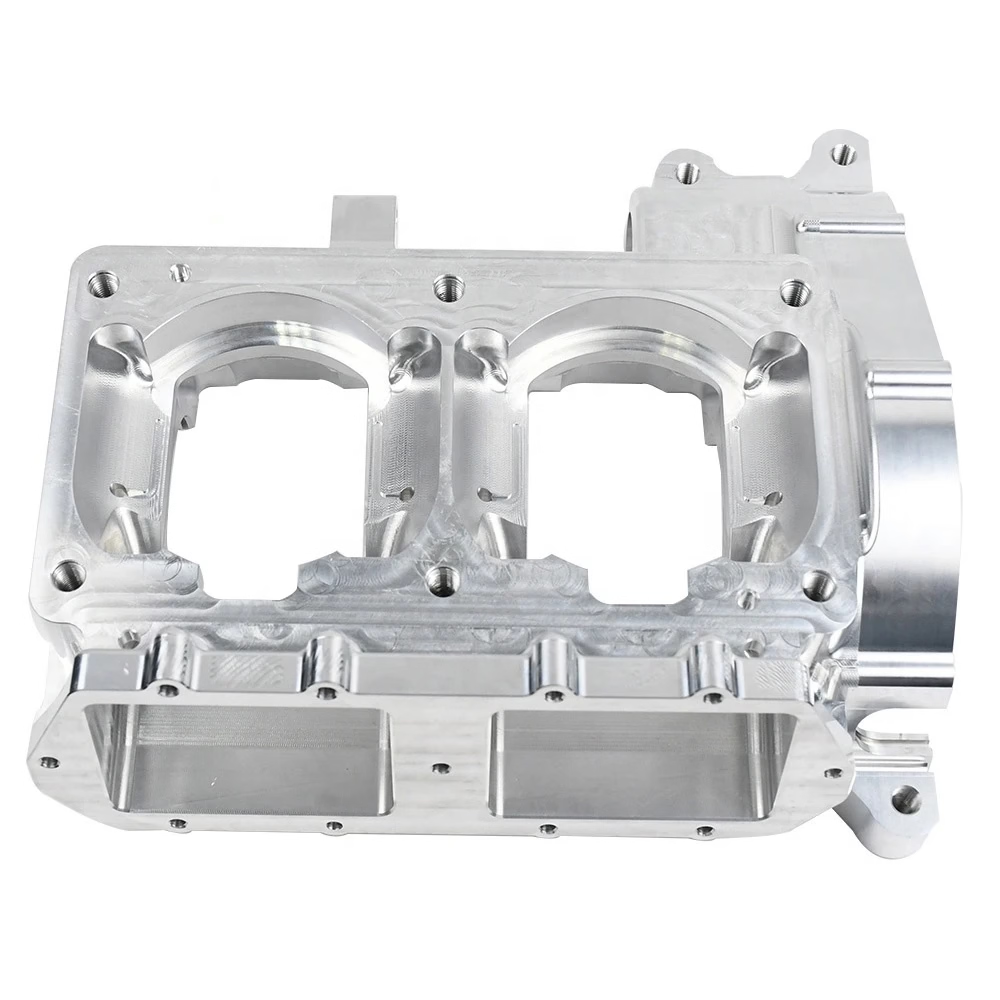
Five-axis machining lets us cut undercuts, angled faces, and contoured pockets without re-fixturing. Every re-fixture adds stack-up error and hours. On a part like a turbine housing or a medical instrument body, that saved setup is often the whole cost argument.
We run 16 simultaneous 5-axis centers and 16 mill-turn centers. Mill-turn matters for parts that are turned and milled: a shaft with cross-drilled holes and milled flats comes off one machine instead of two, and the concentricity between features stays intact.
Complexity has a limit. Deep, narrow cavities need long, thin tools that deflect and chatter. A pocket 60 mm deep and 8 mm wide is a problem on any machine. Sometimes the honest answer is to split the part, or to move that feature to EDM or casting.
Material range and no tooling cost
CNC cuts aluminium 6061 and 7075, stainless 303 and 17-4PH, 4140 steel, titanium Ti-6Al-4V, Inconel, brass C36000, and plastics from POM to PEEK. Switching material means switching feeds, speeds, and tooling, not buying a new mold.
That is the core advantage over casting, forging, and injection molding at low volume. A die or mold is a five-figure commitment before the first good part exists. CNC has no tooling charge, so design changes between prototype and production run cost you programming time, not a new tool.
The flip side is unit cost. At 500 pieces a machined bracket is competitive. At 50,000 pieces, a die casting or a progressive stamping die will beat it badly. The crossover point depends on geometry, tolerance, and material, and it is usually somewhere between a few hundred and a few thousand parts.
When CNC wins and when it does not
Use this as a first filter. Real decisions need a quote, but these are the patterns we see.
| Part situation | CNC fit | Why |
|---|---|---|
| 1–500 parts, tight tolerance | Strong fit | No tooling cost, tolerance held per part |
| 50,000+ simple parts | Weak fit | Casting or stamping wins on unit cost |
| Undercuts and angled faces | Strong fit | 5-axis cuts them in one setup |
| Deep narrow cavities, L/D over 8 | Weak fit | Tool deflection and chatter |
| Prototype with likely design changes | Strong fit | Change the program, not the tool |
| Hollow thin-wall shell | Mixed fit | Possible but slow; casting often better |
| Hardened tool steel, 55 HRC+ | Mixed fit | Needs EDM or grinding after heat treat |
Capital cost, maintenance, and skills
A 5-axis machining center costs several times a 3-axis mill, and the spindle, guideways, and rotary table all wear. Maintenance is not optional; backlash and thermal drift show up in the part long before the machine visibly fails.
The bigger cost is people. Programming, fixture design, and tool selection need experience. A machine that sits idle because nobody can set up the job is more expensive than a slower manual process that runs.
This is why outsourcing usually beats buying at low volume. We carry 127 machines across 3 plants and 150 technicians. That overhead is spread across many customers, which is a cost structure a single product line rarely matches.
Material waste and slow cycle times
CNC is subtractive. A part cut from a 200 × 200 × 80 mm aluminium block may leave 70 percent of that block as chips. On titanium or Inconel, where the stock itself is expensive, that scrap is a real line item.
Cycle time is the other cost. A cavity that takes 40 minutes on a 3-axis mill might take 3 hours with a small tool and light passes. Roughing strategies help, but you cannot cheat physics on tool load.
Where near-net stock is available, we use it. A casting or forging blank that is already close to final shape cuts both cycle time and scrap. For a part with a lot of removed volume, ask whether the blank should be cast first and only the critical faces machined.
Geometry limits and surface finish ceilings
CNC cannot cut an internal corner sharper than the tool radius. A 6 mm end mill leaves a 3 mm corner radius. If your drawing calls for a sharp internal corner, the design has to change or the corner has to be finished another way.
As-machined finish lands around Ra 1.6–3.2 μm. Fine finishes take light passes, smaller stepovers, and more time. Ra 0.2–0.8 μm is achievable on the right geometry, but it is a deliberate operation with its own cost.
Some features simply do not belong on a mill. A part with 200 small holes, a lattice, or an internal channel that curves in three dimensions is usually better as a casting, a metal 3D print, or a combination: print the blank, machine the sealing faces and bores.
Questions engineers ask next
What is the main advantage of CNC machining?
Tolerance combined with repeatability. A CNC machine holds ±0.005 mm and holds it on part 1 and part 1,000 alike, because the position comes from a program and a fixture rather than from an operator's hand.
The secondary advantage is that no tooling is required, so the process fits prototypes and low-volume runs where a mold or die would be wasted money.
Is CNC machining good for complex parts?
Yes, within tooling limits. Five-axis machining cuts undercuts, angled faces, and contoured surfaces in a single setup, which removes both re-fixture error and setup hours.
The limits are deep narrow cavities, sharp internal corners, and features that need a tool longer than about 8 times its diameter. Those features usually move to EDM, casting, or additive.
What are the main disadvantages?
Capital cost, maintenance, and the skilled people needed to program and set up the work. Material waste is high because the process is subtractive, and cycle times grow quickly when the geometry is awkward.
There are also hard geometry limits: internal corner radii, depth-to-diameter ratios, and a practical as-machined finish around Ra 1.6–3.2 μm.
At what quantity does CNC stop being cost-effective?
It depends on geometry, tolerance, and material, but the crossover to casting, forging, or stamping usually falls between a few hundred and a few thousand parts. Simple parts cross over earlier.
Below that range, CNC wins because there is no tooling charge and design changes cost programming time instead of a new die.
Which materials can be machined?
Aluminium 6061, 7075, and 6082; stainless 303, 304, 316L, and 17-4PH; steel 1018, 4140, and 4340; titanium Ti-6Al-4V; Inconel; brass C36000; and plastics including POM, PEEK, and PC.
Material choice is limited by the machine and the tooling, not by the process itself. Hardened steel above roughly 55 HRC is normally ground or EDM-cut after heat treatment instead.
Can CNC hold tight tolerances on thin walls?
It can, but the setup has to carry the part. Thin walls deflect under cutting force, so we use light radial passes, support material behind the wall, and sometimes a semi-finish step before the final cut.
If the wall is thinner than about 0.5 mm over a long span, expect to discuss design changes or a different process.
Send the drawing and we will tell you which side of the line it falls on
Quotation and free DFM analysis within 12 hours. Uploads are secure and confidential, and an NDA is available on request.
12-hour quoteNo MOQ100% inspection±0.005 mm









