
Advantages and Disadvantages of CNC Processing
This page explains the advantages and disadvantages of CNC processing from the tool side, not the brochure side. It covers where milling and turning beat other processes, where they become expensive, and what an engineer or buyer should check before releasing a part. Read it to decide whether a geometry belongs on a CNC machine at all.
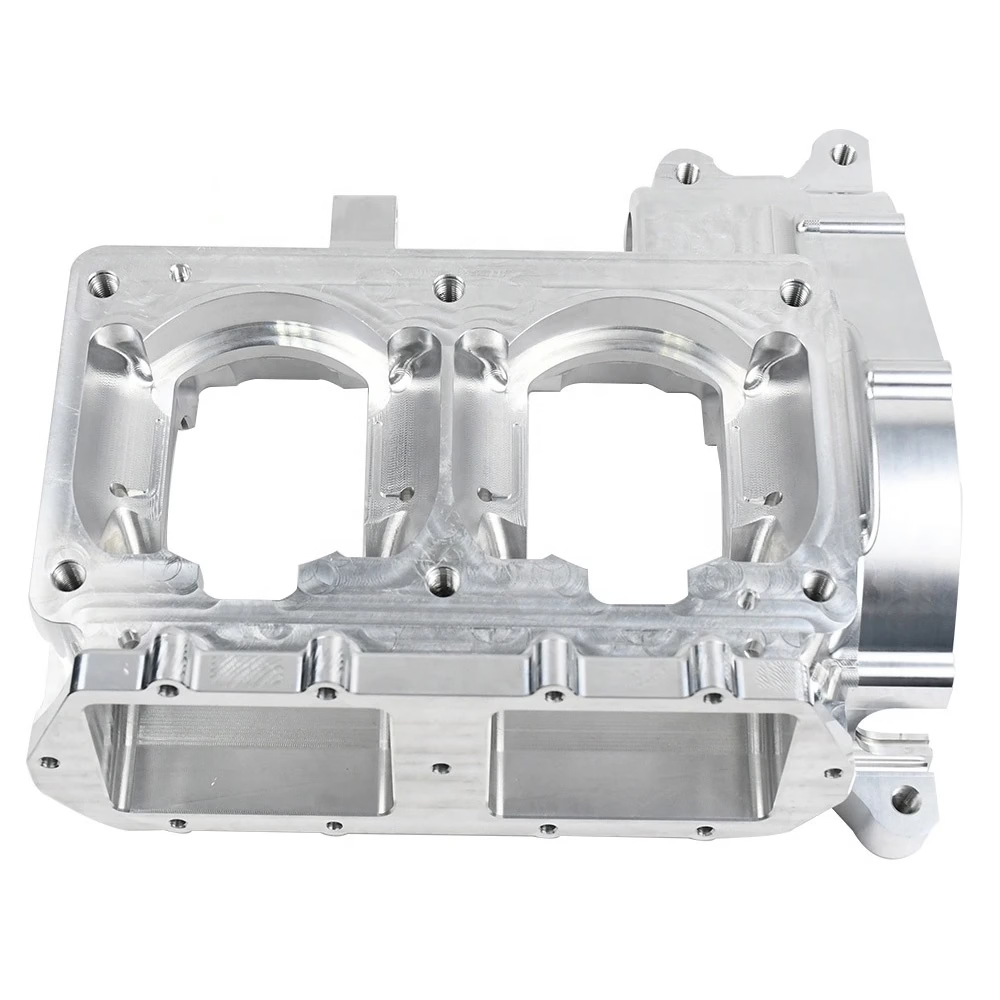
Key takeaways
Advantages and disadvantages of CNC processing: the accuracy side
CNC processing removes material with a cutter whose path is defined by coordinates, not by a human hand. That single fact produces most of the advantages. On our 5-axis machining centers we hold ±0.005 mm (±0.0002 in) on bores and mating faces, and repeat that on part 1 and part 500 without touching the offsets. The operator loads the stock, closes the door, and the same program runs again.
The second advantage is geometry. A 5-axis machine with a Ø400 mm rotary table can reach a port, an undercut or an angled boss that a 3-axis machine cannot, because the tool tilts instead of the part being re-fixtured. Every re-fixture adds error and labor. Tilting the tool removes both.
Surface finish is a dial, not a fixed property. Run a light finishing pass at high spindle speed and you reach Ra 0.2–0.8 μm. Run a roughing pass only and you sit at Ra 1.6–3.2 μm. The difference is minutes of cycle time, and that trade is yours to make per feature.
Material choice is broad. We machine 6061 and 7075 aluminium, 17-4PH stainless, Ti-6Al-4V, Inconel, beryllium copper, PEEK and carbon fibre. A process that cuts Inconel and PEEK with the same machine and the same code base is rare. That range is why CNC stays the default for prototypes and bridge tooling.
- 1RepeatabilityThe 50th part matches the first because nothing is hand-set.
- 2No tooling costNo mold, no die, no pattern. Geometry lives in a file.
- 3Change is cheapA design revision costs an edit and a re-post, not a new tool.
What drives cost in CNC processing
Cycle time is the obvious cost, and it is set by the machine's removal rate. A 4,000 × 400 × 150 mm travel machine roughing a large plate is not the same cost as a 500 × 500 × 450 mm machine cutting a bracket. Bigger travels, slower feeds. Match the part to the smallest machine that fits it.
Tolerance is the less obvious cost. Going from ±0.05 mm to ±0.005 mm means more finishing passes, more inspection, sometimes a temperature-stable room. A single tight bore on an otherwise loose part is affordable. A whole part at ±0.005 mm is not, and it usually does not need to be.
Setup dominates small runs. A fixture, a first-article inspection and a proven program take hours before a single good part exists. On a one-piece prototype that overhead is most of the price. On a 10,000-part run it disappears into the per-part number.
Programming is real labor. Complex 3D surfaces need CAM time, stock models, tool libraries and a proven post. A simple prismatic part can be programmed in an hour. A contoured impeller blade can take most of a day. The file is not free just because the material is.
- 1Feature count beats volumeTen small pockets cost more than one large pocket of the same removed volume.
- 2Deep pockets are expensiveLong, thin tools deflect. They need slower feeds and more passes.
- 3Hard material, slow cutInconel and hardened steel cut at a fraction of aluminium speeds.
Disadvantages of CNC processing you cannot design around
The disadvantages of CNC processing are mostly economic and geometric, and they are predictable. The first is that it is subtractive. Material that is not needed still has to be bought, fixtured and cut away. A part whose final shape is 20 percent of the blank pays to remove 80 percent of it as chips.
Internal cavities are a hard limit. You cannot machine a closed hollow sphere or a bottle with a narrow neck. If a design needs a sealed internal void, it is a casting, a molding or an additive part, not a milling part. No tool path gets inside a closed surface.
Sharp internal corners are another. Every end mill has a corner radius. A square internal corner needs either a radius or a separate EDM operation. Designers who draw true 90° internal corners create a note that will come back as a question.
Volume is the last limit. Cutting one part from solid is efficient at low quantity. At high quantity, a die casting or injection mold amortizes its tooling and wins on unit price. CNC is the bridge, not always the destination.
- 1No closed internal voidsA cavity with no opening cannot be cut.
- 2No sharp internal cornersAdd a radius or plan for EDM.
- 3Thin walls deflectBelow about 0.5 mm, chatter and distortion rise sharply.
How to keep the advantages and avoid the penalties
Design for access. If a cutter cannot reach a feature from at least one direction, that feature will need an extra setup or a different process. A quick check in CAD with a tool diameter equal to the smallest cutter you are willing to pay for shows the problem early.
Loosen tolerance where it does not matter. Call out ±0.005 mm only on the two or three features that mate or seal. Leave the rest at general tolerance. The quote will drop and the function will not change.
Add corner radii to internal pockets. A radius equal to the pocket depth divided by six is a practical starting point. It lets a stiffer tool run at a higher feed and it removes the EDM note from the drawing.
Keep wall thickness uniform. Stepped walls concentrate stress and chatter during the finishing pass. Uniform walls let you run one finishing strategy across the whole part with predictable deflection.
Send a 3D model with the 2D drawing. The model defines the surface, the drawing defines the tolerance and the datum scheme. Both together are what a programmer needs to build a first-article plan.
- 1One setup beats threeDesign features to be reachable from one or two directions.
- 2Datum scheme firstPick datums that exist on the raw stock, not on a finished surface.
- 3Radius the cornersCheaper tool, higher feed, no EDM.
When CNC wins and when it does not
Match the part to the process before quoting.
| Condition | CNC is the right answer | Look elsewhere |
|---|---|---|
| Quantity | 1 to a few thousand parts | Tens of thousands per year |
| Geometry | Open, reachable features | Closed internal cavities |
| Tolerance | ±0.005 mm on key features | Loose tolerance on every feature |
| Material | Metal, engineering plastic, titanium | Soft elastomers, foam |
| Change rate | Design still moving | Design frozen for years |
| Lead time | Days, no tooling | Weeks, tooling required |
| Surface | Ra 0.2–3.2 μm as machined | Textured mold finish required |
| Size | Up to 4,000 mm travel | Beyond machine envelope |
The verdict
If your part is metal or engineering plastic, the design is still moving, and the quantity is under a few thousand, CNC processing is the fast and accurate choice. If the part has a closed internal cavity, needs a textured molded finish, or will run for years at high volume, choose casting or molding and use CNC only for the prototype. Send the model and we will tell you which side of that line it falls on.
Questions engineers ask next
How tight a tolerance can CNC processing actually hold?
On a well-fixtured part, ±0.005 mm (±0.0002 in) is realistic on bores, faces and diameters. That number assumes the datum scheme is clean and the part is not deflecting.
Tighter than that is possible on specific features but it needs temperature control, in-process probing and a longer cycle. Ask whether the function needs it before you ask for it.
Is CNC processing suitable for a single prototype?
Yes. There is no tooling cost, so a one-off part is priced on programming, setup and cycle time. Production can start within 24 hours of an approved program.
The trade is that the first part carries the setup cost. If you plan to make ten revisions, each revision re-pays a smaller version of that cost.
What is the maximum part size you can machine?
Our largest travel is 4,000 × 400 × 150 mm. Other machines cover 750 × 1,150 × 550 mm, 600 × 600 × 600 mm, 500 × 500 × 450 mm and 500 × 310 × 200 mm.
For parts near the limit, check whether the fixture and the tool holder still fit inside the envelope. The travel number is not the usable volume.
Which materials are difficult on a CNC machine?
Titanium and Inconel cut slowly and generate heat at the edge. They need lower surface speed, more coolant and a rigid setup. Cycle time can be several times that of aluminium.
Soft elastomers and foams deflect under cutting force and are better handled by molding or waterjet. Very thin sheet also deflects and often belongs on a laser or punch.
How do I reduce the cost of a CNC part without losing function?
Cut the number of setups, loosen tolerance on non-critical features, and add radii to internal corners. These three changes usually move the quote more than a material swap does.
Also check the blank. A near-net forging or extrusion close to final shape removes roughing time and material waste.
Does CNC processing work for high volume?
It works, but it is rarely the cheapest route once tooling can be amortized. For tens of thousands of parts per year, die casting or injection molding usually wins on unit price.
CNC still has a role in high volume: bridge tooling, secondary operations, and the tight-tolerance features a casting cannot hold.
Send the model, get a manufacturability answer
We review geometry, tolerance and material, then return a quote with a free DFM analysis within 12 hours. No minimum order quantity, from one prototype to 10,000+ part runs.
12-hour quote100% inspectionNDA on request
More from the shop floor
We publish setup notes, tooling trials and inspection data from the factory floor.











