
Advantages and Disadvantages of Combined CNC Machining
Combined CNC machining means one machine does milling, turning, drilling and sometimes grinding in a single setup. This page is written for engineers and buyers who need to decide whether that setup fits their part. You will see where the method wins, where it burns money, and which part features decide the answer.
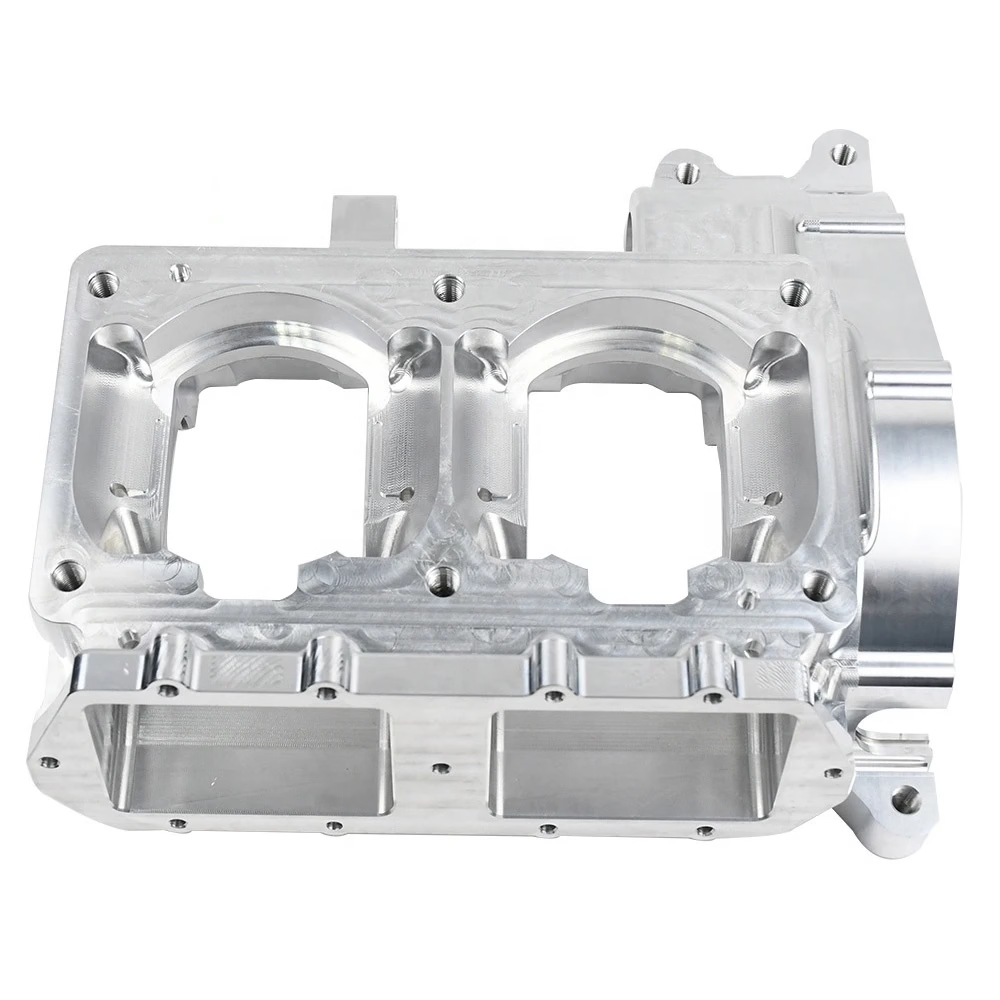
What 'combined' actually means on the shop floor
Combining operations is a setup strategy, not a single machine type. That is why the pros and cons shift from part to part.
One setup, several operations
In a mill-turn center, the spindle turns the part while a milling head cuts flats, slots and cross-holes. The part never leaves the chuck, so position stays locked to the same datum from first cut to last. Add a subspindle and the back face gets finished without a second fixture. That is what combined means in practice.
The alternative is a sequence: lathe, then mill, then drill, then maybe a grinder. Every move between machines adds a re-clamp, a new zero, and a chance for error to stack. With a 4,000 mm maximum processing size and 16 simultaneous 5-axis machining centers, we can keep long parts in one envelope instead of splitting the work.
Combined setups are not only about accuracy. They cut queue time. A part that would visit three machines over four days can finish in one shift on a single platform. For a prototype run of one to twenty pieces, that difference often decides the delivery date.
- 1Turn-mill platformLive tooling and a B-axis head handle milling on a turned part
- 25-axis platformTrunnion and rotary table reach five faces in one setup
- 3SubspindleBack-face work runs while the main spindle cuts the front
- 4Bar feederSuits small turned parts in runs up to 10,000+ pieces
Where combined machining pays off
Datum control is the biggest gain. A valve body with bores on two axes normally needs two fixtures and two zero points. Cut it in one setup and the bore-to-bore position depends on the machine, not on how well the operator reloaded the part. We hold ±0.005 mm on critical features this way, and the spread across a batch stays tight.
Cycle time drops for parts with features on several faces. The tool changes direction instead of the part changing machines. For a housing with 14 holes on four faces, the difference is measured in hours, not minutes. Setup labor also falls: one program, one fixture, one operator.
Fewer setups means fewer scrapped parts. Each re-clamp is a chance to ding a finished surface or load a chip under the jaw. Combined machining removes most of those chances. Our qualification rate of 99.99% comes from exactly this kind of control, plus 100% inspection before shipment.
The method also opens geometry that a 3-axis machine cannot reach. Undercuts, compound angles, and blended surfaces on a titanium bracket are routine on a 5-axis platform. TA1, TA2 and TC4 (Ti-6Al-4V) all machine well when the cutter stays engaged and the setup does not shift.
- 1One datumBores and faces stay aligned without re-fixturing
- 2Less queue timeOne machine replaces three or four in the routing
- 3Complex geometryCompound angles and undercuts become reachable
- 4Lower handling riskFewer clamps mean fewer dents and scratches
Where the method costs you
Machine time is expensive. A mill-turn center runs at a higher hourly rate than a standalone lathe or 3-axis mill. If your part is a simple shaft with one cross-hole, combined machining is the wrong call. Split the work across a lathe and a drill and the price drops.
Programming takes longer. Five-axis toolpaths need collision checks, and post-processors are machine-specific. A part that takes one hour to program for 3-axis may take four for a full 5-axis routine. For a one-off bracket, that engineering time can exceed the machining time.
Fixtures and tooling add cost. Live toolholders, angle heads and custom soft jaws are not cheap. On a run of five parts, the tooling can dominate the quote. This is why we look at quantity before recommending a combined route.
Not every shop can run it. The method needs programmers who understand both turning and milling, and operators who can set up a subspindle without crashing it. That skill gap is real. It is also why some quotes come back high or late.
- 1Higher hourly rateMill-turn and 5-axis time costs more than 3-axis time
- 2Longer programmingCollision checks and posts add engineering hours
- 3Tooling investmentLive tooling and soft jaws raise the entry cost
- 4Skill dependentPoor setup wipes out the accuracy gain
When to combine and when to split
Match the routing to the part, not to the machine list.
| Part feature | Combined routing | Split routing |
|---|---|---|
| Bores on two or more axes | One setup, datum held | Two fixtures, stack-up risk |
| Simple shaft, one cross-hole | Overkill, higher rate | Lathe plus drill, cheaper |
| Run of 1 to 20 pieces | Wins on queue time | Wins only if tools are simple |
| Run of 10,000+ pieces | Bar feeder plus subspindle | Transfer line if volume is huge |
| Titanium or Inconel part | Rigid setup, fewer re-clamps | Re-clamp marks hard to remove |
| Thin-wall aluminium housing | Light passes, one clamp | Re-clamping distorts walls |
| Loose tolerance, ±0.1 mm | Setup cost not justified | 3-axis is enough |
What the material does to the decision
Aluminium is forgiving. Grades like 6061, 7075 and 6082 cut fast, so the cycle-time gain from combining is smaller. The real benefit is geometry: a 5-axis head reaches pockets that a 3-axis machine cannot. For a 6061 housing with angled ports, that alone justifies the route.
Stainless and tool steel push the other way. Grades such as 316L, 17-4PH and 4140 work-harden and generate heat. Each extra setup means another thermal cycle and another chance for the part to move. Keeping the work in one chuck reduces that. It also lets us hold Ra 0.8–1.6 μm on a bored face without a second op.
Titanium and Inconel are the clearest case for combining. TA1, TA2 and TC4 (Ti-6Al-4V) are expensive, and a scrapped part hurts. One rigid setup with constant cutter engagement protects the surface and the tolerance at the same time. If the geometry allows it, we would rather cut it in one pass than move it twice.
Plastics behave differently. POM and PEEK move with clamp pressure, so fewer clamps is a genuine quality gain. ABS and PC are soft enough that a re-clamp can mark a finished face. Combined machining avoids that by leaving the part in place until the last feature is cut.
- 1AluminiumFast cutting, geometry is the main reason to combine
- 2Stainless and steelFewer setups limit heat cycles and movement
- 3Titanium and InconelCost of scrap makes one-setup work attractive
- 4PlasticsLess clamping pressure means less distortion
How we decide on a quote
We start with the feature map. Count the faces that carry tolerance, then count the setups a split routing would need. If that number is three or more, combined machining usually wins on total cost, even at a higher hourly rate. If it is one or two, we quote the simpler route.
Quantity comes next. A single prototype can justify a 5-axis routine because there is no fixture to amortize. A run of 500 identical brackets often does better on a 3-axis with a dedicated fixture. Our quote and free DFM analysis within 12 hours includes a note on which route we chose and why.
We also look at inspection. A combined setup produces features that are hard to measure after the part is split across machines. Keeping the datum intact makes CMM work simpler. Raw material check, in-process monitoring and final inspection are standard, and reports are available on request.
There is no minimum order quantity here. One prototype and a 10,000-part run both go through the same review. Production can start within 24 hours, and parts ship in 3–5 days. That pace only holds if the routing is right from the start, which is why the setup decision matters more than the machine choice.
- 1Feature map firstCount tolerated faces before choosing a route
- 2Quantity checkAmortize fixtures only when the run supports it
- 3Inspection planOne datum makes CMM work easier
- 4No MOQOne piece or 10,000+, same review process
Common questions
Is combined CNC machining always more accurate than a split routing?
No. It is more accurate when the tolerance crosses between faces. If two bores must stay aligned, one setup removes the re-clamp error.
If the part is a simple shaft with a single hole, a split routing holds the same tolerance for less money.
What part size can you handle in one setup?
Our largest travel is 4,000 × 400 × 150 mm on a mill-turn platform. Medium and compact envelopes cover 750 × 1,150 × 550 mm, 600 × 600 × 600 mm, 500 × 500 × 450 mm and 500 × 310 × 200 mm.
A Ø400 mm rotary table handles round parts that need work on the periphery.
Does a combined setup reduce the number of operations I pay for?
It reduces setups, not operations. The machine still drills, mills and turns, but the part stays in one place.
You pay a higher hourly rate for fewer hours and less handling. On parts with three or more tolerated faces, the total usually comes out lower.
Which materials are a poor fit for combined machining?
Very soft plastics and free-machining brass often do not need it. The accuracy gain is small and the rate is higher.
Hardened tool steel above 45 HRC is better ground after machining, so combining only covers the soft state.
How do you handle confidentiality on a new part?
Uploads are secure and confidential. We do not share drawings or models outside the project team.
An NDA is available on request before you send files.
Can you quote both routings so I can compare?
Yes. Tell us the annual volume and the critical tolerances, and we will price the combined route and the split route.
The quote and free DFM analysis come back within 12 hours.
Send the drawing, get a routing opinion
We will tell you whether combining the operations saves money on your part, and quote both routes if the answer is close.
12-hour quoteFree DFM analysis100% inspectionNo minimum order









