
Advantages and Disadvantages of Machine Tools and CNC Principles to Follow
A practical comparison of manual machine tools and CNC for engineers and buyers who need to choose a process. We cover where each one wins, where it costs you, and the CNC principles worth keeping on the shop floor.
What This Page Covers
Manual machine tools, CNC machine tools, and the rules that decide which one suits a given part.
Advantages of Manual Machine Tools
A manual lathe or mill still earns its floor space. Setup is fast when the geometry is simple: a shaft, a bushing, a spacer, a fixture plate with a few holes. The operator feels the cut through the handwheel, hears chatter start, and backs off before the tool breaks. That feedback loop is hard to program.
Cost is the other obvious advantage. A used manual mill costs a fraction of a CNC machining center, needs no programmer, and runs on a standard power drop. For one-off repair work in a maintenance shop, that math rarely changes.
Tooling is simple too. HSS cutters, a chuck, a vise, a set of gauges. No post-processor, no fixture design review, no CAM seat. When a machine goes down at 2 a.m., a maintenance tech can often fix it with hand tools.
None of this means manual machines hold tight tolerance on complex parts. It means they hold the right tolerance on the right part. The judgment is about part count, geometry, and how often the drawing will change.
- 1Best fitOne-offs, repair work, simple turning and facing, fixture building
- 2Typical tolerance±0.05 mm with a skilled operator, looser on deep bores
- 3Setup timeMinutes, not hours, when no fixture is needed
- 4Floor costLow machine price, low maintenance, no CAM seat
Advantages of CNC Machine Tools
CNC changed what a machine tool can hold. The controller moves the axis to the same coordinate on part 1 and part 4,000. Repeatability, not just accuracy, is the real gain. On our 16 simultaneous 5-axis centers, a single setup can reach features on five faces and hold ±0.005 mm on critical bores.
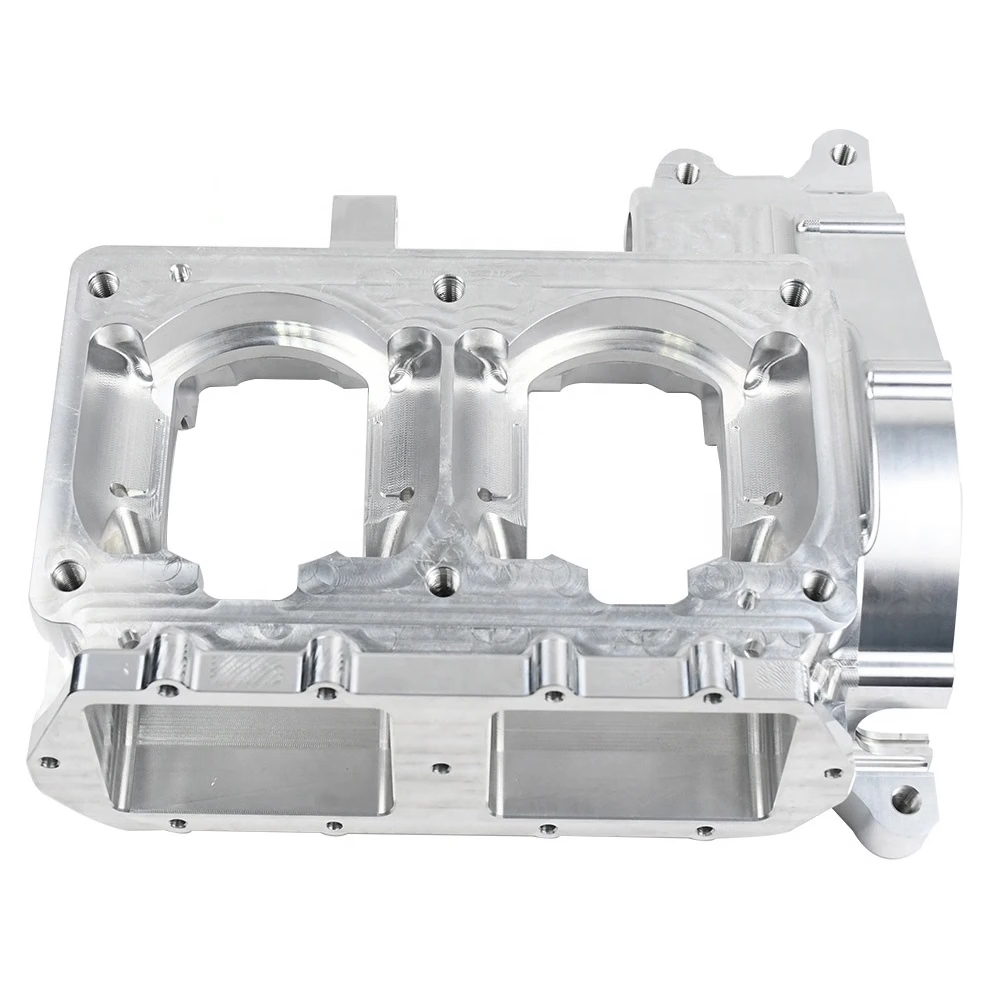
Complex geometry stops being a cost problem. A contoured impeller, an angled port, a thin-wall housing with a blended fillet: these are CAM work, not years of hand skill. Four-axis mills and mill-turn centers cut parts that would need three or four manual setups otherwise, and each setup is a chance to lose position.
Throughput follows. Once the program is proven, the machine runs unattended for hours. One operator can tend several machines, which is how a shop scales without hiring a machinist for every spindle.
Surface finish is more consistent as well. With the right cutter and stepover, we hold Ra 0.8–1.6 μm as a routine finish and Ra 0.2–0.8 μm where the drawing calls for it.
- 1RepeatabilitySame coordinate on every part in the run
- 2Complex geometry5-axis and mill-turn cut features manual setups cannot reach
- 3Unattended runningOne operator can tend multiple machines
- 4Finish controlRa 0.8–1.6 μm routine, Ra 0.2–0.8 μm on request
Disadvantages of CNC Machine Tools
The first cost is capital. A 5-axis machining center, a tool holder package, a CAM seat, and the floor space to hold them add up before the first chip. That money has to come back on part volume or on parts that manual machines simply cannot make.
Programming is the second cost. Someone has to build the model, choose the toolpath, and prove it out. On a simple part, the CAM time can exceed the cutting time. This is why a shop with one prototype and a tight deadline sometimes still reaches for a manual mill.
Fixtures are the third. A CNC will do exactly what the program says, including driving a tool into a weak setup. Soft jaws, vacuum plates, and custom fixtures take design time and are often part-specific.
Then there is the knowledge trap. A CNC makes it easy to cut a wrong part very fast and very consistently. If the model is wrong, the whole run is wrong. First-article inspection is not optional, and neither is catching a drawing error before the program runs.
- 1Capital costMachine, tooling, CAM seat, floor space, and power
- 2Programming timeCan exceed cutting time on simple parts
- 3FixturingCustom workholding adds cost and lead time
- 4Error scalingA bad program repeats the same mistake across the run
CNC Principles to Follow on the Floor
Keep the setup rigid. Most tolerance problems show up as chatter, deflection, or a part that moves in the vise, not as a controller error. Short tool overhang, a solid vise, and a clean table beat a faster feed rate every time.
Cut in the right direction. Climb milling puts the chip load where the cutter is strongest and usually gives a better finish on the side wall. Conventional milling still has a place on work-hardened stainless and on some finishing passes, but it is a choice, not a default.
Control the heat. Roughing at a heavy chip load and then finishing with a light pass keeps the part from moving as it cools. On thin-wall aluminum, that sequence matters more than the spindle speed.
Measure before the run, not after. We check raw material, monitor in-process dimensions, and do a 100% inspection before shipment. Reports are available on request. The goal is to catch a drift on part 20, not to scrap the run at part 400.
- 1Rigidity firstShort overhang and solid workholding before feed changes
- 2Direction mattersClimb milling for finish, conventional where material demands it
- 3Heat controlHeavy rough, light finish to limit thermal movement
- 4Inspection pointsMaterial check, in-process monitoring, final 100% check
Manual vs. CNC Machine Tools: When to Use Which
Use the part count, geometry, and tolerance band as the deciding factors.
| Factor | Manual machine tool | CNC machine tool |
|---|---|---|
| Part count | 1–5 pieces, repair work | Prototype to 10,000+ parts |
| Geometry | Straight turning, facing, simple holes | Contours, 3D surfaces, 5-face features |
| Tolerance | ±0.05 mm with a skilled operator | ±0.005 mm on critical features |
| Setup time | Minutes for a simple part | Hours with CAM and fixture design |
| Per-part cost | Low for one, high for many | High for one, low for many |
| Finish | Depends on operator feel | Ra 0.8–1.6 μm routine, repeatable |
| Best for | Maintenance shops, tool rooms | Production runs and complex parts |
Common Questions
Which machine tool should we choose for a prototype?
For a metal prototype with simple geometry, a manual lathe or mill can be faster because there is no CAM step. Once the part has contours, tight tolerance, or several faces to machine, a CNC is the better call.
Most prototypes we see fall in the second group, so they run on a 3-axis or 5-axis machine from a CAD model.
Do CNC machine tools always beat manual machines on cost?
No. On a single repair part, a manual machine usually wins because programming and fixturing dominate the cost. CNC wins when the same setup runs many parts or when the geometry cannot be cut by hand.
What tolerance can be held without a special setup?
On a rigid setup with a proven program, we hold ±0.005 mm on critical features and Ra 0.8–1.6 μm as a standard finish. Tighter bands need a dedicated fixture and a process review before the run starts.
How do you keep a CNC run from producing a whole batch of bad parts?
First-article inspection and in-process monitoring. We check raw material on arrival, measure during the run, and inspect 100% before shipment. If a dimension drifts, it is caught on the next part, not at the end of the batch.
Can you machine parts too large for a standard machine tool?
We machine up to 4,000 mm on the large-travel machines, with medium travels of 750 × 1,150 × 550 mm and 600 × 600 × 600 mm. A Ø400 mm rotary table handles parts that need multi-face access.
What materials do you run on these machines?
Aluminum 6061, 7075 and 6082, stainless 303, 304 and 17-4PH, alloy steels, copper and brass, titanium TC4, Inconel, and engineering plastics such as POM and PEEK. Each material changes the cutter, the speed, and often the fixture.
Send the Drawing, Get a Process Plan
Upload a CAD file and we will review the geometry, pick the machine tool, and return a quote with DFM notes within 12 hours.
12-hour quote100% inspectionNDA on requestNo MOQ









