
Principles of purchasing CNC machine tools
This page is for engineers and shop owners who have to justify a machine purchase with numbers, not brochures. It covers the five principles that decide whether a machine fits your parts, your tolerance band and your floor space. After reading it, you should be able to reject two or three candidates before you ever ask for a price.
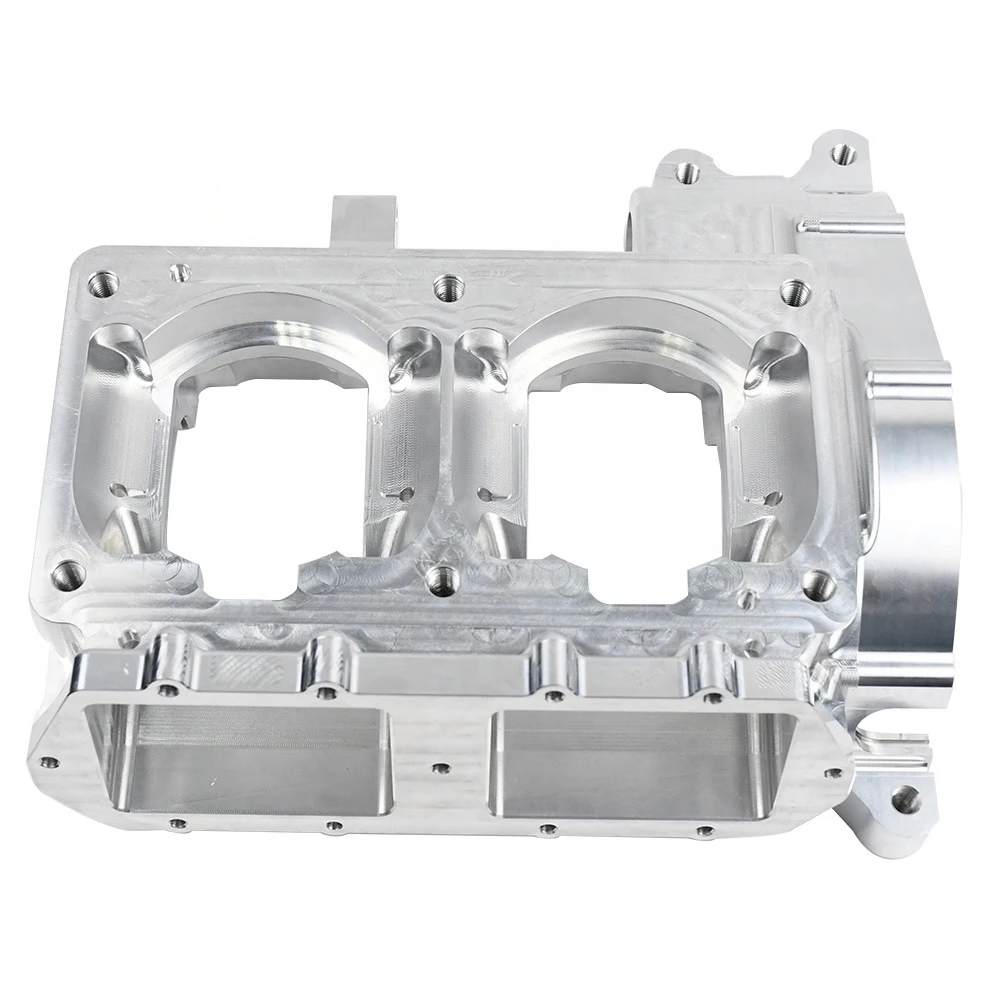
Key takeaways
Match machine type to part geometry
Start with the part, not the catalog. Print the drawing, then mark every face that needs machining and every feature that is hidden behind another feature. A bracket with three open faces and no undercuts is a three-axis job. A housing with ports on five sides and a curved internal channel is not.
The number of setups is the first cost driver. Each re-clamp adds fixture time, adds stack-up error and adds a chance of a scrapped part. If a part needs four setups on a three-axis mill, a five-axis machine may pay back within a year on labor alone.
Size matters as much as shape. A 4,000 mm long weldment will not fit a machine with 750 mm of X travel, no matter how accurate it is. Check travel against the part envelope plus the fixture, then add clearance for tool access.
Do not buy for the part you have today if the pipeline already shows a different family. Write down the three part families you expect to quote over the next two years, and pick the machine that covers at least two of them well.
- 1Undercuts and back-side holesIf they exist, price a five-axis option before you commit to a three-axis mill.
- 2Part envelopeAdd fixture height and tool length to the part size, then compare with axis travel.
- 3Setup countEvery extra clamp is labor plus a new tolerance stack.
Read the tolerance band, not the headline number
A machine rated at ±0.005 mm holds that number under specific conditions: stable temperature, light finishing cuts and a warm spindle. In a shop with a 10 °C swing between morning and afternoon, thermal growth alone can eat most of that band on a 500 mm part.
Ask what the accuracy figure refers to. Positioning accuracy, repeatability and volumetric accuracy are three different measurements. Repeatability is usually the tightest number and the least useful on its own, because it says nothing about how far the tool lands from the commanded position.
Surface finish is linked to the same physics. Ra 0.8–1.6 μm is a normal target for a well-tuned mill on aluminum. Pushing to Ra 0.2–0.8 μm usually needs a finer stepover, a balanced tool holder and a machine with low vibration at the spindle nose.
Match the band to the drawing, not to the sales sheet. If the tightest callout on your part is ±0.05 mm, a ±0.005 mm machine is money you cannot recover. If the callout is ±0.01 mm, buy the accuracy and control the room temperature.
- 1Positioning vs repeatabilityRepeatability tells you scatter, not offset. Ask for both.
- 2Thermal driftA 10 °C room swing moves a 500 mm steel part by roughly 0.06 mm.
- 3Finish targetsRa 1.6–3.2 μm as-machined, Ra 0.8–1.6 μm with a finishing pass.
Count axes against real features
Three-axis machines cover most prismatic parts. They are cheaper to buy, cheaper to tool and easier to program. For a plate with drilled holes and a milled pocket, adding a fourth or fifth axis changes nothing except the invoice.
A fourth axis adds value when the part is long and needs features on multiple sides around one centerline. A shaft with cross-drilled holes is the classic case. The rotary table turns the part instead of the operator turning the fixture.
A fifth axis earns its place when the tool has to reach an angled face without a special fixture. Deep pockets with tapered walls, impeller blades and medical housings are typical. The trade-off is programming time and the need for post-process verification, because a wrong tool vector scraps the part fast.
Simultaneous five-axis is not the same as 3+2 positioning. If your parts need continuous contouring on a curved surface, confirm that the control supports full simultaneous motion. Many machines can index to an angle but cannot cut smoothly through it.
- 13-axisPrismatic parts, open faces, tight budget.
- 24-axisShafts and parts with features around one axis.
- 35-axisAngled faces, undercuts and contoured surfaces without extra fixtures.
Check the support chain before the spindle
A machine is a system: spindle, control, drives, tool holders, coolant and the person who answers the phone at 9 pm. The weakest link sets your uptime, and it is often not the iron.
Ask how long a spindle swap takes and who does it. If the answer involves an overseas flight and a three-week window, price that risk into the decision. A slightly slower machine with local service is often the cheaper machine over five years.
Tooling is part of the purchase. Confirm the taper size, the pull stud standard and whether your existing holders will fit. A machine that needs a full new holder set adds cost that never appears on the quotation.
Consumables and spares should be listed with lead times. Filters, way covers, belts and spindle bearings are the items that stop a machine, and they are the easiest to forget during evaluation.
- 1Service responseAsk for the actual response time in your region, in writing.
- 2Tool holder compatibilityConfirm taper and pull stud before you order the machine.
- 3Spare parts listGet lead times for bearings, belts and way covers.
Cost the machine over five years, not one
Purchase price is the smallest number in the ownership equation. Power, coolant, compressed air, tooling, labor and floor space all run for the life of the machine.
Estimate the hourly rate honestly. A machine that costs twice as much but runs unattended through a second shift can have a lower cost per part than a cheap machine that needs an operator at all times.
Floor space is real money. A large machine with a chip conveyor, coolant tank and tool cart can occupy 20 m² or more. If the building is full, the true cost includes a new lease.
Finally, think about resale and flexibility. A common control and a standard taper hold value. A one-off configuration is hard to sell and hard to reprogram when the product line changes.
- 1Hourly rateInclude power, coolant, air, tooling and operator time.
- 2Floor spaceMeasure the full footprint with conveyors and tanks.
- 3Resale and flexibilityStandard controls and tapers keep options open.
Machine type against part and volume
Use this as a first filter, then verify with a test cut.
| Machine type | Best fit | Weak spot | When to skip it |
|---|---|---|---|
| 3-axis mill | Prismatic parts, open faces, low to mid volume | Needs multiple setups for side features | Part has undercuts on four or more sides |
| 4-axis mill | Shafts and parts with features around one axis | Limited reach on angled faces | Geometry needs simultaneous contouring |
| 5-axis simultaneous | Angled faces, impellers, medical housings | Higher programming and verification cost | Part is a simple plate with drilled holes |
| Mill-turn | Round parts with milled features in one setup | Longer setup and programming time | Part is fully prismatic with no turning |
| Large gantry | Weldments and frames up to 4,000 mm | Slow acceleration, large footprint | Part fits in 750 mm of travel |
The verdict
If your part needs three or more setups and holds a tolerance tighter than ±0.02 mm, buy the five-axis machine and control the room. If the part is a simple plate and the tolerance is ±0.05 mm, buy a three-axis mill and spend the rest on tooling and spindles. Do not buy the middle machine for both jobs.
Questions buyers ask before signing
How do I compare two machines with different accuracy claims?
Ask both vendors for the same three numbers: positioning accuracy, repeatability and volumetric accuracy, measured under the same standard.
Then ask for the test conditions: room temperature, spindle warm-up time and feed rate. A number without conditions is a marketing claim, not a specification.
Is a five-axis machine worth it for low-volume work?
It depends on setup count. If the part needs four clamps on a three-axis mill and one on a five-axis machine, the labor saving is immediate, even at low volume.
If the part needs one setup either way, the five-axis premium is hard to recover. Use a three-axis machine and invest in fixtures.
What floor space should I plan for?
Measure the machine footprint, then add the chip conveyor, coolant tank, tool cart and operator access. A compact vertical mill can need 12 m² of usable floor.
Leave room for the largest part you expect to load, plus a walkway. A machine you cannot load safely is a machine you cannot run.
How do I check spindle and axis condition on a used machine?
Cut a test part with a known geometry, then measure it. A circle-diamond-square test shows contouring errors that a static check misses.
Check backlash on each axis, listen for spindle noise at low and high rpm, and inspect the way covers for chips. Way cover damage usually means the linear guides have seen debris.
When should I outsource instead of buying?
If the part family is still changing, or the annual volume is below the point where the machine pays for itself, outsourcing keeps capital free.
A supplier with 127 high-precision CNC machines and 15 years of experience can absorb the trial-and-error that a first machine purchase would put on your team.
Send your drawing, get a machinability answer
Upload a part and we will tell you which machine type fits, what tolerance is realistic and where the cost sits. No minimum order quantity, from one prototype to 10,000+ part runs.
12-hour quote100% inspectionNDA on request
More from the shop floor
We publish setup notes, tooling trials and inspection data from the factory floor.











