GreatLight CNC Machining Factory logo
CNC Machining
Rapid Prototyping
Materials
Industries
News
About GL

Get Instant Quote

Supply chain operations

AI in Supply Chains

Most AI projects in supply chains stall on data, not algorithms. We quote machined parts from a verified digital file in 12 hours, so the physical side of your supply chain stops being the variable.

Tolerance to ±0.005 mmNo MOQISO 9001 / IATF 169493–5 day shippingNDA on request
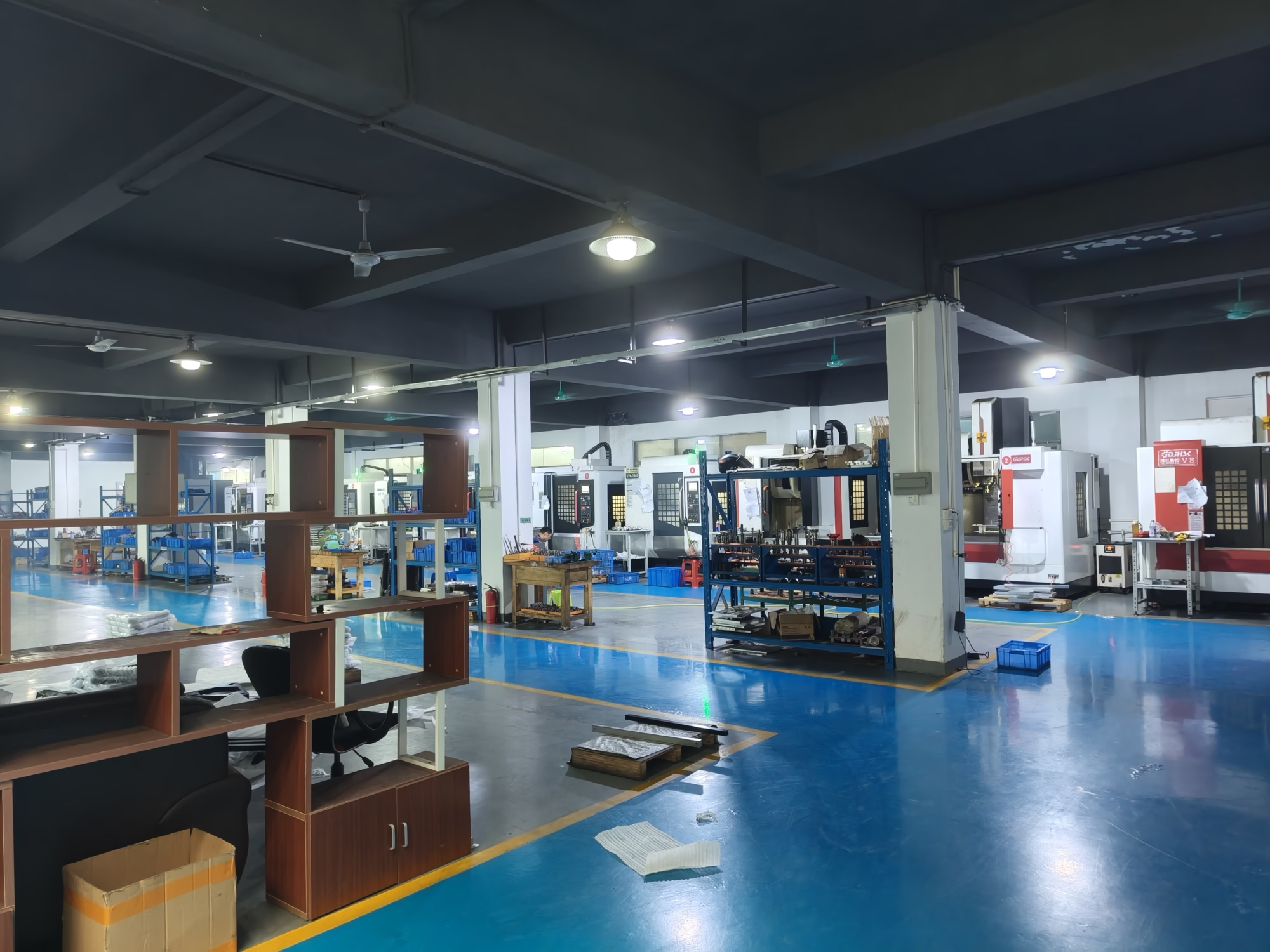
GreatLight Metal new factory building
127High-precision CNC machines
±0.005 mmAchievable tolerance
12 hQuote and free DFM analysis
3–5 daysTypical part shipping
Where it breaks

Four failures that stall AI in supply chains

These show up before any model gets trained.

01

Your data disagrees with itself

Inventory sits in one system, sales orders in another, and supplier confirmations in email. The same part number carries three different lead times. A forecast model trained on that mix returns numbers nobody trusts, so planners go back to the spreadsheet.

02

The ERP only updates once a shift

A legacy ERP refreshed at the end of each shift cannot feed a predictive model that needs fresh machine or inventory states. Integrating it means custom middleware, and that middleware becomes another system to maintain. Weekly batch planning survives this. Real-time optimization does not.

03

Nobody was trained to read the output

A procurement manager who has run RFQs by hand for a decade now gets a probability score for a supplier delay. Without a session on how the score is built, the score gets ignored. Upskilling in data literacy is not optional. It is the difference between a tool in use and a tool in a drawer.

04

The team expects to be replaced

Fear of automation kills adoption faster than bad software. When planners believe the model is being trained to remove them, they feed it bad inputs or route around it. That resistance is a management problem, not a data science problem. Name what changes and what does not.

What we control

Make the physical side of the supply chain deterministic

You cannot fix your ERP in a quarter. You can stop losing weeks to parts that arrive late or out of spec.

CNC Machining Services Online
Digital thread

A quote that is a real engineering review, not a price list

Every upload gets checked against the geometry before anyone quotes it. We look at wall thickness, tool reach, deep pockets, and the datum scheme on your drawing. If a feature needs a 5-axis setup or a different stock size, that shows up in the DFM notes within 12 hours, along with the revised cost.

This matters when your planning model assumes a part is buildable as drawn. A quote that hides a manufacturability problem shifts the risk downstream, and the delay lands in the same schedule your AI is trying to optimize. Getting the review early keeps the assumption honest.

  • 1
    12-hour turnaroundQuote plus free DFM analysis on the same file.
  • 2
    No MOQOne prototype or a 10,000+ part run, same process.
  • 3
    Secure uploadsFiles stay confidential; NDA available on request.

Get Instant Quote

CNC Lathe Technical Specifications Terminology
Process control

Tolerances that hold on the 5th part and the 500th

Sixteen simultaneous 5-axis machining centers and sixteen mill-turn centers cover the geometry that three-axis work cannot reach in one setup. Fewer setups means fewer datum shifts, and datum shifts are where a part drifts out of tolerance between the first article and the production run.

Inspection is not a final gate you hope passes. Raw material is checked on arrival, dimensions are monitored during the run, and every part is inspected before it ships. Reports are available on request. If your supply chain model treats incoming quality as a fixed probability, this is the number that sets it.

  • 1
    Tight geometryØ400 mm rotary table and 4,000 mm maximum part length.
  • 2
    Repeatable finishRa 0.8–1.6 μm for sealing and bearing surfaces.
  • 3
    Verified output100% inspection before shipment, reports on request.
Fit the method to the part

Which process fits which part

Pick the route before you pick the supplier.

Part conditionProcessWhy
Complex geometry, one setup5-axis machiningReaches angled faces without re-fixturing
Round parts, tight concentricityMill-turnTurning and milling in a single cycle
Thin walls, low volume3-axis + fixtureCheaper setup when access is open
Sheet panels, bracketsSheet metal fabricationFaster than cutting from billet
Plastic covers, small batchVacuum castingTooling cost stays low
Die-cast housingsMetal die castingVolume parts with a stable wall
Prototype in daysRapid prototypingProves fit before hard tooling
Capabilities

Services behind the parts you plan for

One supplier for the operations that normally sit across four vendors.

01

5 Axis CNC Machining

Sixteen simultaneous 5-axis centers for contoured faces, impellers, and parts that need five sides in one setup.

02

CNC Milling & Turning

Three-axis, four-axis, and mill-turn capacity across 127 machines, from single prototypes to 10,000+ part runs.

03

Rapid Prototyping

Fit and function checks before hard tooling, so a design error does not become a schedule slip.

04

Sheet Metal Fabrication

Brackets, panels, and enclosures when the part is flat stock rather than a machined body.

05

Custom 3D Printing

Low-volume plastic and geometry that milling cannot reach, useful for jigs and covers.

06

Part Surface Finishing

Anodizing, plating, powder coating, bead blasting, and laser marking, with a 1.5 mm minimum character height.

Scope

What a job includes

Same inclusions whether you order one part or ten thousand.

ItemDetail
MaterialsAluminium, stainless, steel, copper, brass, titanium, plastics
ToleranceDown to ±0.005 mm (±0.0002 in) where the drawing allows
Finish rangeRa 0.2–0.8 μm fine, up to Ra 3.2 μm as machined
Order sizeNo minimum order quantity
Lead timeProduction start within 24 hours; parts ship in 3–5 days
DocumentationInspection reports on request; NDA available
Why GreatLight

Numbers that hold up under audit

Fifteen years of machining, three plants, one process standard.

15Y

Machining since 2011

Fifteen years of production work across aerospace, automotive, medical, and robotics parts. The process library is written down, not carried in one person's head.

3

Wholly-owned plants

7,600 m² of manufacturing space in Dongguan plus a Singapore factory, so capacity is ours to schedule rather than rented from a broker.

150

Technicians on staff

Programmers, machinists, and inspectors in one organization. Questions about a drawing go to the person who will cut it.

99.99%

Qualification rate

Measured across shipped production. That is the incoming quality assumption your planning model can actually use.

4

Quality certifications

ISO 9001:2015, IATF 16949:2016, ISO 13485:2016, and ISO 27001:2022 cover process, automotive, medical, and data handling.

<2%

Historical late-delivery rate

Below 2% across past orders. Not a promise, a record. Batch size does not change how the schedule is built.

7,600 m²Manufacturing space
127CNC machines
16Simultaneous 5-axis centers
4,000 mmMaximum processing size

Industry fit

What each sector requires, and what we deliver

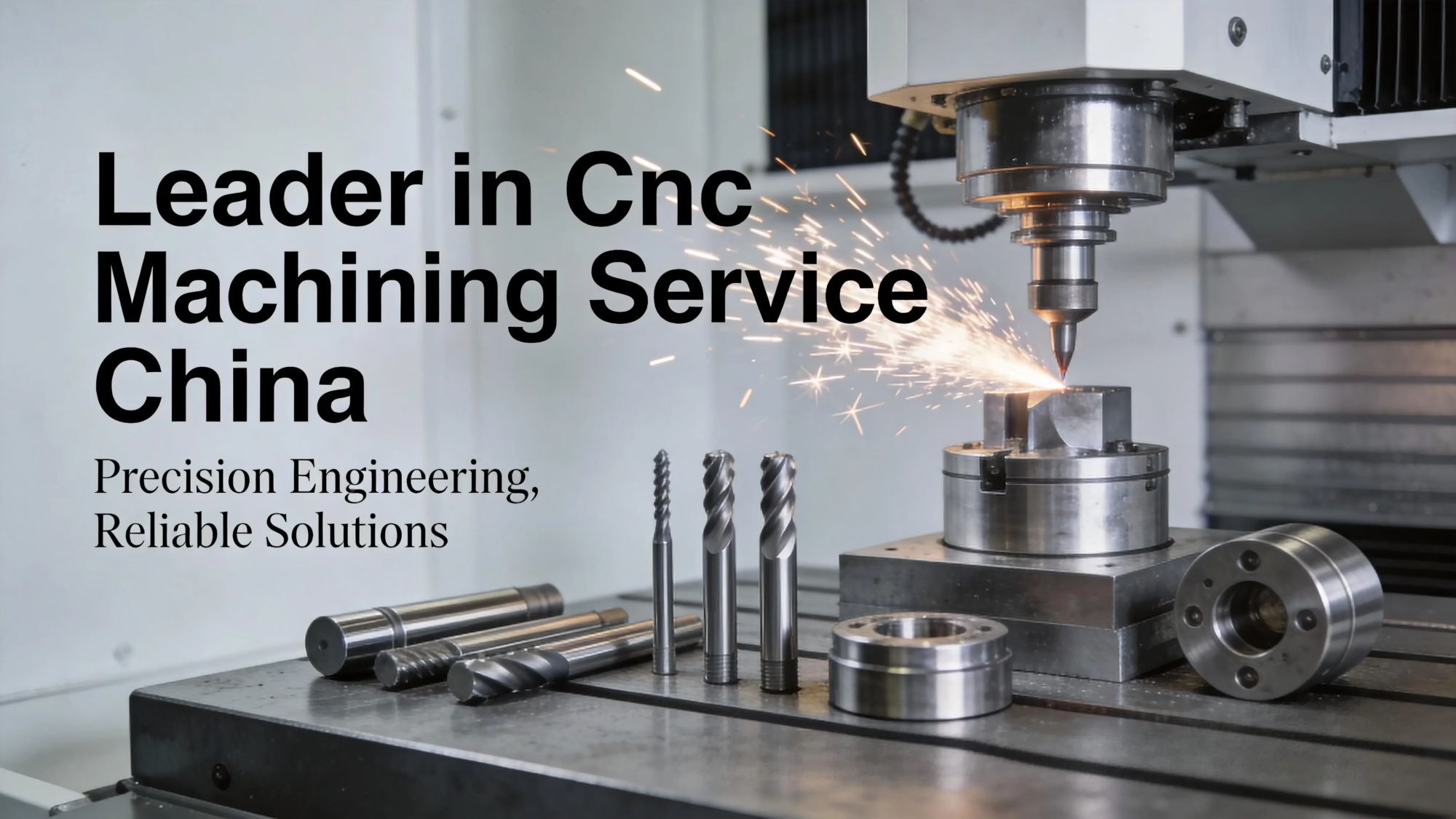
Leader in Cnc Machining Service China

Aerospace

Lightweight structural parts and brackets where traceability and dimensional repeatability are the entry requirement.

  • ±0.005 mm
  • Inspection reports on request
  • ISO 9001:2015
oplus_262178

Automotive & EV

Housings, brackets, and fixtures in aluminium and steel, run against an IATF-bound process and documented in-process checks.

  • IATF 16949:2016
  • 99.99% qualification
  • Ra 1.6–3.2 μm
6011

Medical Devices

Small stainless and titanium components with repeatable finishes on sealing and sliding surfaces, produced under ISO 13485 process control.

  • ISO 13485:2016
  • Ra 0.2–0.8 μm
  • 17-4PH / 316L
cnc machining

Robotics & Automation

Joint housings, end-effector plates, and gearbox parts that need five-sided access and tight bore alignment.

  • 5-axis in one setup
  • Ø400 mm rotary table
  • No MOQ
FAQs

Questions engineers ask before switching

We already have AI planning tools. Where do machined parts still break the plan?

Most planning models assume an incoming part meets the drawing on the date it was promised. When either assumption fails, the model is not wrong, its input is. That is the part of the chain we control.

We return a quote and DFM notes in 12 hours, start production within 24 hours, and ship in 3–5 days. If a feature cannot be machined as drawn, you hear it before the order, not after the first article.

How do we integrate your output into our ERP without custom middleware?

We keep it simple. You get the machined part, a packing list, and inspection reports on request. The data that matters to a planning system is dimensional, and it is in the inspection report rather than buried in a portal.

If your team wants structured data, tell us the field format at the quote stage. We would rather agree on that before the run than after.

What tolerance can you actually hold on a production run?

Down to ±0.005 mm (±0.0002 in) where the geometry and material allow it. Not every feature on every part reaches that, and a supplier who says otherwise is guessing.

The practical limit depends on the feature. A bore in aluminium is easier than a thin wall in titanium. Send the drawing and the DFM notes will say which features we can hold and which need a design change.

Does order size change the process?

No minimum order quantity, from one prototype to a 10,000+ part run. A single part still goes through the same setup, first-article check, and final inspection.

What changes at volume is fixturing and cycle planning, not whether the part is inspected. Quality is measured across shipped production at 99.99%.

Can you work from a 3D file only, without a drawing?

Yes, if the file is a solid model with correct units. A STEP file is enough for quoting and machining in most cases.

What the model cannot tell us is the datum scheme and the critical dimensions. If a feature is functional and tight, mark it. Otherwise we call it out in the DFM notes and ask before we cut.

How is confidentiality handled on AI or defense-adjacent projects?

Uploads are secure and confidential, and we sign an NDA on request. ISO 27001:2022 covers how we handle information internally.

We do not publish customer names or part photos without written permission. If you need the drawing deleted after the run, say so at the quote stage.

What finish can we specify for sealing or bearing surfaces?

Ra 0.8–1.6 μm covers most sealing and bearing fits. Where a print calls for finer, Ra 0.2–0.8 μm is available. As-machined is Ra 1.6–3.2 μm.

Finishes go beyond surface roughness. Anodizing, electroless nickel, zinc plating, powder coating, bead blasting, and laser marking are all in-house, with a 1.5 mm minimum character height for marked text.

How does a five-axis setup change the cost of a complex part?

It usually removes setups, not adds cost. A part that needs four faces can run in one cycle on a 5-axis center instead of three or four fixtures, and each fixture removed is a datum shift that cannot happen.

The tradeoff is programming time. If the geometry is actually simple, a three-axis machine with a good fixture is cheaper. The DFM notes will say which route we recommend and why.

Send the drawing. Get a real answer in 12 hours.

Upload a STEP file or PDF and we return a quote with DFM notes. One part or ten thousand, the review is the same.

12-hour quote100% inspectionNo MOQNDA on request

Trusted by engineers and manufacturers worldwide

Tesla Ford Motor Company BYD Auto Denso Magna International Boeing Airbus Medtronic KUKA FANUC