
Aluminum CNC Machine Services: What Engineers Should Check Before Ordering
This page explains how aluminum CNC machine services actually run: which alloys cut well, where 3-axis stops and 5-axis starts, and how tolerance, wall thickness and finish interact. Written for design and manufacturing engineers sourcing aluminum parts from prototype to production.
Aluminum Is Easy to Cut. Holding the Print Is Not.
Aluminum forgives a lot of mistakes. It also hides them until the part is anodized or assembled.
Which Aluminum Alloy You Pick Changes the Whole Setup
The alloy drives tool choice, spindle speed and how much material you can leave for a second op. 6061-T6 is the default for most brackets, housings and fixtures because it machines clean and welds well. It is not the strongest option, and it is not the most stable when you thin a wall below 1 mm.
When stiffness matters more than cost, 7075 cuts at a slower feed and needs sharper tools, but it holds a thread and a bearing bore far better. 2024 machines to a fine finish and is common in aerospace work, though it corrodes faster and usually needs anodizing or primer.
Casting alloys behave differently. ADC12 and A380 come in near-net shape, so you remove less stock and the part costs less at volume, but you inherit porosity. A porosity pocket that opens during machining can scrap a housing. For a machined-from-solid prototype, that risk disappears.
Aluminum Alloys We Machine and Where They Fit
Pick the alloy by function first, then by finish and cost.
| Alloy | Typical use | Machining note |
|---|---|---|
| 6061 / 6061-T6 | Brackets, housings, fixtures | General-purpose, good finish, welds well |
| 7075 | Aerospace, high-load parts | Higher strength, slower feeds, sharper tools |
| 2024 | Aerospace structures | Fine finish, needs anodizing or primer |
| 5052 / 5083 | Panels, marine, tanks | Tough and formable, gummy on deep cuts |
| 6063 / 6082 | Extrusions, frames | Good anodizing response, moderate strength |
| ADC12 | Die-cast housings | Near-net shape, watch for internal porosity |
When 3-Axis Is Enough and When You Need 5-Axis
Most flat plates, pockets and simple bores run fine on a 3-axis machine. If every feature is reachable from one or two directions, adding rotary axes only adds setup cost. A 3-axis cut on a well-fixtured block is often the cheapest and fastest route to a good part.
The picture changes with undercuts, angled ports, or features on five faces of a block. Here a 5-axis center removes the part in one setup, which matters because every re-fixture adds positional error. On a part with a true position callout of 0.02 mm, that error is the difference between passing and rework.
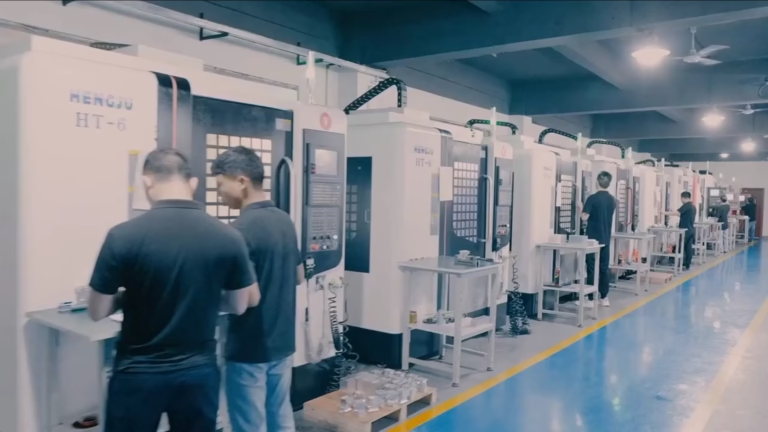
Mill-turn centers cover a different gap. Shafts, bushings and parts with a turned OD and milled flats finish in one cycle, so concentricity stays tight. We run 16 simultaneous 5-axis centers, 12 four-axis mills, 27 three-axis machines and 16 mill-turn centers, which lets us match the machine to the geometry instead of forcing the geometry onto the machine.
Tolerance, Wall Thickness and Finish Are Linked
A ±0.005 mm callout is achievable on aluminum, but not on every feature. Thin walls move under cutting force and then relax. Deep bores wander. Long, unsupported sections deflect. The tolerance you can hold depends on how much metal surrounds the feature and how the part is held.
As-machined surfaces land around Ra 1.6–3.2 μm. Where a sealing face or a bearing seat needs better, we plan a finishing pass or a secondary operation that reaches Ra 0.8–1.6 μm, and down to Ra 0.2–0.8 μm on specific faces. Chasing a fine finish across the whole part usually costs more than it returns.
Anodizing adds a layer and can shift a dimension, so it belongs in the tolerance stack from the start. Hardcoat builds more than clear anodize and changes the color of the edge. Marking a critical diameter before anodize and re-checking after is a normal step, not an extra one.
Which Shop Setup Fits Your Aluminum Part
Match the route to the geometry and volume.
| Part situation | Route | Why |
|---|---|---|
| Flat plate, open pockets | 3-axis | One or two setups, lowest cost |
| Features on five faces | 5-axis | One setup, less positional error |
| Turned OD plus milled flats | Mill-turn | Concentricity in one cycle |
| Complex shape, low volume | 5-axis or 3D printing | No tooling cost, fast iteration |
| Housing at 10,000+ parts | Die casting plus machining | Near-net shape cuts cycle time |
| Prototype before tooling | CNC from solid | No porosity risk, design still open |
How to Prepare Prints for a Fast Quote
A clean quote starts with a STEP file plus a 2D drawing that carries the tolerances, datums and finish callouts the 3D model cannot express. If the drawing says general tolerance ±0.1 mm but one bore needs ±0.005 mm, that one bore is where the cost sits. Say so on the print.
Call out the alloy and temper, the finish and the quantity. Adding a note about the function, such as a press fit or a sliding surface, lets the machinist plan the operation around the critical feature instead of guessing. It also speeds up the DFM check.
We return a quotation and a free DFM analysis within 12 hours, and production can start within 24 hours of approval. Parts typically ship in 3–5 days. There is no minimum order quantity, so one prototype and a 10,000-part run go through the same process. Uploads stay confidential, and an NDA is available on request.
Questions Engineers Ask About Aluminum Machining
Can you hold ±0.005 mm on aluminum?
Yes, on features with enough surrounding material and a stable setup. Thin walls, deep bores and long unsupported sections are harder.
We review the print during the DFM check and tell you which callouts are realistic before cutting metal.
Which aluminum alloy should I choose for a structural bracket?
6061-T6 covers most brackets and fixtures at a good cost. Move to 7075 when the part carries higher load or needs a strong thread.
If corrosion resistance matters and the part will not be anodized, 5052 or 5083 is worth a look.
Does anodizing change my dimensions?
Yes. The coating adds a layer on the surface, so tight features must account for it in the tolerance stack before machining.
Hardcoat builds more than clear anodize. We machine to the pre-plate size and confirm critical dimensions after finishing.
When is die casting cheaper than machining from solid?
At higher volumes, usually thousands of parts, because the tooling cost spreads out and cycle time drops.
For one prototype or low volume, CNC from solid avoids tooling cost and the porosity risk that comes with castings.
What is the largest aluminum part you can machine?
Our maximum processing size is 4,000 mm, with travels up to 4,000 × 400 × 150 mm on the largest machines.
Smaller envelopes cover 750 × 1,150 × 550 mm, 600 × 600 × 600 mm, and compact 500 × 500 × 450 mm and 500 × 310 × 200 mm setups.
How do you handle confidential designs?
Uploads are treated as confidential, and we can sign an NDA on request before files are shared.
Our information security process follows ISO 27001:2022, which covers how files are stored and who can access them.
Send Your Aluminum Part for a Quote
Upload a STEP file and drawing. You get a quotation and a free DFM analysis within 12 hours.
12-hour quote±0.005 mm100% inspectionNo minimum order









