
AMR Composite Robot Helps the CNC Treatment Industry Cut Workforce Cost
Mobile composite robots now tend lathes and mills on real shop floors, not just in demo cells. This page explains where an AMR composite robot helps a CNC shop cut labor cost, which parts and batch sizes fit, and when the numbers do not work. Written for process engineers and shop managers who have to justify the spend.
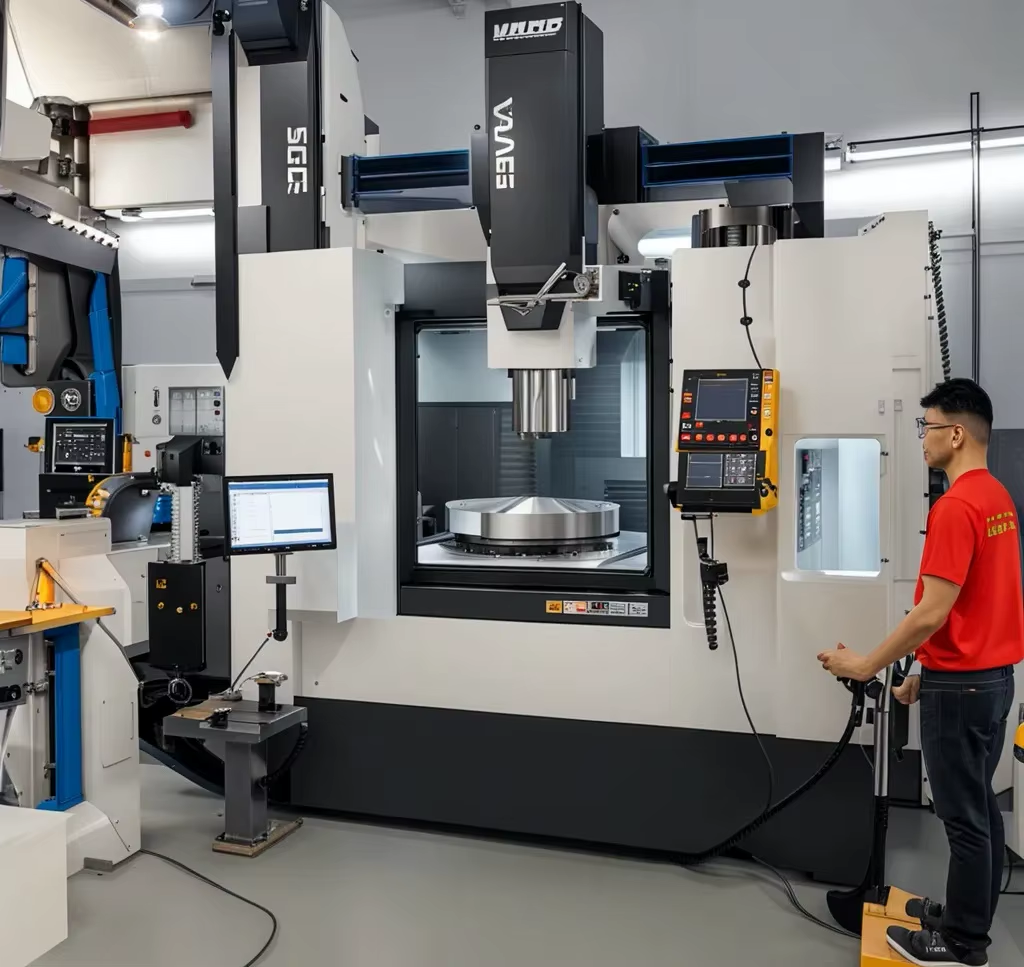
What Labor Cost Really Means in a CNC Shop
Labor cost in a machining job is not just the hourly wage. It is the operator standing at the machine door waiting for a cycle to finish, the loader who swaps blanks every four minutes, the inspector who checks one part in fifty, and the second-shift premium paid to keep three machines running after 18:00. Add those hours up across a month and the wage line usually hides 30 to 50 percent more time than the payroll sheet shows.
That is the cost an AMR composite robot helps attack. A mobile base carries a six-axis arm and a gripper between machines, so one unit can load a lathe, unload it, blow off chips, place the part on a gauging station, and move to the next cell. The same robot covers several machines in a shift instead of one fixed cell.
The work is repetitive and boring, which is exactly why it is expensive to staff. Operators leave. Agencies charge a premium for weekend coverage. A robot on a mobile base does not call in sick.
- 1Door-to-door timeLoad, unload, chip clear, and gauge in one loop.
- 2Second shiftOne robot can cover three to six machines across a shift.
- 3Fixture handlingVises and chucks stay manual; the robot only moves the part.
Which CNC Tasks an AMR Composite Robot Should Take First
Start with the dullest job on the floor. Loading round bar into a lathe, pulling a finished shaft, and stacking it in a tray takes no judgment. A two-finger gripper with a V-block jaw handles that all day. The same logic applies to a three-axis mill cutting the same bracket from a plate: the robot places the blank, closes the vise, starts the cycle, and returns when the spindle stops.
Deburring is the second candidate. A robot holding a pneumatic spindle can run a chamfer along an edge for hours without losing pressure. It will not match a skilled hand on a complex blend, but it removes the bulk of the burr before a human finishes the detail.
Inspection support is the third. The robot can place a part onto a gauging fixture and read the result through a probe or a vision camera. It does not decide whether a part is good. It just moves the part and logs the number.
When Automation Does Not Pay Back
A robot cell needs repeatable part presentation. If the blank arrives in a tangled bin with no orientation, the robot will spend more time untangling than machining. Sorting by hand first is cheaper.
Short runs kill the case. Setup for a new part family on a mobile robot takes time: teach the pick point, the vise position, the gripper change, and the safe path. A job that runs for two hours and never comes back will not recover that setup.
Tight tolerances on the part do not block automation. The robot just moves metal; the machine holds the tolerance. What blocks it is a part that needs constant human feel during the cycle, such as a thin wall that springs when the vise opens. Those jobs stay manual until the fixture is redesigned.
Task Fit at a Glance
Use this to decide which jobs to move to a mobile robot first.
| Task | Good fit | Poor fit | Reason |
|---|---|---|---|
| Lathe tending | Bar stock, 20–200 mm Ø | Tangled bin feed | Orientation must be repeatable |
| Mill tending | Plate in a vise | Loose casting in a soft jaw | Vise gives a fixed pick point |
| Deburring | Straight edge, chamfer | Complex blend, thin wall | Robot holds pressure, not feel |
| Gauging | Go/no-go probe check | Subjective visual call | Robot moves the part, not the decision |
| Batch size | 500+ parts per run | Under 50 parts | Setup time must be recovered |
| Part weight | Under 20 kg per piece | Over 35 kg per piece | Gripper and arm payload limits |
Workholding, Tolerance, and Gripper Choices
The robot does not set the tolerance. The machine does. A 5-axis center can hold ±0.005 mm on a well-supported part, and the robot only needs to place the blank within the vise repeatably. A pick repeatability of ±0.1 mm is usually enough when a chamfer or a lead-in guides the part into the jaws.
Gripper choice follows the part. A two-finger parallel gripper with hardened jaws suits square and round stock. A three-finger centric gripper suits round parts that must stay on center. A vacuum cup works for flat plate but fails on oily or porous surfaces. Magnetic grippers are fast on steel but leave no grip on aluminium.
Fixtures must be robot-friendly. A vise with a hard stop and a repeatable jaw position is better than a custom soft jaw that varies with clamping force. If the blank varies in length, add a spring-loaded stop so the robot does not have to feel the seat.
- 1Pick repeatability±0.1 mm is enough for most vise-loaded work.
- 2Part toleranceSet by the machine, not by the robot.
- 3Gripper materialHardened steel jaws for steel; nylon pads for soft aluminium.
What Integration Actually Requires
A mobile robot needs a safe path between machines. That means floor markings, a lidar or bumper safety system, and a handshake with each machine door. Older CNC machines without an auto-door option need a door actuator, which is a mechanical retrofit.
The robot also needs a place to put finished parts. A tray or a conveyor at each machine keeps the loop short. If the robot has to travel far to a central bin, the cycle time grows and the value drops.
Software ties it together. The robot controller has to know which machine is free, which program to run, and where the next blank sits. A simple job scheduler on a tablet is enough for a small cell. Larger cells use a cell controller that talks to the CNC through Ethernet or I/O.
Common Questions
How many machines can one AMR composite robot cover?
It depends on cycle time and travel distance. In a compact cell with three machines within 10 m, one robot can usually cover all three if the total cycle time fits the loop.
If travel is long or cycle times are short, two robots or a fixed rail may be better.
Does the robot change the tolerance we can hold?
No. The CNC machine holds the tolerance. The robot only places the blank and removes the finished part.
What can change is scrap rate if the blank is not seated correctly. A spring stop and a seating check solve that.
What gripper should we buy first?
Start with a two-finger parallel gripper and a set of hardened jaws. It covers most round and square stock.
Add a three-finger centric gripper when you need to hold round parts on center for a second operation.
Can the robot run lights-out?
Yes, for jobs with a stable cycle and a clear part flow. You still need a way to stop the cell when the blank tray runs empty or a tool breaks.
Most shops start with one shift, then extend to a second shift before going lights-out.
What part size is too large for a mobile robot?
Payload is the limit. Most mobile composite robots handle parts under 20 kg comfortably.
For larger parts, the arm and gripper grow, and the mobile base needs more counterweight. At that point a fixed cell is usually cheaper.
Do we need to redesign our fixtures?
Often yes, but the changes are small. A hard stop, a repeatable jaw position, and a lead-in chamfer are usually enough.
If the part needs human feel during clamping, the fixture needs a rethink before the robot can take over.
Send Us the Part and We Will Tell You If a Robot Fits
Upload your drawing or sample. We review the geometry, the batch size, and the workholding, then quote the machined parts. If the job suits a mobile robot cell, we will say so; if it does not, we will say that too.
12-hour quote100% inspectionNDA on request









