
Are All Mass Produced Parts CNC Machining?
No. CNC is one process in a much larger set, and for high volumes it is often the wrong one. This page is for engineers and buyers who need to pick a process before tooling money is spent. After reading it you can tell which parts belong on a mill, which belong in a mold, and where the break-even sits.
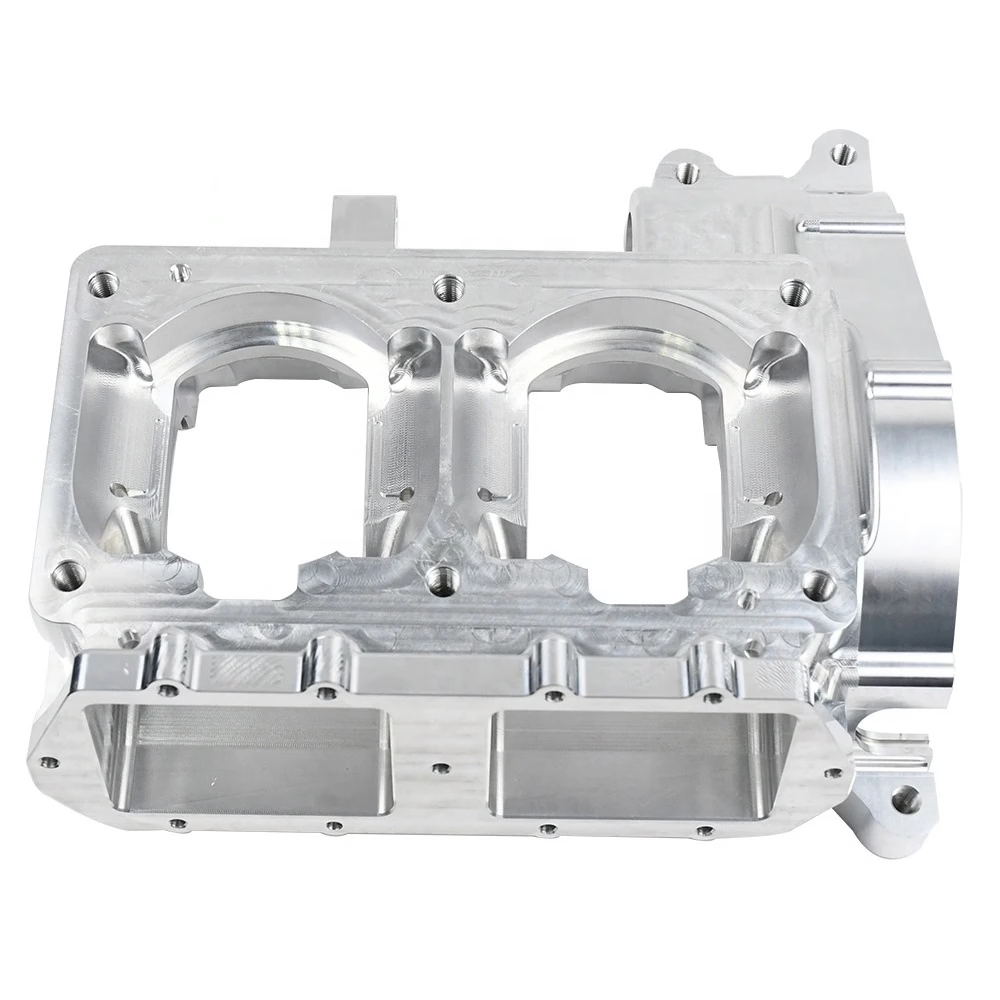
What decides the process for a production run
Volume sets the budget. Geometry and tolerance decide whether the cheap process can actually hold the print.
How CNC cost behaves as volume climbs
CNC machining has almost no tooling. You pay for programming, a fixture, and a first article. That makes it the cheapest route at one piece and still reasonable at a few hundred. The cost per part is then machine time plus tool wear plus operator attention, and that number barely moves when you order 5,000 instead of 500.
A molded or cast part works the other way. The mold or die costs real money up front, then each shot costs cents because the shape is formed in seconds and not cut away. At 200 parts the mold is a waste. At 200,000 parts the CNC route would be absurd.
That crossover is the whole question. It is not a matter of which process is better. It is a matter of where your quantity sits relative to the tooling break-even point for that specific geometry.
- 1CNC break-even is highSetup is low, unit cost stays flat with volume
- 2Molding break-even is low volumeTooling dominates, unit cost drops fast
- 3Geometry caps everythingUndercuts and thin walls rule out some processes early
Mass production methods and where CNC fits
Typical ranges for planning. Final numbers depend on part size, material and tool complexity.
| Process | Typical volume | Tooling cost | Tolerance / finish |
|---|---|---|---|
| CNC machining | 1 to ~5,000 | Low, fixture only | ±0.005 mm, Ra 0.2–0.8 μm |
| Injection molding | 10,000+ | High, steel mold | ±0.05 mm, as-molded surface |
| Die casting | 10,000+ | High, H13 die | ±0.05 mm, needs machining |
| Sheet metal stamping | 10,000+ | Medium, progressive die | ±0.1 mm, flatness varies |
| Investment casting | 500 to 50,000 | Medium, wax tooling | ±0.1 mm, rough surface |
| 3D printing | 1 to ~200 | None | ±0.1 mm, layered finish |
When CNC is the right call at volume
CNC wins whenever the tolerance or the surface finish is tighter than a mold can hold. A sealed hydraulic manifold with cross-drilled passages at ±0.005 mm is not going to be molded in plastic. Neither is a titanium bracket with a 0.4 mm wall that has to survive a load case.
It also wins when the quantity is genuinely small but the part is critical. Ten sets of flight hardware, or 40 medical instrument housings, will never justify a die. We run those as machined parts with 100% inspection before shipment and full dimensional reports.
There is a third case people forget. A part can be molded or cast and still need CNC. Die cast automotive housings get their mating faces and bores machined after casting because the casting cannot hold the tolerance where it matters. The production part is a hybrid, and the machining step stays in the process forever.
- 1Tolerance below ±0.05 mmMolds and dies cannot reach it reliably
- 2Low volume, high valueTooling spend never pays back
- 3Undercuts and deep pockets5-axis reaches what a two-part mold cannot
- 4Post-cast finishingMachining as a secondary step on castings
Where CNC stops making sense
Once a part has a simple, draft-friendly shape and the volume passes a few thousand, CNC becomes a tax on every unit. A plastic enclosure machined from a solid block wastes most of the block as chips. The same enclosure injection molded uses grams of pellets per shot.
Simple flat brackets are another case. If the part is 2 mm steel with a few holes, a progressive stamping die produces them faster than any mill and at a fraction of the unit cost. Machining that part at 50,000 pieces is a planning error, not a precision choice.
Material is the last limit. Some grades are difficult or impossible to mold at production rate. PEEK and carbon-fibre-filled nylon can be injection molded, but the tooling wears and the process window is narrow. For a few hundred parts, machining the same geometry from PEEK stock is often the practical answer.
A short checklist before you commit to tooling
Start with the tightest tolerance on the drawing. If it is under ±0.05 mm and it is functional, not cosmetic, CNC is likely to stay in the process even after you add a mold. Ask which features drive that tolerance and whether they can be machined after molding or casting.
Then look at annual volume, not lifetime volume. A part that ships 200 units a year for ten years never justifies a die, even though the total is 2,000. Tooling is paid back by rate, not by total.
Finally, check the geometry against a mold. Draft angles, uniform wall thickness, and no undercuts are the conditions that make molding cheap. If the part fails those, the tooling cost rises and the break-even moves further away.
- 1Find the critical toleranceBelow ±0.05 mm usually means machining stays
- 2Use annual rateTooling payback depends on units per year
- 3Test the geometryDraft, wall thickness and undercuts set mold cost
Bridge production while the tool is being built
Tooling takes weeks. Market demand does not wait. A common pattern is to machine the first 500 to 2,000 units so the product ships while the mold is cut, then switch to molding once the tool is qualified. The machined units use the same CAD model, so the transition is a process change, not a design change.
We do this often for automotive and medical programs. The bridge parts are produced on 16 simultaneous 5-axis centers, inspected to the same drawing, and delivered in 3–5 days per batch. When the molded parts arrive, the two batches are dimensionally comparable because both were checked against the same nominal.
The value is not just speed. Bridge production proves the design before you spend on a hardened tool. If a wall cracks or a boss interferes, you find out on machined parts, not on a €40,000 mold.
Common questions
At what quantity does CNC stop being cost-effective?
There is no single number. It depends on part size, material and how much tooling the alternative needs. For a small plastic part, molding can win above roughly 5,000 pieces. For a large aluminum housing, the die cost is high and CNC may stay competitive well past 10,000.
Can a molded part still need CNC machining?
Yes, and it is common. Die cast and injection molded parts usually get their critical faces, bores and threads machined after forming. The mold creates the net shape; the mill creates the tolerance. That secondary step is planned into the process from the start.
What tolerances can CNC hold in production?
Our standard production tolerance is ±0.005 mm on critical features. Surface finish runs from Ra 0.2–0.8 μm on fine finishes to Ra 1.6–3.2 μm as machined. Molds and dies typically hold around ±0.05 mm, so a tighter functional callout keeps CNC in the routing.
Is there a minimum order quantity?
No. We run from one prototype to 10,000+ part runs. The same process and inspection apply at both ends. Low volume is often the reason a customer chooses CNC over molding in the first place.
How fast can bridge production start?
Quotation and free DFM analysis come back within 12 hours, and production can start within 24 hours of approval. Parts ship in 3–5 days. That schedule is designed for teams waiting on a mold.
Do you machine parts after casting or molding?
Yes. We take castings, forgings and molded blanks and machine the features that need tighter control. The part arrives as a near-net shape and leaves with the drawing tolerances held on the functional surfaces.
Send the drawing, get a process recommendation
Upload your CAD file and we will tell you which process fits your volume, with a quote and free DFM feedback within 12 hours.
12-hour quoteDFM analysis included100% inspectionNDA on request









