
Are There Different Types of CNC Machines?
Yes, and the differences matter more than the labels. This guide breaks down the main families of CNC equipment, what each one does well, and where each one stops being the right choice. It is written for engineers and buyers who need to match a part to a process before quoting.
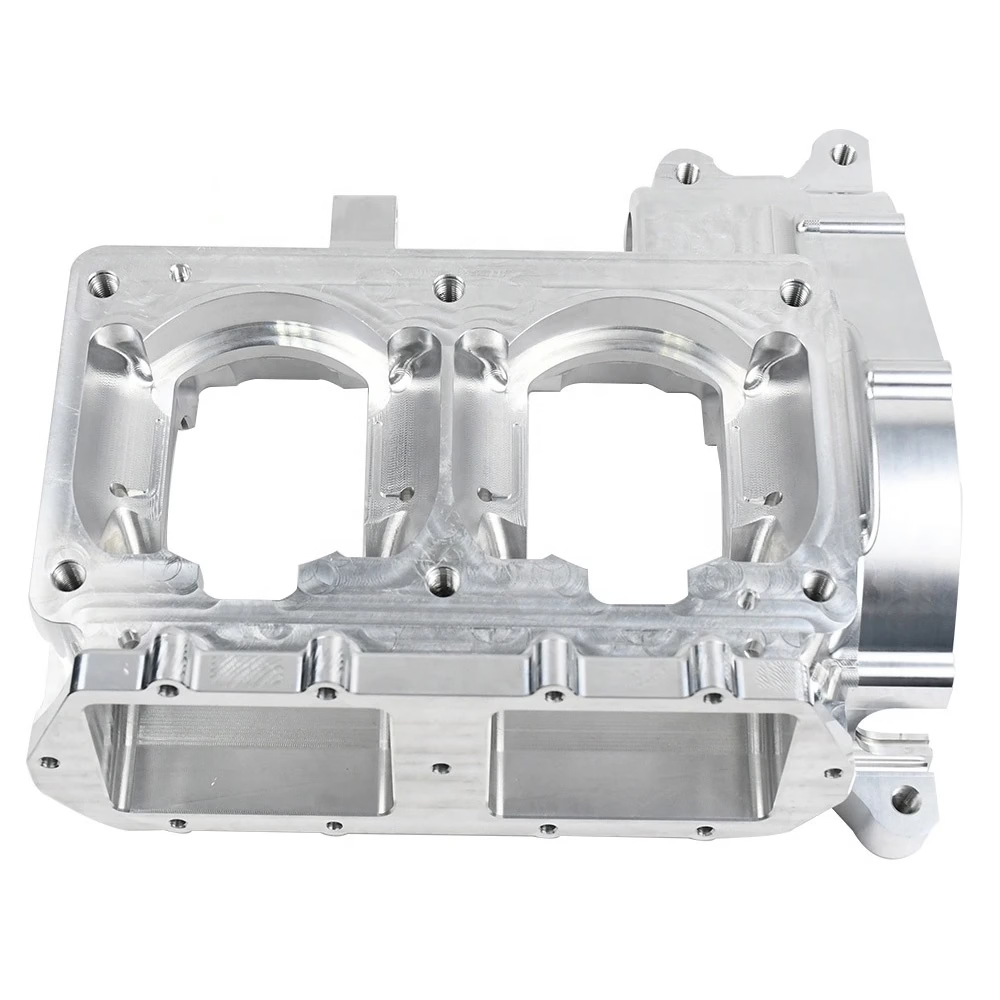
How CNC Machines Are Classified
Two questions decide most of the classification: how the tool and workpiece move relative to each other, and what the cutting energy actually is.
The Main Families of CNC Equipment
Most people ask whether there are different types of CNC machines because the terminology in quotes and RFQs is inconsistent. One supplier says milling center, another says VMC, a third says 3-axis. They may mean the same machine or three different ones.
A cleaner way to sort them is by motion. In milling, the tool spins and the workpiece stays put. In turning, the workpiece spins and the tool stays put. Everything else is a variation on those two ideas, plus the non-cutting processes that remove material with heat, abrasive, or a wire.
That single distinction explains why a shop cannot quote every part on one machine. A shaft with a groove running along its length is a turning job. A plate with pockets on five faces is a milling job. Push either part onto the wrong machine and you add setups, fixtures, and cost.
The table below covers the families we run in our three plants, with the geometry each one handles best and the point where it stops being economical. Use it as a first filter before you read the sections that follow.
- 1MillingRotating multi-point tool, stationary workpiece. Pockets, slots, faces, 3D contours.
- 2TurningRotating workpiece, single-point tool. Shafts, bushings, threads, diameters.
- 3Mill-turnBoth motions in one machine. Parts with turned bodies and milled features.
- 4Non-cuttingLaser, plasma, waterjet, EDM. Sheet, plate, hardened or thin sections.
Machine Family at a Glance
Typical geometry, materials, and the case where each family is the wrong pick.
| Family | Best geometry | Typical materials | Wrong pick when |
|---|---|---|---|
| 3-axis mill | Flat plates, open pockets, drilled holes | Aluminium, steel, plastics | Undercuts on more than one face |
| 4-axis mill | Cylindrical parts with milled flats | Aluminium, stainless, titanium | True 3D contoured surfaces |
| 5-axis mill | Impellers, housings, angled ports | Titanium, Inconel, hardened steel | Simple 2D plates at high volume |
| CNC lathe | Shafts, bushings, threaded diameters | Steel, brass, stainless | Prismatic parts with no round axis |
| Mill-turn center | Turned body plus milled features | Steel, aluminium, 17-4PH | Parts that fit a single-process machine |
| Laser / plasma | Flat sheet and plate profiles | Mild steel, stainless, aluminium | Thick sections needing tight edges |
Axis Count: What You Actually Gain
Axis count is the most over-sold number in machining. A 3-axis mill moves in X, Y, and Z. It cuts almost any prismatic part if you can reach every face with a re-fixture. For a flat bracket with a few holes, that is the cheapest route and the fastest one.
A 4-axis machine adds rotation about one axis, usually A. Now the part can spin on a rotary table while the tool works. A Ø400 mm rotary table lets us cut flats, slots, and cross-holes on a cylindrical part in a single setup. Fewer setups means less stack-up error.
A 5-axis machine adds a second rotary axis, so the tool can approach the part from almost any direction. The real gain is not the extra directions. It is that you machine angled features without a custom fixture, and you keep the tool engaged with the surface on complex contours.
That is why a 5-axis machine earns its cost on impellers, medical housings, and parts with intersecting angled bores. It does not earn its cost on a 200-piece run of flat plates. More axes are not universally better. They are better for specific geometry.
Travel, Spindle, and Workholding Limits
Machine type is only half the decision. The part has to physically fit, and the spindle has to have the reach and torque to cut it. We run three travel classes. The compact class covers 500 × 500 × 450 mm and 500 × 310 × 200 mm. The medium class covers 750 × 1,150 × 550 mm and 600 × 600 × 600 mm. The large class reaches 4,000 × 400 × 150 mm.
A long, thin part is a different problem from a bulky one. A 4,000 mm rail fits the large machine but may deflect under cutting force in the middle. We would plan support and light finishing passes rather than assume the envelope solves it.
Spindle choice follows the material. Aluminium wants high speed and high feed. Titanium and Inconel want lower speed, higher torque, and more coolant. A router spindle that flies through acrylic will stall in 17-4PH. Match the spindle to the alloy, not to the part name.
Workholding is the constraint people forget. A part with no flat face to clamp is harder to hold than to cut. Sometimes the right answer is a mill-turn center, where the bar stays in the chuck and the features get cut without a second fixture.
How to Pick a Process for Your Part
Start with geometry, not with a machine name. Sketch the part and mark which faces need material removed. If every face is reachable from one direction, a 3-axis mill is enough. If features wrap around a cylinder, think turning or 4-axis.
Then check tolerance and finish. Our standard working tolerance is ±0.005 mm, with fine finishes to Ra 0.2–0.8 μm and as-machined surfaces at Ra 1.6–3.2 μm. Tight tolerance on a deep pocket is harder than the same tolerance on an open face, because tool deflection grows with reach.
Then check quantity. No minimum order quantity applies here, so a single prototype and a 10,000-piece run both start the same way. At low volume, setup time dominates and a 5-axis machine saves money by removing fixtures. At high volume, a dedicated lathe or a 3-axis mill with a good fixture usually wins.
Finally, check material. Aluminium 6061 and 7075 cut fast. Stainless 316 and 17-4PH work-harden if the feed is wrong. Titanium TC4 and Inconel need rigid setups and sharp tools. The machine that handles one may not handle the next at the same cost per part.
- 1Prismatic, one direction3-axis mill. Lowest cost per part.
- 2Round with milled flats4-axis mill or mill-turn center.
- 3Angled or contoured faces5-axis. Fixture savings often cover the rate.
- 4Flat sheet, large outlineLaser or plasma, then finish machining if needed.
When the Wrong Machine Still Works
A machine type is not a hard rule. A skilled programmer can cut a round part on a 3-axis mill with a rotary table and patience. It will cost more, and the tolerance stack will be worse, but it is possible. Knowing when to bend the rule is part of the trade.
The usual reason to bend it is lead time. If a 5-axis machine is busy and the part is simple, running it on a 3-axis mill with two extra setups may still ship faster. We weigh that trade on every job rather than defaulting to the biggest machine.
The other reason is volume. For 10,000 small bushings, a lathe with a bar feeder beats any mill. For a one-off housing with five faces, the 5-axis machine wins. The same shop quote can swing by a factor of three depending on which way we go.
Common Questions
How many types of CNC machines are there?
There is no fixed number, because the categories overlap. The practical set is milling, turning, mill-turn, and the non-cutting processes such as laser, plasma, waterjet, and EDM. Within milling you then split by axis count: 3, 4, and 5.
For quoting purposes, the useful split is narrower. Most machined parts fall into one of three buckets: prismatic milling, cylindrical turning, or a mix of both.
Do I need a 5-axis machine for my part?
Only if the geometry demands it. Angled bores, contoured surfaces, and features on five faces in one setup are the usual triggers. If every face is reachable from one direction, a 3-axis machine will be cheaper and just as accurate.
A good test is to count the setups. If a 5-axis machine removes two fixtures and a re-datum, it usually pays for itself on the first order.
What is the difference between a CNC mill and a CNC lathe?
In a mill, the tool rotates and the workpiece stays still. In a lathe, the workpiece rotates and the tool stays still. That single difference decides which parts each machine can make.
Mills handle pockets, slots, and flat faces. Lathes handle diameters, threads, and concentric features. A mill-turn center does both, which is why it suits parts with a turned body and milled pockets.
Can you machine hard materials like titanium and Inconel?
Yes. We machine titanium grades TA1, TA2, and TC4 (Ti-6Al-4V), plus Inconel and magnesium AZ31B and AZ91D. These alloys need lower cutting speeds, higher torque, and rigid workholding.
They also wear tools faster, so toolpath strategy matters more than on aluminium. We plan roughing and finishing passes around the alloy rather than the part shape alone.
How do I know which machine my quote was priced on?
Ask. A quote should state the process, the number of setups, and the tolerance the price assumes. If a supplier will not say, the price is hard to compare against another shop.
We include a free DFM analysis with every quote, so you can see where the cost sits and whether a different machine would change it.
What are your size and tolerance limits?
Maximum processing size is 4,000 mm, and our standard tolerance is ±0.005 mm (±0.0002 in). Surface finish ranges from Ra 0.2–0.8 μm for fine work to Ra 1.6–3.2 μm as machined.
Every part gets 100% inspection before shipment, with raw material checks, in-process monitoring, and a final inspection. Reports are available on request.
Send Us Your Part and We Will Match the Process
Upload a drawing or STEP file. You get a quotation and a free DFM analysis within 12 hours, with the machine type and setups spelled out.
12-hour quote100% inspectionNo minimum orderNDA on request









