
Auto Injector Barrel Machining in China
This page is for device engineers and sourcing teams who need machined auto injector barrels or barrel components from a Chinese supplier. It covers material choice, bore and flange tolerances, surface finish, cleaning, and the checks that tell you whether a shop can actually hold them.
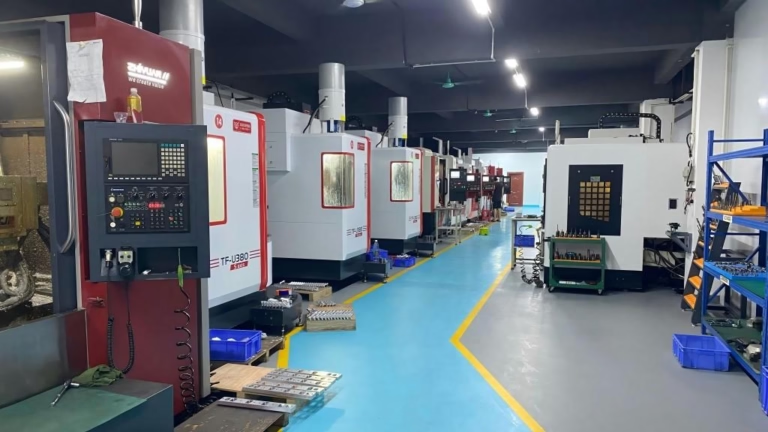
What Makes an Auto Injector Barrel Hard to Machine
A barrel is a thin-wall tube with a controlled bore, a sealing surface, and often a window or flange. Every one of those features fights the others.
Geometry and Tolerance Stack on a Barrel Body
An auto injector barrel holds the drug, guides the plunger, and locates the needle assembly. Those three jobs set the drawing. Bore diameter and roundness control dose accuracy and seal drag. The flange or shoulder that seats the needle controls concentricity with the bore axis. Wall thickness controls how much the part deflects when the plunger pushes through it.
The difficulty is that these features are not independent. Boring a thin wall releases residual stress from the bar stock, so the bore moves after the cut. Turning the flange adds a second setup, and any runout between setups shows up as bore-to-flange eccentricity. On a 0.8 mm wall in 316L, we often see 0.01–0.02 mm of movement in the first hours after machining if the stock is not stress-relieved.
That is why barrel work is mostly a fixturing and sequence problem, not a spindle-speed problem. A shop that machines the bore in one pass with a single setup, then checks roundness at three axial positions, will hold ±0.005 mm far more often than one that chases the same number with more setups.
- 1Bore roundnessUsually the tightest callout on the print; check at both ends and mid-length.
- 2Bore-to-flange concentricityDrives needle alignment; degrades fast with each extra setup.
- 3Wall thicknessThin walls deflect under clamping; light passes and soft jaws matter.
- 4Window and gate edgesRequire deburring that does not round over the sealing land.
Choosing the Barrel Material
Most auto injector barrels are machined from 316L stainless, 17-4PH, or a medical-grade polymer. 316L is the default for drug contact because it resists corrosion and cleans predictably. It also galls and work-hardens, so feeds and speeds need to be conservative and tooling sharp. 17-4PH gives higher strength and hardness when the barrel sees higher plunger forces, but it needs a heat-treat step that will move dimensions unless the sequence accounts for it.
Cyclic olefin polymer and PEEK appear where the drug is sensitive to metal ions or where the part must be molded rather than machined. Machined PEEK is common for prototype and low-volume barrels because tooling cost is zero. It cuts cleanly with sharp carbide, but it absorbs moisture and will grow slightly in a humid room, so measure in a controlled environment.
Titanium is rare in this application. It is used when weight matters or when the drug formulation rules out stainless, and it costs significantly more machining time. If a supplier recommends titanium for a standard saline or biologic barrel, ask why.
Material certificates matter more here than on most jobs. Ask for the mill cert with the heat number, and make sure the lot on the cert matches the lot that goes into the machine.
Barrel Material Comparison
Typical starting points for machined auto injector barrel bodies. Confirm against your own drug-contact and sterilization requirements.
| Material | Why it is used | Watch out for |
|---|---|---|
| 316L stainless | Drug contact, corrosion resistance, cleanable | Work hardening, galling, residual stress |
| 17-4PH (SUS630) | Higher strength, hardness after aging | Heat-treat distortion; sequence around it |
| PEEK | No metal ions, machinable without tooling | Moisture absorption; measure dry |
| POM (acetal) | Low cost, easy to cut, good dimensional stability | Limited sterilization options |
| Ti-6Al-4V | Low weight, biocompatible | Long cycle times, higher cost per part |
Surface Finish, Burrs, and Cleanliness
Bore finish drives two things: seal friction and particle retention. A rough bore wears the plunger seal and traps drug residue. A polished bore can be too smooth to hold a lubricant film, which raises breakaway force. In practice, drug-contact bores land between Ra 0.2 μm and Ra 0.8 μm, with non-critical outer surfaces at Ra 1.6–3.2 μm.
Burrs are the bigger risk. A burr at the bore edge or a window edge can break off during assembly and end up in the drug path. We deburr with controlled hand tools and, where the geometry allows, with abrasive flow or a back-chamfer tool. Laser marking is used for identification, with a minimum character height of 1.5 mm so it stays legible after cleaning.
Cleaning is part of the process, not an afterthought. Machined barrels need to come out free of cutting fluid, chips, and lapping compound. If the shop cannot describe its cleaning and packaging sequence in specific terms, that is a warning sign. Ask what the parts are rinsed with, how they are dried, and what they are packed in.
- 1Drug-contact borePlan for Ra 0.2–0.8 μm depending on seal and formulation.
- 2Non-critical surfacesRa 1.6–3.2 μm is usually enough; do not polish what does not need it.
- 3DeburringSpecify edge breaks in microns, not 'deburr all edges'.
- 4Laser markingMinimum character height 1.5 mm to survive cleaning.
Feature, Target, and How It Is Verified
| Feature | Typical target | Verification method |
|---|---|---|
| Bore diameter | ±0.005 mm | Air gauge or bore mic, at three depths |
| Bore roundness | 0.005 mm or tighter | Roundness tester, both ends |
| Bore-to-flange runout | 0.01 mm | CMM with rotary table |
| Bore surface finish | Ra 0.2–0.8 μm | Surface profilometer, axial trace |
| Burr condition | No loose burr, edge break on print | Visual at 10× plus FAI report |
What to Check Before You Place an Order in China
China has a deep base of precision machine shops, and the range of capability is wide. Two shops can quote the same barrel print and produce parts that differ by an order of magnitude in roundness. The quote tells you very little. The process plan tells you a lot.
Ask for a short process plan before the order: how many setups, where the datums are, how the bore is finished, how the part is held for the second operation, and what the inspection plan looks like. A shop that can answer these in two paragraphs understands the part. A shop that answers with machine lists and certifications does not.
Then verify on the first article. A first article inspection report with actual measured values, not just pass or fail, is the minimum. For a barrel, that report should include bore diameter at three depths, roundness, concentricity, and surface finish traces. If the shop cannot produce that on the FAI, it will not produce it in production.
Certifications are a filter, not a guarantee. ISO 13485:2016 is the relevant one for medical device work. ISO 9001:2015 covers general quality, and IATF 16949:2016 and ISO 27001:2022 indicate automotive and information-security discipline respectively. Ask which certificate covers the plant that will machine your part, not just the group.
- 1Process plan firstTwo paragraphs on setups and datums beats a machine list.
- 2FAI with numbersActual values, not pass or fail, for every critical feature.
- 3Certificate scopeConfirm the certificate names the plant doing the work.
- 4NDA before drawingsSign it before you upload barrel geometry.
Questions Engineers Ask
Can you machine a barrel with a 0.5 mm wall without distortion?
Yes, with the right sequence. We rough, stress-relieve where the material allows, then finish the bore and the OD in a way that keeps clamping forces low.
The limit depends on length-to-diameter ratio. Short barrels with a 0.5 mm wall are routine. Long thin barrels need more passes and more inspection, and we will tell you up front if the geometry is not practical to machine.
What surface finish can you hold inside the bore?
We work in the Ra 0.2–0.8 μm band for drug-contact bores, measured with a profilometer on an axial trace.
Going below Ra 0.2 μm is possible but rarely useful. It adds cost and can reduce lubricant retention, so we will ask what the seal and formulation actually need.
Do you provide material certificates and inspection reports?
Yes. Mill certificates with heat numbers are available for the metal lots we machine, and inspection reports are issued on request.
For a barrel we normally supply an FAI report with measured values for bore diameter, roundness, concentricity and surface finish.
How do you handle drug-contact cleanliness?
Parts are cleaned to remove cutting fluid, chips and lapping residue, then dried and packed for the agreed cleanliness level.
Tell us your cleaning and sterilization route at quoting stage. It affects the finish we leave on the bore and the packaging we use.
What volumes can you run?
There is no minimum order quantity. We machine from a single prototype to runs of 10,000+ parts.
Prototype and low-volume barrels are usually machined from bar or plate. Higher volumes can move to mill-turn or dedicated fixturing to cut cycle time.
How do you protect our barrel drawings?
Uploads are handled as confidential and we sign an NDA on request before drawings are shared.
We hold ISO 27001:2022 for information security, which covers how design data and customer files are stored and accessed.
Send Us Your Barrel Drawing
Upload the print and we will return a quotation with a free DFM analysis within 12 hours, including notes on bore tolerance, finish and feasibility.
12-hour quoteFree DFM analysisISO 13485:2016NDA on request









