
Auto CNC Machining Services
This page covers how we machine automotive parts: which geometries go on 3-axis, 4-axis or 5-axis, how tolerances are held, and where machining stops making sense. It is written for design and manufacturing engineers sourcing auto cnc machining services for prototypes or production runs.
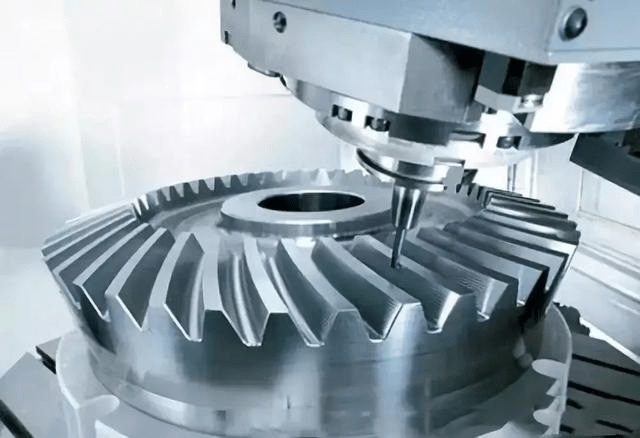
What an auto CNC job actually involves
Automotive parts are machined to fit, seal, rotate or conduct. Each function sets its own tolerance band and surface finish.
Which car parts belong on which machine
Most automotive parts we machine fall into three groups. Prismatic housings and brackets come first: pump bodies, sensor mounts, control arms, motor end plates. These usually run on 3-axis or 4-axis mills. Round or near-round parts come next: bushings, shafts, fittings, pistons. Those go to turning or mill-turn centers to keep concentricity in one setup.
Parts with angled faces, deep pockets or ports on five sides are the third group. They need simultaneous 5-axis work, because repositioning a heavy fixture three times adds error and hours. We hold 16 simultaneous 5-axis machining centers, 12 four-axis mills, 27 three-axis machines and 16 mill-turn centers across 127 high-precision machines.
Size decides the rest. Our largest travel is 4,000 × 400 × 150 mm, so long extruded rails and frame sections fit. Medium work runs on 750 × 1,150 × 550 mm and 600 × 600 × 600 mm travels. Compact parts such as fittings and small brackets use 500 × 500 × 450 mm or 500 × 310 × 200 mm machines, which hold tighter geometry on small features.
A rotary table of Ø400 mm handles parts that need indexing under a single spindle. If your part is a thin plate with one flat face and a few holes, a 3-axis machine is the right answer, not a 5-axis one. We will tell you that.
Part type, machine choice and typical tolerance
Use this to sanity-check your drawing before you send it.
| Part type | Best machine | Typical tolerance | Why |
|---|---|---|---|
| Flat bracket, one face | 3-axis mill | ±0.05 mm | Single setup, no angle work needed |
| Bearing housing | Mill-turn | ±0.01 mm | Bore and face cut in one chucking |
| Intake manifold | 5-axis | ±0.02 mm | Ports on five sides, complex angles |
| Transmission shaft | CNC turning | ±0.005 mm | Roundness and runout dominate |
| EV motor end plate | 4-axis mill | ±0.01 mm | Bolt pattern plus pilot bore |
| Long frame rail | Large 3-axis | ±0.05 mm | 4,000 mm travel, limited Z |
| Aluminium heat sink | 3-axis mill | ±0.05 mm | Thin fins, light finishing pass |
| Titanium exhaust flange | 5-axis | ±0.02 mm | Heat and tool wear need care |
Holding tolerance on automotive parts
Our general machining tolerance is ±0.005 mm (±0.0002 in). That number is not free. It requires temperature-stable cutting, sharp tooling and probing on the machine. We apply it where the drawing demands it, not everywhere.
Surface finish follows the same logic. As-machined surfaces land at Ra 1.6–3.2 μm. A bearing seat or sealing face usually needs Ra 0.8–1.6 μm, and optical or hydraulic sealing surfaces can go to Ra 0.2–0.8 μm. Each step down adds a finishing pass and time, so we ask which faces actually seal or slide.
Material choice drives the rest. Aluminium 6061-T6, 7075 and ADC12 machine fast with good finish. Stainless 303 and 17-4PH resist corrosion but work-harden, so feeds and speeds need control. Titanium TC4 (Ti-6Al-4V) and Inconel cut slowly and wear tools, which affects cost more than tolerance does.
Every part is inspected before shipment. We check raw material, monitor dimensions in process, and run a final inspection. Reports are available on request. Historical qualification rate is 99.99%. If a feature cannot be verified with our equipment, we say so before cutting metal.
Materials and finishes for under-hood and EV parts
Under-hood parts see heat, vibration and road salt. Aluminium 6061 and 6082 cover most brackets and housings. Cast aluminium ADC12 works for die-cast bodies that later get machined faces. Steel 1018, 1045 and 4140 handle shafts and high-load mounts, and 17-4PH covers parts that need strength plus corrosion resistance.
EV hardware often needs electrical isolation or conductivity. Anodizing comes in clear, colour, hardcoat and conductive versions; hardcoat gives a wear surface on aluminium, conductive anodizing keeps grounding paths alive. Electroless nickel and zinc plating protect steel fasteners and fittings.
For appearance parts, powder coating, black oxide, bead blasting and brushing are available. Laser marking handles part numbers and traceability codes down to a minimum character height of 1.5 mm. If your marking is smaller than that, it will not read cleanly after finishing.
We also run die casting, sheet metal fabrication, vacuum casting and 3D printing. That matters when a part starts as a machined prototype and later moves to a casting or stamped design. Keeping both stages under one roof avoids re-qualifying a new supplier mid-program.
Certifications, inspection and schedule
Our quality system holds ISO 9001:2015, IATF 16949:2016, ISO 13485:2016 and ISO 27001:2022. IATF 16949 is the one automotive buyers ask about, because it covers PPAP-style discipline, traceability and change control. ISO 27001 covers how we handle your drawings and CAD files.
Quotation and free DFM analysis come back within 12 hours of upload. Production can start within 24 hours after the drawing and material are confirmed. Parts ship in 3–5 days for most jobs. Historical late-delivery probability sits below 2%.
Uploads are secure and confidential. We sign NDAs on request, and the agreement covers drawings, models and any tooling built for your program. If your part needs first-article inspection or a dimensional report, ask at quote time so it is built into the schedule.
GreatLight Metal Technology was founded in 2011 and runs three wholly-owned plants, including a site in Singapore at No.3 Joo Koon Circle. The Dongguan plant covers 7,600 m² with 150 technicians.
Common questions from automotive engineers
Can you machine a part from a single prototype without tooling cost?
Yes. We have no minimum order quantity, so a single prototype is quoted the same way as a production run. No mold or die is needed for CNC work.
If the part later moves to die casting or vacuum casting, we can machine the first samples and quote tooling separately.
What tolerance can you actually hold on a 200 mm aluminium bracket?
±0.005 mm is our general claim, but geometry and setup count. A 200 mm bracket with one face and a few holes typically holds ±0.02 mm without special fixturing.
Tighter bands need probing, temperature control and sometimes a second setup. We will tell you which features can hold and which cannot.
Do you provide material certificates and inspection reports?
Yes. Raw material is checked on receipt, and mill certificates can be supplied with the shipment.
In-process and final inspection records are kept, and dimensional reports or first-article inspection documents are available on request.
How do you handle parts that need heat treatment between operations?
We plan the sequence so roughing happens before heat treatment and finishing after. That removes distortion before the final cuts.
If the heat treat is outside our process, we coordinate the schedule and keep the part traceable through each step.
Which finishes survive road salt and engine heat?
Hardcoat anodizing on aluminium and electroless nickel on steel both hold up well. Zinc plating is common but thinner, so it suits fasteners more than exposed brackets.
For high-heat areas, bare machined aluminium or stainless 17-4PH is often the safer choice over a coated surface.
Can you work from a STEP file only, without a 2D drawing?
Yes, but tolerances and datums must be agreed in writing. A STEP model shows nominal geometry, not what is critical.
We mark up the model with a tolerance plan and send it back for your confirmation before cutting. That avoids a mismatch later.
Send your drawing and get a quote within 12 hours
Upload a STEP or drawing and we return a quote with free DFM notes. Your files stay confidential, and an NDA is available on request.
12-hour quote100% inspectionNo MOQNDA on request









