
Axis CNC Service for Sale: Choosing 3, 4 or 5 Axis
This page explains what an axis CNC service for sale actually includes, where 3, 4 and 5-axis work each fit, and how to read a quote before you commit. It is written for design engineers and sourcing engineers comparing suppliers. By the end you can judge which axis count your part needs and what to ask for.
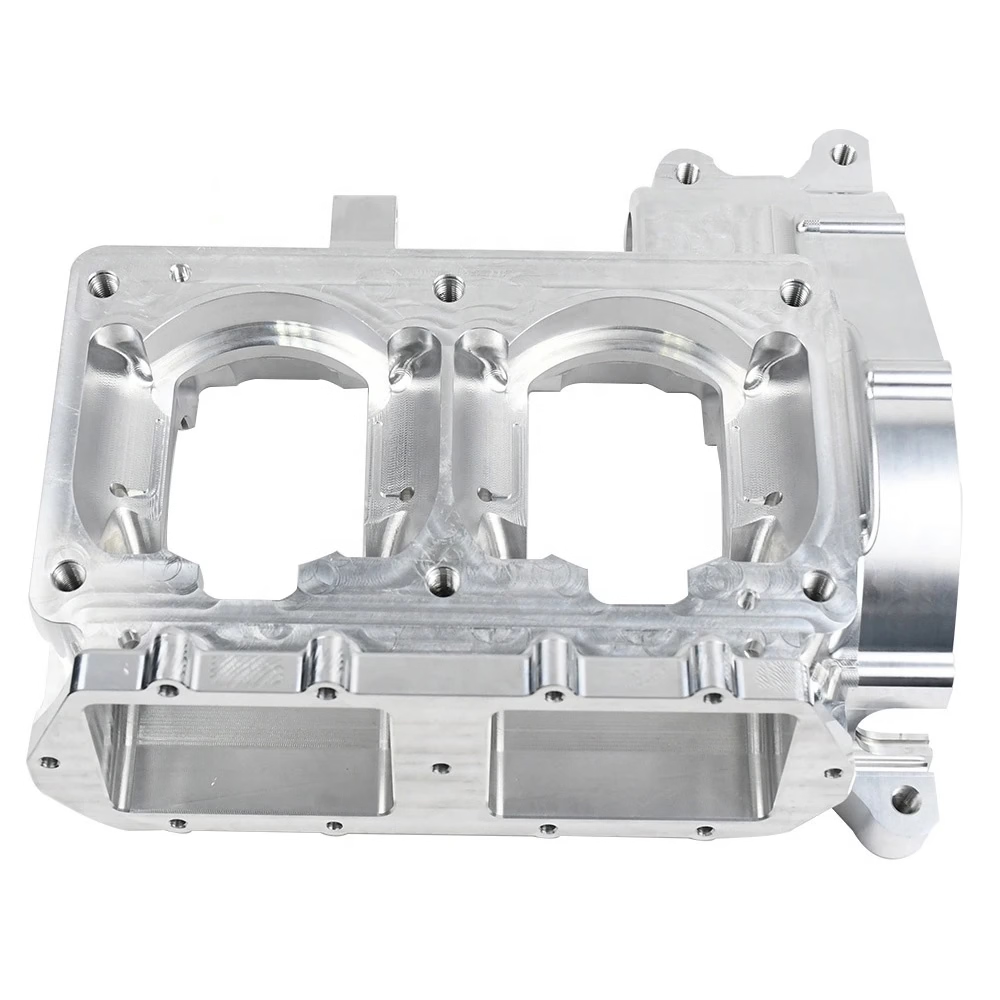
What You Are Buying When You Buy Axis Capacity
Axis count is a setup decision, not a quality rating. More axes reduce re-fixturing; they do not fix a bad process.
What the Axis Count Actually Changes
A 3-axis machine moves the tool in X, Y and Z while the part stays still. Every new face of the part means a new setup: unclamp, rotate, re-zero, clamp again. Each setup adds stack-up error and adds labor. For a flat bracket with holes on one face, that is fine and it is the cheapest route.
A 4-axis machine adds a rotary table, usually turning around X or Y. The part can be indexed to several faces without being removed. Think of a shaft with cross-drilled holes, or a housing with features on four sides. What you gain is fewer setups, not more freedom of tool angle.
Five-axis work adds two rotary motions, so the tool can reach an angled face while the part stays clamped. That is the real difference: undercuts, deep pockets on curved walls and blended surfaces come off in one setup. Tolerances hold because the part never moves between operations.
The trade-off is programming time and machine hourly rate. A five-axis toolpath takes longer to prove out, and the machine costs more per hour. If your part has three flat faces, a five-axis quote will look expensive for no reason.
So the question is not which machine is better. It is how many setups your geometry forces.
Axis Count vs Part Geometry
Use this as a first filter before you send an RFQ.
| Axis count | Typical part | Setup count | Watch out for |
|---|---|---|---|
| 3-axis | Plates, brackets, flat pockets | 1–3 | Deep cavities need long tools |
| 4-axis | Shafts, cross-drilled housings | 1–2 | Rotary table limits part swing |
| 5-axis | Impellers, angled ports, organic shapes | 1 | Higher hourly rate and CAM time |
| 3+2 (positioned) | Prismatic parts with angled faces | 1 | Not true simultaneous motion |
| Mill-turn | Turned parts with milled flats | 1 | Bar diameter limits |
What Sizes and Tolerances We Hold
GreatLight runs 127 high-precision CNC machines across three wholly-owned plants covering 7,600 m², with 150 technicians. Sixteen of those are simultaneous five-axis machining centers, twelve are four-axis mills, twenty-seven are three-axis machines and sixteen are mill-turn centers. If your part sits between categories, we quote the cheapest machine that holds the print.
Size is usually the first limit engineers hit. Our largest travel is 4,000 × 400 × 150 mm for long, slim parts. Medium machines run 750 × 1,150 × 550 mm and 600 × 600 × 600 mm, and compact cells cover 500 × 500 × 450 mm and 500 × 310 × 200 mm. The rotary table is Ø400 mm, which caps the swing diameter on four and five-axis work.
Standard tolerance is ±0.005 mm (±0.0002 in). Surface finish lands at Ra 0.8–1.6 μm as a normal machined result, Ra 0.2–0.8 μm when a fine finish is specified, and Ra 1.6–3.2 μm for as-machined faces where appearance does not matter. Tell us the finish on the drawing rather than assuming it.
We inspect 100% of parts before shipment: incoming raw material check, in-process monitoring and final inspection, with reports on request. Qualification rate across production runs is 99.99%. That number comes from checking every part, not sampling a batch.
Materials and the Axes They Suit
Aluminium alloys cover 6061, 6061-T6, 2024, 5052, 5083, 6063, 6082, 7075 and ADC12. They cut fast on any axis count, so aluminium rarely drives the machine choice. Thin walls and long tools are the actual risk, not the alloy.
Stainless grades include 303, 304, 316, 316L, 420, 430, 431, 440C and 17-4PH (SUS630). Stainless work-hardens, so we keep the chip load heavy enough to cut under the hardened layer. On five-axis parts this matters more, because a tool that rubs on an angled face will glaze the surface.
Steel grades run 1018, 1045, 4130, 4140, 4340, A36 and tool steel. Titanium and superalloys cover TA1, TA2, TC4 (Ti-6Al-4V), Inconel and magnesium AZ31B / AZ91D. Titanium and Inconel generate heat at the cutting edge, so five-axis toolpaths that keep engagement constant extend tool life and hold the tolerance after the part cools.
Plastics include ABS, PC, PMMA, POM, PA, PEEK, PP, HDPE and carbon fibre. PEEK and carbon fibre both wear tools quickly and need sharp geometry. For carbon fibre we plan the toolpath to avoid delamination at the exit face.
Material vs Axis Recommendation
| Material group | Recommended axes | Reason | Notes |
|---|---|---|---|
| Aluminium | 3 or 4-axis | Fast cutting, low tool wear | Thin walls need support |
| Stainless 303/304/316 | 4 or 5-axis | Fewer setups on hard material | Control chip load |
| Titanium TC4 | 5-axis | Constant tool engagement | Heat management is key |
| Inconel | 5-axis | Tool life depends on path | Slow speeds, rigid setup |
| PEEK / carbon fibre | 3 or 4-axis | Sharp tools, low heat | Watch exit-face delamination |
Lead Time, Quantity and Confidentiality
Quotation and a free DFM analysis come back within 12 hours. Production can start within 24 hours of a confirmed order, and parts normally ship in 3–5 days. Historical late-delivery probability sits below 2%. Those figures apply to standard jobs; a part that needs custom fixturing will take longer, and we say so at quote stage.
There is no minimum order quantity. One prototype and a 10,000+ part run go through the same process. For volume work we quote batch pricing tiers, so you can see the cost at each quantity instead of guessing.
Uploads are secure and confidential. An NDA is available on request before you send drawings, which is standard for aerospace, medical and automotive programs. Files stay with the project engineer handling your quote.
Questions Engineers Ask Before Ordering
How do I know whether my part needs five axes?
Count the setups a 3-axis machine would need. If the answer is three or more, or if any feature sits on a curved or angled surface, five-axis is usually cheaper overall despite the higher hourly rate.
If all features are reachable from one or two flat directions, stay with 3 or 4-axis. You will get a lower price and the same tolerance.
What is the largest part you can machine?
Maximum travel is 4,000 × 400 × 150 mm. Medium machines cover 750 × 1,150 × 550 mm and 600 × 600 × 600 mm, and compact cells handle 500 × 500 × 450 mm and 500 × 310 × 200 mm.
The Ø400 mm rotary table limits swing diameter on four and five-axis work. Send the envelope and we will confirm which cell fits.
Which materials can you run on five-axis centers?
Aluminium 6061, 7075 and 2024, stainless 303 to 17-4PH, steels up to 4340, titanium TC4, Inconel, magnesium and engineering plastics including PEEK and carbon fibre.
For each material we set speeds, feeds and tool geometry at the CAM stage rather than reusing a generic profile.
Do you provide inspection reports?
Yes, on request. Every part is inspected before shipment, covering raw material check, in-process monitoring and final inspection. Reports can carry GD&T annotations for traceability.
Qualification rate across production runs is 99.99%.
Can you handle one prototype and then a production run?
Yes. There is no minimum order quantity, so a single part and a 10,000+ run use the same route. Batch pricing tiers show the cost at each quantity.
If the prototype needs changes before production, we quote the revision as a new job so the pricing stays clear.
How are drawings protected?
Uploads are secure and confidential. We can sign an NDA before you release files, and drawings stay with the engineer handling your project. We hold ISO 27001:2022 for information security.
Send the Drawing, Get a Machine Recommendation
Tell us the geometry, material and tolerance. We will come back with the axis count, a price and a DFM note within 12 hours.
12-hour quote100% inspectionNo MOQ









