
Axis CNC machining service: choosing 3, 4 or 5 axes for your part
This page explains how an axis CNC machining service decides between 3-axis, 4-axis and simultaneous 5-axis work, what each setup costs you in time and accuracy, and which part geometries actually need the extra axes. Written for design engineers and sourcing engineers who have to sign off on a process route.
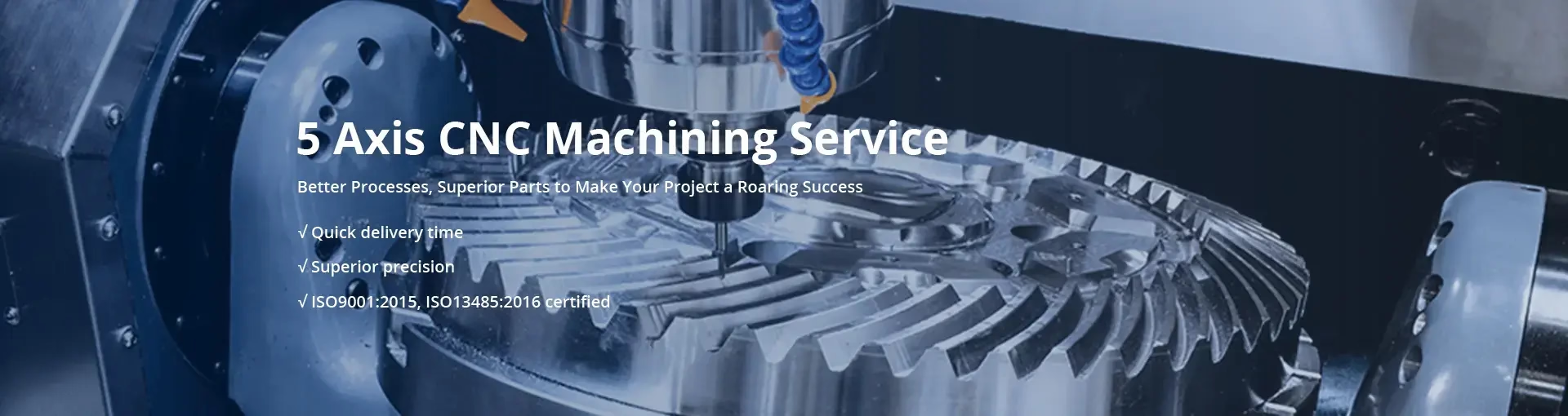
What an axis CNC machining service actually decides
More axes are not automatically better. The right count comes from the part, not the machine list.
What the axis count changes on the shop floor
A machining center has a fixed number of controllable axes. Three linear axes move the tool in X, Y and Z. A fourth axis rotates the workpiece, usually on a rotary table. A fifth axis tilts it, so the tool can approach a face from an angle instead of only from above.
The practical difference is setup count. Every time an operator unclamps a part and turns it to reach a new face, the datum moves a little. On a three-axis job with six machined faces, that can mean five or six setups, each one a chance to lose 0.02 mm of position. A fixture that repeats to ±0.002 mm helps, but it does not remove the error. It only keeps the error consistent from part to part.
This is where a simultaneous five-axis machine pays for itself. The table tilts and rotates while the tool cuts, so a deep cavity, an undercut or a compound angle can be reached without a second fixture. Positional 3+2 machining is a middle step: the table indexes to a new angle, locks, then cuts. You get the reach of five axes without continuous rotary motion.
Short tools matter more than people expect. A five-axis spindle can hold a stubby tool because it tilts the part into the cutter instead of reaching down a deep wall. Stubby tools deflect less, so the surface finish holds and the wall stays parallel. That is often the real reason a part comes off a five-axis machine in tolerance.
Which parts belong on 3, 4 or 5 axes
Three-axis work is still the fastest route for prismatic parts: plates, brackets, housings and covers where every feature is reachable from one direction. If your part fits in a vise and all the critical features sit on one face, adding axes only adds cycle time.
A fourth axis earns its place when the part is rotary by nature. Shafts, pins, bushings, cam profiles and connectors with cross-drilled holes can be cut in one clamping because the table indexes between features. The alternative is two or three separate three-axis setups and a re-datum between each one.
Five axes suit contoured surfaces and angled features. Impellers, turbine blades, orthopedic implants, robot arm joints and engine components with organic curves all fall in this group. So do parts with undercuts or pockets deeper than three times the tool diameter, where a straight tool cannot reach the floor without chatter.
There are cases where five axes are the wrong answer. A simple rectangular plate with a single flat face does not need them, and neither does a part whose tolerances are loose enough for three-axis work. Sheet metal, casting and 3D printing can also beat machining on cost for some geometries. We say so when that happens.
Axis count compared on the same shop floor
Typical figures from our Dongguan and Singapore plants.
| Machine type | Best for | Typical setups | Tolerance |
|---|---|---|---|
| 3-axis (27 machines) | Prismatic plates, brackets, covers | 1–2 | ±0.005 mm |
| 4-axis (12 mills) | Shafts, bushings, cross-drilled parts | 1 | ±0.005 mm |
| 3+2 positional (16 centers) | Angled faces, deep pockets, undercuts | 1 | ±0.005 mm |
| Simultaneous 5-axis (16 centers) | Impellers, blades, contoured implants | 1 | ±0.005 mm |
Materials and the limits each one puts on the cut
Aluminium is the easiest group to machine at high axis counts. Grades 6061, 7075 and 6082 cut cleanly at high spindle speeds, and a five-axis toolpath can run a 4,000 mm part without a fixture change. Thin walls down to 0.8 mm are practical if the toolpath keeps the load steady.
Stainless 304 and 316 work-harden if the tool rubs instead of cuts. On a five-axis job this shows up in corners, where the rotary motion slows and the chip load drops. We adjust feed per tooth rather than spindle speed to keep the edge engaged. Titanium Ti-6Al-4V and Inconel are harder again: heat stays in the cut, so coolant delivery and toolpath direction matter more than the axis count.
Plastics such as POM, PEEK and PC machine well but move with temperature. A five-axis cut generates less clamping stress, which helps on long thin parts, yet the part still needs to cool before final measurement. Copper, brass and beryllium copper cut freely and hold tight tolerances, though beryllium copper dust needs extraction.
Magnesium AZ31B and AZ91D are light and fast to cut, but chips are flammable. We run them on dedicated machines with chip handling that keeps the swarf clear. If your alloy is not on our list, send the datasheet and we will say whether it is worth quoting.
How we hold tolerance across multiple axes
Rotary axes introduce error that a linear machine does not have. A tilted table adds a small angular error that becomes a position error at the tool tip, and the further the tool is from the center of rotation, the larger that error grows. Machine geometry is calibrated on a schedule to keep this in check.
In-process probing catches drift before the part is finished. We probe the datum and key features while the part is still clamped, so any shift is corrected in the same setup rather than found at final inspection. On parts with a ±0.005 mm callout, that is the difference between scrap and a shipped part.
Every part is inspected before shipment. That covers a raw material check, in-process monitoring and a final inspection, with reports on request. Across the plants the qualification rate runs at 99.99%, and the historical probability of a late delivery is below 2%.
Surface finish depends on the toolpath as much as the machine. We hold Ra 0.8–1.6 μm as a standard machined finish, Ra 1.6–3.2 μm as-machined where the drawing allows it, and Ra 0.2–0.8 μm on parts that need it. Anodizing, plating, powder coating, bead blasting and laser marking are all available before the part ships.
From file to first article
Send a STEP file and we return a quotation plus a free DFM analysis within 12 hours. The DFM note flags features that will need a fifth axis, a custom fixture or a change to the drawing, so you see the cost driver before you commit. There is no minimum order quantity: one prototype and a 10,000-part run go through the same front end.
Production can start within 24 hours of a released order, and parts usually ship in 3–5 days. Uploads are treated as confidential, and an NDA is available on request. If your program needs a first article inspection report or a specific certificate package, tell us at the quote stage rather than after the run starts.
Our capacity sits across 127 high-precision CNC machines, including 16 simultaneous 5-axis centers, 12 four-axis mills, 27 three-axis machines and 16 mill-turn centers. Maximum processing size reaches 4,000 mm, with travels from 500 × 310 × 200 mm up to 4,000 × 400 × 150 mm and a Ø400 mm rotary table. Four certifications cover the plants: ISO 9001:2015, IATF 16949:2016, ISO 13485:2016 and ISO 27001:2022.
Common questions from engineers
Do I need simultaneous 5-axis or is 3+2 enough?
If every feature can be reached after the table indexes and locks, positional 3+2 is usually faster and cheaper. Simultaneous motion is needed when the surface itself is contoured and the tool has to stay normal to it, as on an impeller blade or a curved implant face.
Send the model and we will tell you which one the geometry actually requires. Sometimes only two or three features on the part need continuous motion.
How do you price a five-axis part compared with three-axis?
Price follows setup count, cycle time and inspection effort, not the axis count by itself. A part that goes from three setups to one often costs less on a five-axis machine even at a higher hourly rate, because the operator touches it once.
A part that fits in a vise with all features on one face will not get cheaper from a fifth axis. We quote the process we would run, and we say when three axes win.
What tolerances can you hold on rotary axes?
We work to ±0.005 mm (±0.0002 in) on qualified features. The achievable figure on any given part depends on how far the feature sits from the center of rotation and on the material.
Parts with a tight callout get probed in-process while still clamped, and we can supply inspection reports on request.
Can you machine a prototype and then run production on the same process?
Yes. There is no minimum order quantity, so a single prototype can be cut on the same machine type and with the same fixture concept as the later run. That keeps the first article representative.
If the geometry changes between prototype and production, the DFM analysis is re-run before the production order is released.
Which materials do you machine most often?
Aluminium 6061-T6 and 7075, stainless 304, 316 and 17-4PH, steel 4140 and 4340, titanium Ti-6Al-4V, and engineering plastics such as POM and PEEK.
Inconel, magnesium and beryllium copper are also run, with the handling those alloys need. Send the datasheet if you are unsure.
How is confidentiality handled?
Uploads are secure and confidential. We can sign your NDA or provide ours before files are transferred, and access to drawings is limited to the people running the job.
ISO 27001:2022 covers our information security management, which matters when the part is a pre-release design.
Send the model, get a process recommendation
Quotation and free DFM analysis within 12 hours. Tell us the part and we will say which axis count it needs.
12-hour quoteDFM included100% inspectionNo MOQ









