
Basic Knowledge of 3 Axis CNC Milling
This page covers how 3-axis milling works, what geometry it handles well, and how to set up a part so the first run fits. It is written for design engineers and buyers who need to decide between 3-axis, 4-axis and 5-axis before releasing a drawing.
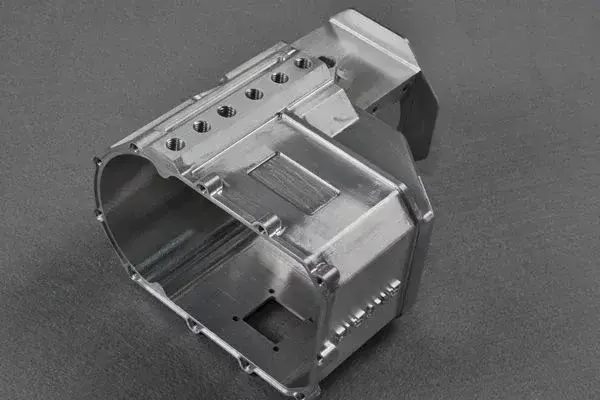
What the three axes actually do
A 3-axis mill moves the cutting tool along three linear directions. X runs left and right, Y runs front and back, Z runs up and down. The spindle stays vertical on most machines. The workpiece is clamped to the table and does not rotate during the cut.
That single fixed orientation is the whole story. Every feature you machine is reached from one direction unless you stop the program and re-clamp the part. A pocket, a slot, a drilled hole pattern and a contoured wall can all come off one setup if they face the spindle.
Picture a cube on the table. The top face is easy. The four side faces and the bottom face each need their own setup, or a re-fixture, or a different machine. That is not a weakness. It is the constraint that sets the cost of the part.
Which parts suit three axes
Flat plates, housings, brackets, manifolds and covers with features on one or two faces are the natural home of this process. Prismatic parts, in other words. If a designer can lay the part flat and reach every critical feature from above, the setup count stays low and the price follows.
Pockets with vertical walls, stepped shoulders, counterbores, tapped holes and open contours are all routine. So are parts that need a tight flatness or parallelism callout on a single face, because the part sits still and the geometry is measured from one datum.
Parts with undercuts, deep side slots, or holes that cross at odd angles are harder. An undercut means the tool cannot reach the feature from above without gouging the wall. Those parts usually move to a 4-axis or 5-axis machine, or get split into two pieces that bolt together.
- 1Good fitPrismatic parts, one or two machined faces, pockets, slots, bolt patterns
- 2WorkableParts with four sides of features if the volume justifies extra setups
- 3Poor fitUndercuts, organic surfaces, impeller blades, deep angled cross-holes
Setup count drives cost and error
Every time the part leaves the vise, two things happen. You lose time, and you stack a new positional error on top of the last one. A three-setup job has three chances to drift. A one-setup job has one.
So the first question on a drawing review is not how tight the tolerance is. It is how many orientations the part needs. If a designer can consolidate features onto a single accessible face, the shop can hold position better and quote lower.
For multi-setup work, we use a common datum and re-probe the part after each re-clamp. On our three-axis machines the working envelopes are 500 × 500 × 450 mm, 600 × 600 × 600 mm and 750 × 1,150 × 550 mm, so most plate and housing work fits without repositioning mid-cut.
What accuracy to expect, and what to avoid
On a rigid setup with a sharp tool, a 3-axis mill holds ±0.005 mm on critical features and Ra 0.8–1.6 μm on a milled face. As-machined surfaces sit around Ra 1.6–3.2 μm. A finishing pass with a small stepover gets you into the Ra 0.2–0.8 μm range on flat faces and shallow contours.
Those numbers assume the part is not moving. Thin walls below about 1 mm deflect under cutting force, and no machine can compensate for that. Deep pockets with a length-to-diameter ratio above 4:1 need a smaller tool, which flexes more and slows the feed.
Tolerance also depends on datum choice. If a drawing calls a tight position on a hole relative to a face that gets re-clamped, the shop has to fight the setup. Tie critical callouts to a datum that stays accessible in the same orientation and the process gets predictable.
Three axes against four and five
Use this to decide which process a part belongs on before quoting.
| Process | How it moves | Best for | Watch out for |
|---|---|---|---|
| 3-axis | X, Y, Z linear only | Prismatic parts, one or two faces | Multiple setups for side features |
| 4-axis | X, Y, Z plus one rotary | Cylindrical parts, holes around a shaft | Rotary table limits part size |
| 5-axis | Three linear plus two rotary | Organic shapes, angled holes, undercuts | Higher hourly rate, longer programming |
| Mill-turn | Turning plus milling in one setup | Shafts with flats and cross-holes | Not for large flat plates |
Material choices and cutter selection
Aluminium is the easy case. Grades like 6061, 7075 and 6082 cut fast with two- and three-flute carbide end mills at high spindle speed. Stainless 304 and 316 work-harden, so the cutter has to stay in the cut with a steady feed and sharp edges. Titanium Ti-6Al-4V needs lower surface speed and rigid workholding to stop chatter.
Steel grades such as 1045, 4140 and 4130 sit in the middle. They machine well with coated carbide and a flood coolant, though pre-hardened stock above 35 HRC will wear tools quickly. Plastics like POM, PEEK and ABS cut cleanly but need sharp tooling and air blast to clear chips, because heat builds up fast.
Tool selection follows the feature, not the material alone. A long-reach cutter for a deep pocket will chatter before the machine reaches its own limit. If a pocket is deeper than three times the cutter diameter, expect to slow the feed or add a roughing pass with a larger tool first.
What to check before you release a drawing
Look at each face that carries a tolerance and ask which direction the tool comes from. If that direction is not the top of the part as clamped, the feature needs a second setup or a different machine. Fix it in CAD, not on the shop floor.
Then check internal corners. A cutter has a radius, so a square internal corner is not machinable without a broach or EDM. Add a corner radius at least a third of the pocket depth and the part stays on the mill.
Finally, check thread depth and hole depth. A blind tapped hole needs clearance for the tap and the chip. A rule of thumb is thread depth plus two pitches of run-out at the bottom. Tighter than that and the tap bottoms out.
Common questions
Can a 3-axis machine drill a hole at an angle?
Only if the part is tilted in the fixture so the hole axis lines up with the spindle. That works for a single angle on a small part, but it adds a setup and a re-probe.
For several angled holes on one part, a 5-axis machine is usually cheaper overall than building a tilted fixture.
How many setups does a typical part need?
Most flat housings and brackets need one or two. A part with features on all six faces can need four or more, and the cost climbs with each one.
We review the drawing and tell you which faces drive the setup count before quoting, so you can decide whether to redesign.
What is the smallest internal corner radius you can cut?
It depends on the cutter. A 3 mm end mill leaves a 1.5 mm corner radius and reaches about 12 mm deep before chatter becomes a problem.
Specify a corner radius that a stock cutter can reach. If the drawing calls a sharp corner, the part needs EDM or a redesign.
Does 3-axis milling work for prototypes and short runs?
Yes. Setup is fast and programming is simpler than 5-axis, so one-off parts and small batches are economical.
There is no minimum order quantity here. We run from a single prototype up to 10,000-piece runs on the same process.
How do you hold tolerance across multiple setups?
We use a common datum that stays on the part through every setup, and re-probe the workpiece after each re-clamp.
Critical callouts are tied to that datum, and 100% inspection before shipment confirms the position on the finished part.
What surface finish can I expect from a milled face?
As-machined faces land around Ra 1.6–3.2 μm. A finishing pass brings that to Ra 0.8–1.6 μm, and a light finishing cut with a small stepover reaches Ra 0.2–0.8 μm.
If the part needs a mirror finish, bead blasting or polishing after milling is more reliable than chasing it with the cutter.
Send a drawing and get a setup plan
We review your part for setup count, tool reach and tolerance, then quote with a DFM note inside 12 hours. No minimum order quantity.
12-hour quote100% inspectionNDA on request









