
Basic Knowledge of Vertical CNC Milling Machines
This page explains how a vertical CNC mill is built, how it cuts, and where its limits sit. It is written for design engineers and buyers who need to judge whether a VMC fits a part before sending it out for quote.
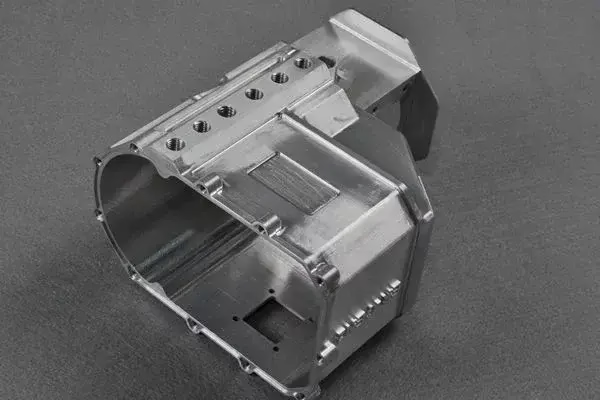
What a vertical CNC mill actually is
Spindle above the part, table below, three linear axes as the baseline.
How a vertical machining center is built
A vertical CNC milling machine, usually shortened to VMC, holds the spindle on a vertical axis above the workpiece. The tool rotates in the spindle and moves down into the part. The table carries the workpiece and travels in X and Y, while the spindle head moves in Z. On many VMCs the table also moves in Z instead, depending on the builder. Either way, the cutting action stays the same: a rotating tool fed into a clamped part.
This layout is the opposite of a horizontal machining center, where the spindle points sideways and the part sits on a tombstone or indexer. Vertical machines trade some chip evacuation and reach for easier setup, better visibility of the cut, and lower fixturing cost. For most 3-axis work under 1,000 mm, that trade is worth taking.
The structure matters as much as the axes. A cast iron base, a rigid column, and preloaded linear guides decide how much chatter you get at full depth of cut. A light frame can still hold ±0.005 mm on a finishing pass, but it will struggle with a 20 mm end mill taking 5 mm radial engagement in 4140 steel.
- 1FrameCast iron or polymer concrete bed absorbs vibration; steel weldments ring more.
- 2SpindleBelt-driven to 8,000 rpm or integral to 15,000+ rpm; higher speed suits aluminium.
- 3GuidesLinear rails for speed, box ways for heavy cuts and damping.
- 4ControlLook-ahead and servo tuning decide accuracy on contoured surfaces.
3-axis, 4-axis, and 5-axis: what changes
A 3-axis VMC moves X, Y, and Z only. Every feature you cut must be reachable from the top, or the part has to be re-fixtured for a second setup. That second setup is where most errors creep in, because the datum shifts a little each time you unclamp.
A 4-axis machine adds a rotary table, usually turning about the X axis. Now you can cut four sides of a part in one setup. Shafts, impellers with straight flutes, and parts with bolt patterns around a bore become far simpler. A Ø400 mm rotary table covers most of this work.
A 5-axis machine adds a second rotary axis, so the tool can tilt relative to the part. This lets you cut undercuts, deep pockets with short tools, and complex contoured surfaces without re-fixturing. It also lets you keep the tool perpendicular to a curved surface, which gives a better finish and longer tool life. The trade is programming time and machine cost.
Which machine fits which part
Match the geometry to the axis count before you worry about tolerance.
| Part feature | Best axis count | Why |
|---|---|---|
| Flat plate, pockets from one side | 3-axis | All features reachable from top; single setup. |
| Holes on four sides of a block | 4-axis | Rotary table indexes the part; one datum. |
| Impeller or turbine blade | 5-axis | Tilted tool reaches twisted surfaces in one pass. |
| Deep pocket, tool must stay short | 5-axis | Tool tilt avoids long, flexing end mills. |
| Large frame, 3,000 mm long | 3-axis gantry | Travel 4,000 × 400 × 150 mm on our largest bed. |
| Turned shaft with milled flats | Mill-turn | Turning and milling in one setup; no re-chuck error. |
Workholding and setup decide the result
The machine only cuts as well as the part is held. A vise is fine for a block with parallel sides. Beyond that, you need soft jaws machined to the part profile, a fixture plate with dowel pins, or a vacuum chuck for thin plates. Thin walls deflect under clamping force, so light cuts and support from below matter more than spindle power.
For a first article, we often leave tabs or a sacrificial base so the part stays attached during the last operation. The tabs get cut by hand or on a second pass. It sounds crude, but it beats watching a finished part fly off the table.
Zero-point clamping systems let you move a fixture between machines without re-indicating. That helps when a part needs 3-axis roughing, then 5-axis finishing. The datum travels with the pallet, so the second setup repeats within a few microns.
- 1ViseFast, but limited to parts with two parallel faces.
- 2Soft jawsMachined to the part profile; good for round or irregular shapes.
- 3Fixture plateDowel pins and clamps locate the blank; repeatable to ±0.01 mm.
- 4Vacuum chuckHolds thin plates flat without clamp marks.
Tolerance, finish, and what drives both
A VMC can hold ±0.005 mm on a well-supported feature, but not on every feature of every part. The achievable number depends on the material, the tool reach, and how many setups the part needs. A 10 mm deep bore in aluminium is easy. A 10 mm bore 120 mm deep in 316 stainless is another story, because the long tool bends.
Surface finish follows the same logic. A sharp tool, a rigid setup, and a finishing pass with a small stepover get you to Ra 0.8–1.6 μm without extra work. Going below Ra 0.2–0.8 μm usually means a separate finishing operation or a different process.
Heat is the quiet variable. Aluminium pulls heat into the chip, so it cuts fast. Titanium and Inconel push heat back into the tool, so speeds drop and coolant matters. If a design calls for a deep pocket in Inconel, expect longer cycle times and more tool changes.
- 1Rigid setupShortest tool, fewest setups, thickest support under the cut.
- 2Sharp toolDull edges rub, raise temperature, and smear the finish.
- 3MaterialAluminium and brass cut clean; titanium and Inconel need slower feeds.
- 4Inspection100% inspection before shipment; reports on request.
When a vertical mill is the wrong choice
A VMC is not the answer for every part. If the part is a long shaft with a single turned diameter, a lathe or mill-turn center is faster and cheaper. If the part is a thin, flat panel with hundreds of holes, a turret punch or laser may beat milling on cost.
Deep, narrow cavities are another limit. A vertical spindle needs tool length to reach the bottom, and long tools chatter. A horizontal machine or an EDM sinker can reach where a VMC cannot. For hardened steel above 45 HRC, milling gets expensive fast, and grinding or EDM usually wins.
Very large parts can exceed the table. Our largest travel is 4,000 × 400 × 150 mm. Beyond that, the part has to be split or moved to a different process. It is better to know this before the design is frozen than after the quote comes back.
Common questions from engineers
What is the difference between a VMC and a CNC mill?
A CNC mill is any milling machine under numerical control. A VMC is a specific layout: vertical spindle, enclosed work area, automatic tool changer, and a table that moves the part.
In practice the terms overlap. When a shop says VMC, it usually means a 3-axis enclosed machining center with a tool carousel.
Can a 3-axis VMC cut a part with features on five sides?
Yes, but it needs multiple setups. Each time you unclamp and rotate the part, the datum shifts slightly. Two setups are common. Four or five setups add cost and risk.
If the part has tight tolerances between features on different faces, a 4-axis or 5-axis machine is usually cheaper overall because it holds one datum.
What tolerance should I put on a drawing for a VMC part?
Put the tolerance the function needs, not the tightest number you can write. ±0.005 mm is achievable on supported features, but it costs time and inspection effort.
For non-critical dimensions, ±0.1 mm or a general tolerance block is enough. That keeps the quote down and the cycle time short.
How does material choice affect the milling process?
Aluminium 6061 and 7075 cut fast with high spindle speeds. Stainless 303 and 304 are gummier and need slower feeds. Titanium and Inconel generate heat at the cutting edge and wear tools quickly.
We machine 6061, 7075, 303, 304, 316L, 17-4PH, 4140, Ti-6Al-4V, Inconel, and several plastics. Each has its own speed and feed window.
Do you inspect parts before shipping?
Yes. Every order gets raw material check, in-process monitoring, and final inspection before shipment. Inspection reports are available on request.
For first articles, we can supply dimensional reports against the drawing so you can verify before the run continues.
How many parts can you run?
There is no minimum order quantity. We run from one prototype to 10,000+ part runs.
The setup cost is the same for one part or a thousand, so the per-part price drops as quantity rises. Send the drawing and we will quote both.
Send a drawing, get a real answer
Upload your CAD file and we will return a quote with DFM notes, usually within 12 hours. No minimum order quantity, and your files stay confidential.
12-hour quote100% inspectionNo MOQNDA on request









