
BattleBot Armor Plate AR500 Steel: What CNC Machining Can and Cannot Do
This page is for builders and mechanical engineers who need a battlebot armor plate cut from AR500 steel, not a generic steel plate. We cover what 470–540 BHN does to cutters, where thick plate warps, and how to judge whether a shop can hit the geometry and weight targets your weapon class demands.
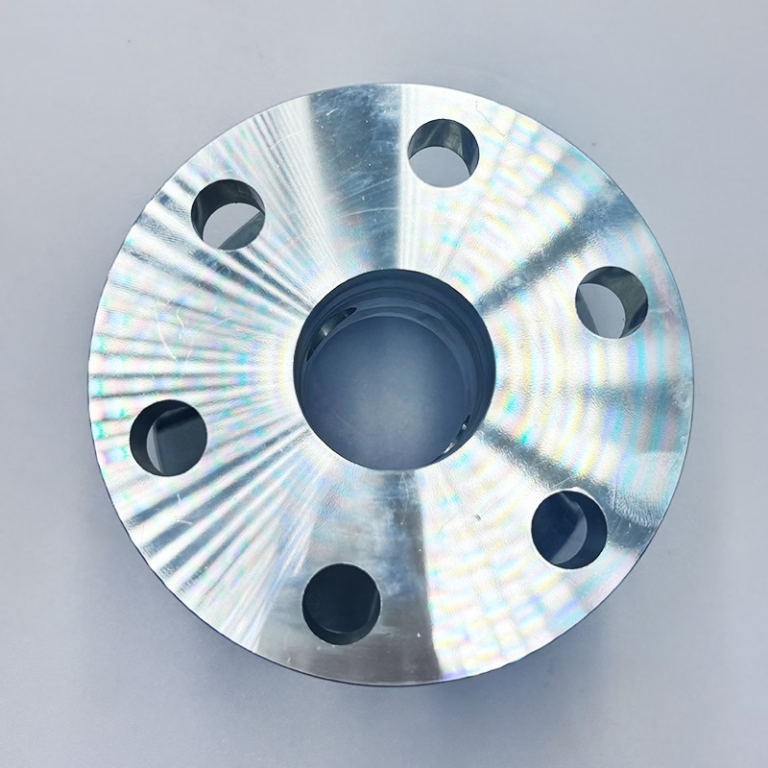
Machining Hardened Plate Is a Different Trade
AR500 behaves like no mild steel you have cut before. The hardness that stops a spinner also destroys HSS tooling in seconds.
Why AR500 Responds the Way It Does
AR500 is a through-hardened carbon-alloy steel, not a wear liner bolted on for looks. Genuine plate usually lands between 470 and 540 BHN, with tensile strength near 1600 MPa. That hardness is uniform through the thickness, so you cannot machine into a soft core and call it done. Every cut is a cut in hard steel.
For a combat robot this matters because armor sees impact, not steady load. A horizontal spinner delivers its energy into a small contact patch in a few milliseconds. Hard plate spreads that load and resists gouging better than 4140 or mild steel of the same mass. The trade-off is that the same plate fights every cutter you put near it.
Thickness usually falls between 6 mm and 20 mm depending on the weapon class and the weight budget. Thin plate saves kilograms but deflects. Thick plate survives hits but eats the weight allowance you wanted for drive and weapon motors. Most teams end up with a mixed layout: heavy AR500 at the front wedge or plow, thinner sections elsewhere.
- 1Hardness range470–540 BHN through-hardened; no soft core to cut into.
- 2Typical plate6–20 mm for front wedges, plows and side skirts.
- 3Design driverMass versus coverage, not just raw thickness.
Tool Wear and Heat in AR500 Milling
Speeds and feeds drop hard. Compared with mild steel, surface speeds on AR500 often run 70–80% lower. Carbide is not optional, and even sub-micron grades can dull after one plate if the feed per tooth is wrong. Too light a chip rubs the edge and work-hardens the surface. Too heavy a chip chips the corner.
Heat is the second problem. Tool-tip temperatures can pass 600 °C in a deep pocket, which softens the cobalt binder and turns a controlled cut into a smear. Flood coolant or high-pressure through-tool coolant is how you keep the edge alive. Air blast alone is not enough on a 16 mm plate.
Roughing and finishing should be separated. A trochoidal or high-feed roughing path clears material with a light radial engagement, then a finishing pass establishes the walls and floors. Trying to hit final dimensions in one pass is how you scrap a plate that took a week to design.
- 1ToolingCarbide only; expect short edge life and plan for it.
- 2CoolantFlood or high-pressure through-tool, not air.
- 3StrategySeparate roughing and finishing passes.
Warpage and Datum Control on Thick Plate
AR500 plate carries internal stress from rolling and heat treatment. When you remove material on one side, that balance shifts and the plate moves. On a 12 mm section we commonly see flatness drift of a few tenths of a millimeter after roughing, which is enough to break a bolted joint or jam a wedge against the arena floor.
The fix is sequencing. Rough both faces, let the plate rest, then semi-finish and finish. Where the design allows, remove material symmetrically from both sides so the stress release is even. If the part is mostly one-sided pockets, plan a stress-relief pass and accept a re-clamp.
Datum shift is the other trap. A three-axis mill profiling 16 mm plate often needs multiple setups, and each re-clamp adds error. Five-axis machining with a rotary table keeps more features in one setup, so the mounting holes, countersinks and pocket walls stay in the same coordinate frame. For armor plates with tight hole patterns, that single-setup approach is usually the difference between a bolt-on fit and a rework loop.
- 1Stress releaseRough, rest, then finish; balance material removal.
- 2Flatness riskA few tenths of a millimeter drift after roughing.
- 3SetupsFewer setups means less datum shift.
AR500 Plate vs. Common Alternatives
A quick comparison for teams balancing protection, mass and machinability.
| Material | Hardness | Machining | Best use |
|---|---|---|---|
| AR500 | 470–540 BHN | Carbide, slow, high wear | Front wedge and plow |
| 4140 | 28–34 HRC | Moderate, predictable | Frames and mounts |
| AR400 | 360–440 BHN | Easier than AR500 | Side skirts, lighter hits |
| Mild steel A36 | Low | Fast, low cost | Test rigs only |
| Titanium Ti-6Al-4V | ~36 HRC | Slow, gummy, costly | Weight-critical panels |
Where Five-Axis Machining Earns Its Keep
Armor plates are rarely rectangles. Weight relief pockets, angled deflectors, countersunk bolt holes and integrated mounting bosses all live on the same plate. A three-axis machine can do the flat work, but the angled faces and blended radii need either a tilt fixture or a fifth axis.
Five-axis work on hardened plate is not about speed. It is about reaching a feature without re-clamping. When the plate stays in one setup, the pocket floor, the counterbore and the mounting hole pattern share a datum. That keeps the plate flat against the chassis and the bolt holes aligned with the frame.
We run 16 simultaneous five-axis machining centers as part of a 127-machine shop, with travels up to 4,000 mm. For combat robot work the relevant envelope is the medium and compact machines, where a 750 × 1,150 × 550 mm work zone covers most armor plates with room for fixtures. A Ø400 mm rotary table handles angled faces without a dedicated tilt block.
- 1Single setupPockets, holes and angled faces share one datum.
- 2Rotary tableØ400 mm for angled faces and wrapped features.
- 3EnvelopeMedium and compact machines cover most plates.
When AR500 Is the Wrong Answer
AR500 is not always the right call. If the part is a bracket, a motor mount or a chassis rail, use 4140 or 1018 and save the tooling budget. Hard plate belongs where impact lands, not everywhere on the robot.
Weight is the other reason to say no. A full AR500 shell can push a robot over its class limit and leave nothing for drive. Teams often do better with AR500 at the front and thinner, easier-to-machine material at the rear. That mixed approach also shortens machining time, because you are not cutting hard steel for parts that never see a weapon.
There is a practical limit on geometry too. Deep, narrow pockets in 16 mm AR500 are slow and risky. Long thin end mills deflect and break. If a design calls for a 3 mm wide pocket at 15 mm depth, we will suggest a redesign: wider pockets, larger corner radii, or a bolted-on plate instead of a machined pocket.
- 1Use 4140 insteadBrackets, mounts and non-impact structure.
- 2Weight splitHard plate at the front, lighter material elsewhere.
- 3Redesign triggerDeep narrow pockets in thick hard plate.
What to Check Before You Send a Drawing
Ask the shop what they will do about warpage, not just what tolerance they advertise. A ±0.005 mm claim means little if the plate moves after roughing and nobody planned a stress-relief sequence. Ask about their roughing and finishing strategy on hardened plate, and whether they inspect flatness after the final pass.
Ask about tooling and coolant. A shop that runs AR500 regularly will talk about carbide grades, feed per tooth and through-tool coolant without prompting. A shop that mostly cuts aluminum will quote the job and then struggle.
Finally, check the paperwork side. For robotics teams shipping internationally, an NDA and a secure upload path matter, especially for competition-season designs. We hold ISO 9001:2015, IATF 16949:2016, ISO 13485:2016 and ISO 27001:2022, and we inspect 100% of parts before shipment with reports on request. That is a baseline, not a sales pitch. The real test is whether the plate fits the frame on the first try.
- 1Warpage planSequenced roughing, resting and finishing.
- 2Tooling talkCarbide grades and coolant should come up unprompted.
- 3ConfidentialityNDA available; uploads kept secure.
Questions Engineers Ask About AR500 Armor Plates
Can AR500 plate be laser cut instead of machined?
Laser cutting handles the outer profile and large holes, but it leaves a heat-affected zone at the cut edge. On 470–540 BHN plate that edge can crack under impact. For armor that takes hits, we machine the profile and the critical holes.
If you laser cut first, plan a machining pass on the loaded edges and the bolt holes.
What thickness should a battlebot armor plate be?
Most plates land between 6 mm and 20 mm. Front wedges and plows sit at the thick end because they take direct spinner hits. Side skirts and rear panels can be thinner.
The right number comes from your weight budget and weapon class, not a rule of thumb. Run the mass calculation before you commit to a thickness.
How much does AR500 warp during machining?
On a 12 mm plate we commonly see a few tenths of a millimeter of flatness drift after roughing, caused by internal stress release. Symmetric material removal and a rest period between roughing and finishing reduce it.
If flatness is critical, tell us the number on the drawing so the sequence can be planned around it.
Do you machine countersinks and weight-relief pockets in the same setup?
Whenever the geometry allows, yes. Keeping pockets, countersinks and mounting holes in one setup means they share a datum, so the plate bolts to the frame without a rework loop.
Deep narrow pockets in thick AR500 may still need a second operation or a design change.
What is the minimum order quantity for AR500 armor plates?
No minimum order quantity. We run from one prototype plate to 10,000+ part runs, so a single competition plate and a small production batch both fit the same process.
Quotation and a free DFM analysis come back within 12 hours.
Can you help if my design has a deep narrow pocket in AR500?
We will flag it in the DFM review. Long thin end mills deflect in hard steel, and the risk of a broken tool or a scrapped plate goes up fast.
Usual fixes are wider pockets, larger corner radii, or a bolted-on plate instead of a machined pocket.
Send Your Armor Plate Drawing for a DFM Review
Upload your CAD file and we will come back within 12 hours with a quotation and a manufacturability review, including any AR500 geometry that needs a second look.
12-hour quoteFree DFM analysis100% inspectionNDA on request









