
Buy CNC Machining Turning Services Without Guesswork
A practical guide for engineers and sourcing teams comparing turning suppliers. It covers which parts belong on a lathe, which need mill-turn, what tolerance and finish you can actually hold, and what to send for a quote. Read it and you can judge whether a shop fits your part before you place the order.
What This Page Covers
Turning is a different process from milling, and the quote you get depends on which one your part actually needs.
Turning First, or Milling First?
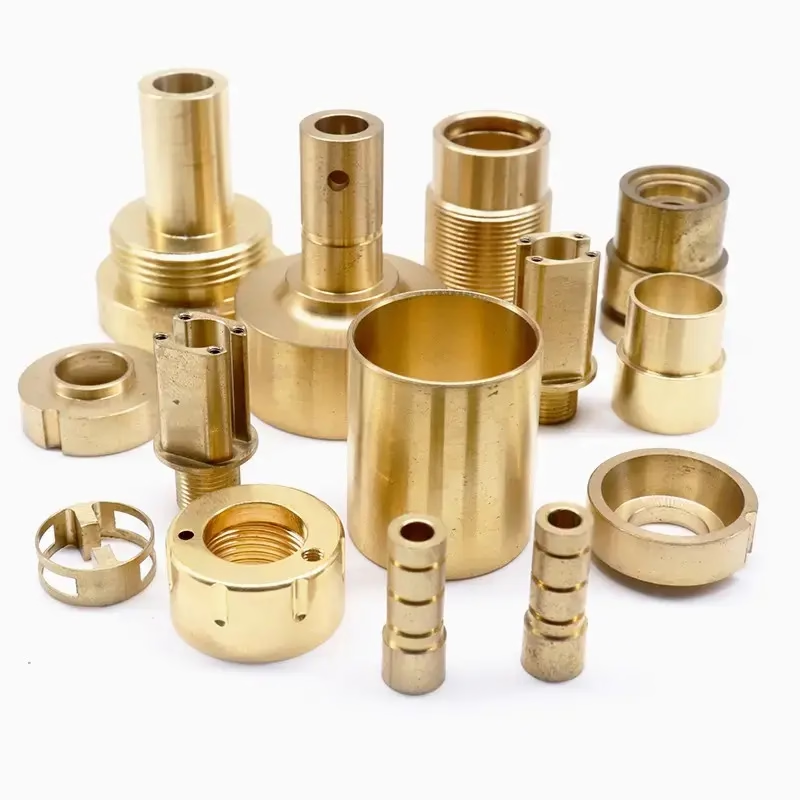
Turning removes material by rotating the workpiece against a single-point tool. If your part is round, has a bore, or carries threads, grooves, or a face that must run true to an axis, turning is usually the cheaper and faster route. A shaft, a bushing, a hydraulic fitting, a sensor housing: these are turned parts. When a drawing is mostly cylindrical, sending it to a mill wastes setup time.
Milling runs the opposite way. The tool spins and moves in X, Y, and Z while the part stays put. Pockets, slots, flat faces, and holes on multiple sides are milling work. Many real parts need both. A valve body may start as a turned blank, then get its mounting flange and port pattern milled.
That is why we quote from the drawing and the functional callouts, not from a category name. If we see the axis relationships and the critical features, we can say whether the part runs on a lathe, a mill-turn center, or a three-axis mill with a rotary table. The answer changes the price and the lead time.
A simple test before you buy CNC machining turning from anyone: count how many features sit off the main axis. One or two off-axis holes can often be done in a second op on a mill. A part with features on four sides and a tight true-position callout belongs on mill-turn or five-axis, where one setup holds the datums.
- 1Mostly round, axial featuresTurning or Swiss-type lathe. Low setup cost, fast cycle.
- 2Round plus off-axis holesTurn then mill, or mill-turn if the tolerance stack is tight.
- 3Precision bore and threadTurning, with the bore as a single-setup datum.
- 4Atypical, non-cylindricalMilling or five-axis. Turning adds no value here.
What ±0.005 mm Really Means on a Turned Part
Tolerance is not one number for the whole part. On a turned part, diameter, roundness, and concentricity between two bores are separate things, and each one drives a different cost. A ±0.005 mm callout on a 12 mm diameter ground in a controlled shop is routine. The same number on a 300 mm long shaft with a thin wall is a different conversation.
The rule of thumb: the tighter the tolerance relative to the feature size, the more the process depends on temperature, fixture rigidity, and tool wear. Aluminum moves with heat. Stainless work-hardens at the cut. Titanium pushes the tool away from the surface. If a callout is tighter than the part needs, we will flag it during DFM analysis rather than quietly burning cycle time.
Finish follows a similar logic. As-machined turning lands around Ra 1.6–3.2 μm. A fine turned or bored surface can reach Ra 0.8–1.6 μm. Below that, you are usually looking at grinding, honing, or a polished bore, which is a second operation and should be quoted as one.
So when you compare quotes, compare the same callouts. A low price on a drawing with an unclear tolerance block is not a real price. Send the drawing with the critical dimensions marked, and ask each supplier to state which features they will inspect.
Turning Feature Guide: What Fits Which Machine
Use this to decide what to ask for before you buy CNC machining turning capacity. Values are typical for our shop, not a universal rule.
| Part feature | Best process | Typical tolerance | Notes |
|---|---|---|---|
| Shaft, pin, bushing | CNC turning | ±0.005 mm on diameter | Single setup, fast cycle |
| Threaded fitting or connector | CNC turning | ±0.005 mm, thread gauge | Thread is cut in the same op as the bore |
| Housing with side ports | Mill-turn | ±0.005 mm true position | One setup keeps the bore and ports aligned |
| Flange with bolt circle | Turning + milling | ±0.01 mm on hole pattern | Turn the OD and face first, then drill |
| Long, thin shaft | Swiss-type lathe | Depends on L/D ratio | Support is the limiting factor, not the machine |
| Thin-wall tube | Turning with soft jaws | ±0.01 mm, roundness first | Chatter control matters more than spindle speed |
Material Choice Changes the Turning Quote
The same geometry in 6061-T6 and 17-4PH stainless is not the same job. Aluminum cuts fast and holds a good finish, so turned aluminum parts are usually the cheapest per piece and the easiest to hold at ±0.005 mm. It also dents, so handling and packaging matter.
Stainless 303 is the free-machining grade and behaves well on a lathe. 304 and 316 are tougher, gummier, and work-harden if the feed is too light, which means a slower cycle and more tool changes. 17-4PH in the H900 condition is strong and still machinable, but it is often the point where a shop moves to carbide inserts and a more rigid setup.
Titanium TC4 (Ti-6Al-4V) and Inconel sit at the hard end. Heat stays in the cut, tools wear quickly, and the material wants to deflect away from the tool. These parts are quoted with lower feed rates and more inspection, not because the shop is padding the price, but because the process physically takes longer.
Plastics are their own case. POM and PA turn cleanly. PEEK holds dimension but is expensive, so it is usually for small, high-value parts. Carbon fibre composites wear tools fast and need dust control. Tell us the material and the condition up front, and the quote will reflect the real cutting behavior.
- 1Aluminum 6061-T6, 7075Best cost-to-precision ratio for turned parts.
- 2Stainless 303, 316L, 17-4PHWatch work-hardening on light finishing passes.
- 3Titanium and InconelLower feed, more tool wear, tighter process control.
- 4Brass and copperCuts freely; copper needs sharp tools and good chip evacuation.
What to Send So the Quote Is Real
A turning quote is only as good as the input. The fastest path is a 3D model plus a 2D drawing with the tolerance block, material, finish, and quantity. If the drawing has GD&T, send it. If some dimensions are reference only, say so. A supplier who guesses at the critical callouts will either overprice the job or miss it.
Quantity changes the method. One prototype is turned on a lathe with soft jaws and hand measurement. A 10,000-part run may get a bar feeder, custom workholding, and a CMM program. The tolerance is the same on paper, but the process plan is not, and the per-piece price reflects that. Tell us the annual volume and the ramp, not just the first order.
Finish and marking belong in the same conversation. Anodizing, electroless nickel, and black oxide are common on turned parts, and each adds handling and masking steps. Laser marking has a minimum character height of 1.5 mm, so a dense part number may need a different placement or a larger area.
Finally, tell us what happens after the part leaves the shop. If it presses into a housing and the fit is critical, we will inspect the mating diameter, not just the nominal. If it is a spare part with a wide tolerance, we can quote a faster, cheaper route. The functional requirement is the input that makes the price make sense.
Turning vs Mill-Turn vs Milling: When Each Wins
A quick way to pick the process before you ask for a quote.
| Question | Turning | Mill-turn | 3-axis milling |
|---|---|---|---|
| Part is mostly cylindrical? | Yes, first choice | Yes, if off-axis features exist | No, wasteful setup |
| Features on multiple sides? | No, needs a second op | Yes, in one setup | Yes, with refixturing |
| Concentricity between bores? | Good in one setup | Best, no re-chuck error | Poor without a fixture |
| Setup cost for 1 part? | Low | Medium | Medium to high |
| Typical lead time on 5 parts? | 3–5 days | 3–5 days | 3–5 days |
Inspection and Paperwork on a Turning Order
A turned part can be measured wrong and still look right. The diameter is easy. The roundness, the runout between two bores, and the thread pitch diameter are the ones that cause assembly problems. We inspect 100% of parts before shipment, with raw material check, in-process monitoring, and final inspection, and we share reports on request.
Our in-house measurement includes the equipment needed to verify the callouts we quote: micrometers, bore gauges, height gauges, and a CMM for true-position and profile work. If your print calls for a first article inspection report, say so at quote time. It is a different workflow from a standard dimensional check sheet, and it should be planned, not added at the end.
For regulated industries, the paperwork matters as much as the part. We hold ISO 9001:2015, IATF 16949:2016, ISO 13485:2016, and ISO 27001:2022. The first covers general quality, the second automotive, the third medical devices, and the fourth information security. If your program needs a specific certificate on file, ask and we will confirm what applies.
Tolerance, finish, and inspection should match the drawing. If a supplier quotes ±0.005 mm but inspects with calipers only, the number is a promise, not a process. Ask how the critical features are measured before you buy CNC machining turning from any shop.
Common Questions From Engineers
Can I order one turned prototype, or is there a minimum?
There is no minimum order quantity. We run from one prototype to 10,000+ part runs.
For a single part, we typically turn it on a lathe with soft jaws and inspect the critical callouts by hand or on the CMM, depending on the tolerance.
How fast can I get a quote and parts?
Quotation and free DFM analysis come back within 12 hours. Production can start within 24 hours after you approve the plan.
Parts normally ship in 3–5 days. Our historical late-delivery probability is below 2%.
What tolerance can you hold on a turned part?
We quote to ±0.005 mm (about ±0.0002 in) on turned features, depending on size, material, and wall thickness.
On long or thin-wall parts, the limiting factor is usually deflection and heat, not the machine. We will tell you during DFM if a callout needs a different approach.
Which materials do you turn most often?
Aluminum 6061-T6, 7075, and 2024; stainless 303, 304, 316L, and 17-4PH; steel 1018, 1045, and 4140; brass C36000; copper C110; titanium TC4; and plastics such as POM, PA, and PEEK.
If you are not sure which grade fits the function, send the application and we will suggest one.
Do you offer finishing and marking on turned parts?
Yes. Anodizing (clear, colour, hardcoat, conductive), electroless nickel, zinc, silver and gold plating, powder coating, black oxide, bead blasting, tumbling, brushing, and polishing.
Laser marking and engraving are available with a minimum character height of 1.5 mm.
How do you handle confidentiality on my drawings?
Uploads are secure and confidential. We can sign an NDA on request before you send files.
We hold ISO 27001:2022 for information security, which covers how design data and production records are handled.
Send the Drawing. Get a Real Turning Quote.
Upload your model and drawing, and we will return a quotation with free DFM analysis within 12 hours. Tell us the material, the critical callouts, and the volume, and the price will reflect the actual process.
12-hour quoteNo minimum order100% inspectionNDA on request









