
Buy SS CNC Machining Parts: What to Specify
This page is for engineers and buyers sourcing stainless steel machined parts. It covers the grades we run, the tolerance and finish you can ask for, and the points worth checking before you place a purchase order.
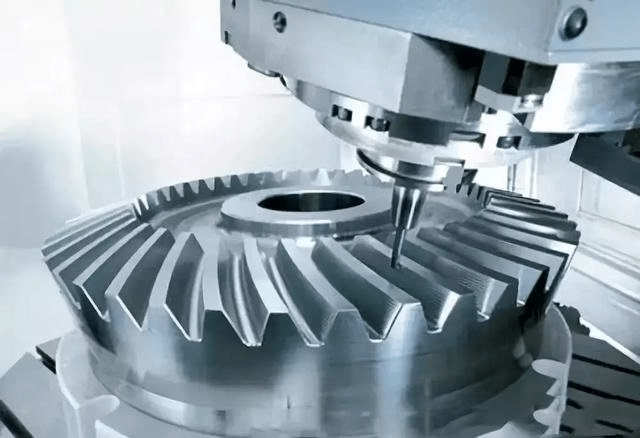
Buying Stainless Steel Machined Parts Without Guesswork
Grade, geometry, and finish decide the price and the lead time. Here is how those three interact.
Pick the Grade Before You Ask for a Price
Stainless is not one material. A quote for 304 is not a quote for 316L, and neither one predicts what 17-4PH will cost. When you buy SS CNC machining parts, the alloy drives cutting speed, tool wear, and how much stock you can take in one pass. 303 machines fastest because of its sulfur content, so it suits bushings, fittings, and high-volume turned parts where corrosion resistance is moderate. 304 gives better corrosion resistance and weldability but tends to gum up on finishing passes.
316 and 316L add molybdenum for chloride resistance. They belong in marine hardware, food equipment, and medical fixtures. 17-4PH is a precipitation-hardening grade. It machines in the annealed state and then reaches high strength after heat treatment, which makes it common for shafts, valves, and aerospace brackets. 420, 430, 431, and 440C cover the harder wear applications such as knife components and pump parts.
One rule of thumb from the shop floor: if a part needs deep pockets or thin walls, 303 and 304 behave very differently. 303 chips break cleanly. 304 work-hardens at the cut, so a light finishing pass on a thin rib can push the material past the point where the tool cuts it cleanly. Tell us the wall thickness at the quoting stage and we will pick the grade or the strategy that holds the feature.
- 1303Best machinability, moderate corrosion resistance, turned parts
- 2304 / 316LBetter corrosion resistance, watch work hardening on thin walls
- 317-4PHAnnealed machining, then heat treat for high strength
- 4440C / 420Hardened wear parts, slower cutting, more tool wear
What ±0.005 mm Actually Applies To
Our general machining tolerance is ±0.005 mm. That figure applies to specific dimensions you call out, not to every feature on the drawing. A 300 mm long stainless shaft cannot hold ±0.005 mm over its full length without a second operation or a temperature-controlled setup, so we flag those features before quoting rather than after.
Geometry matters as much as the number. A stainless part with a 6:1 depth-to-diameter ratio in a bore is a different job than an open pocket. Deep holes need peck drilling and sometimes a gun drill, and the tool can wander. Thin floors deflect under cutting force. Sharp internal corners in a milled pocket require a small cutter, which means slower feed rates and more passes. If you can add a corner radius, the part gets cheaper without losing function.
We run 127 high-precision CNC machines, including 16 simultaneous 5-axis machining centers, 12 four-axis mills, 27 three-axis machines, and 16 mill-turn centers. Maximum processing size is 4,000 mm, with travels of 4,000 × 400 × 150 mm on the large frames and 750 × 1,150 × 550 mm on the medium ones. A Ø400 mm rotary table handles parts that need access from several faces in one setup. Fewer setups usually means tighter true position between features.
- 1Call out critical dims±0.005 mm applies to the features you mark, not the whole drawing
- 2Deep boresAbove 6:1 depth-to-diameter, expect peck drilling and longer cycle time
- 3Corner radiiA radius instead of a sharp corner removes a small-cutter operation
Finish Choice Changes Cost More Than Grade
Stainless parts often look finished when they leave the machine, which hides the fact that surface finish is a separate decision. As-machined surfaces sit around Ra 1.6–3.2 μm. A high-quality finish is Ra 0.8–1.6 μm, and fine finishing reaches Ra 0.2–0.8 μm. Each step up adds passes and inspection time.
For stainless, bead blasting is the usual way to even out tool marks and give a uniform matte look. Tumbling and brushing work for small parts in bulk. Polishing goes further for sanitary or appearance-critical faces. Laser marking is available for part numbers and traceability codes, with a minimum character height of 1.5 mm so the mark stays legible after finishing. We also run electroless nickel, zinc, silver, and gold plating, powder coating, black oxide, and anodizing on the aluminum side of the shop.
Passivation deserves its own line on the purchase order. Machining leaves free iron on the surface, and that iron is where corrosion starts. A nitric or citric passivation step after machining removes it. If your part goes into a washdown environment or a medical device, specify passivation and ask for the report.
- 1Bead blastingEvens out tool marks, uniform matte finish
- 2PassivationRemoves free iron after machining; specify it for wet environments
- 3Laser markingMinimum character height 1.5 mm, survives finishing
Inspection, Documentation, and How Fast Parts Move
Every order gets 100% inspection before shipment. That covers a raw material check, in-process monitoring, and a final inspection, with reports available on request. For stainless parts that will be welded or heat treated, we can supply mill certificates so you know what went into the part.
Our plants hold ISO 9001:2015, IATF 16949:2016, ISO 13485:2016, and ISO 27001:2022. The last one matters more than it sounds. It covers information security, so your drawings and models stay controlled. Uploads are secure and confidential, and an NDA is available on request if your program needs one.
On timing: quotation and free DFM analysis come back within 12 hours. Production can start within 24 hours of approval, and parts ship in 3–5 days. Historical late-delivery probability is below 2%. There is no minimum order quantity, so a single prototype and a 10,000+ part run go through the same process. If your project has a hard date, say so early and we will tell you whether the schedule is realistic.
- 112 hoursQuotation and free DFM analysis turnaround
- 23–5 daysTypical shipping window after production start
- 3No MOQFrom one prototype to 10,000+ parts
Stainless Grades at a Glance
Typical shop-floor behavior for the grades we run most.
| Grade | Machinability | Corrosion resistance | Typical parts |
|---|---|---|---|
| 303 | Excellent, free-cutting | Moderate | Bushings, fittings, turned hardware |
| 304 / 304L | Good, work-hardens | Good, general purpose | Brackets, housings, food equipment |
| 316 / 316L | Fair, gummier | High, chloride resistant | Marine, medical, chemical fixtures |
| 17-4PH | Good in annealed state | Good, high strength after aging | Shafts, valves, aerospace brackets |
| 420 / 440C | Fair, abrasive | Moderate, wear focused | Knife parts, pump components |
| 430 / 431 | Good | Moderate | Decorative and structural parts |
Finish and Tolerance Options
| Item | Value | Notes |
|---|---|---|
| General tolerance | ±0.005 mm | Applies to called-out dimensions |
| Tolerance (imperial) | ±0.0002 in | Same features, imperial drawing |
| As-machined finish | Ra 1.6–3.2 μm | Standard after cutting |
| High-quality finish | Ra 0.8–1.6 μm | Added passes and inspection |
| Fine finish | Ra 0.2–0.8 μm | Appearance and sealing faces |
| Max part size | 4,000 mm | Large-frame travels 4,000 × 400 × 150 mm |
Common Questions
Can you machine 316L parts with thin walls?
Yes, but wall thickness changes the strategy. 316L work-hardens at the cut, so a light finishing pass on a thin rib can push the material past the point where the tool cuts cleanly.
Send the wall thickness and the tolerance on that feature with your RFQ. We will either adjust the toolpath, add a support, or tell you the feature needs a different grade.
Do stainless parts need passivation after machining?
If the part sees moisture, washdown, or a medical environment, specify passivation. Machining leaves free iron on the surface and that is where pitting starts.
We can run nitric or citric passivation after machining and include the report with the shipment.
What is the smallest quantity I can order?
There is no minimum order quantity. One prototype and a 10,000+ part run both go through the same process.
For single parts, expect the setup to be a larger share of the price. That is normal for stainless.
How do I know the material is what I ordered?
We do a raw material check as part of incoming inspection, and mill certificates are available on request.
For parts that will be welded or heat treated, ask for the certificate with the quote so it is built into the paperwork.
Can you hold ±0.005 mm on a long stainless shaft?
Not over the full length in one pass. ±0.005 mm applies to the dimensions you call out, and long features usually need a second operation or a temperature-stable setup.
We flag these features during DFM analysis so the tolerance and the price match what the part actually needs.
How fast can stainless parts ship?
Quotation and free DFM analysis come back within 12 hours. Production can start within 24 hours of approval, and parts ship in 3–5 days.
Historical late-delivery probability is below 2%. If you have a hard date, tell us at the RFQ stage.
Send Your Stainless Part for a Quote
Upload your drawing or STEP file and we will return a quote with DFM notes within 12 hours.
12-hour quoteNo MOQ100% inspectionNDA on request









