
Cheap Price Provide CNC Machining Parts Service
This page is for engineers and buyers comparing quotes for machined parts. It explains where the money actually goes in a cheap price provide CNC machining parts service, which features drive cost up, and how to read a quote before you place a purchase order.
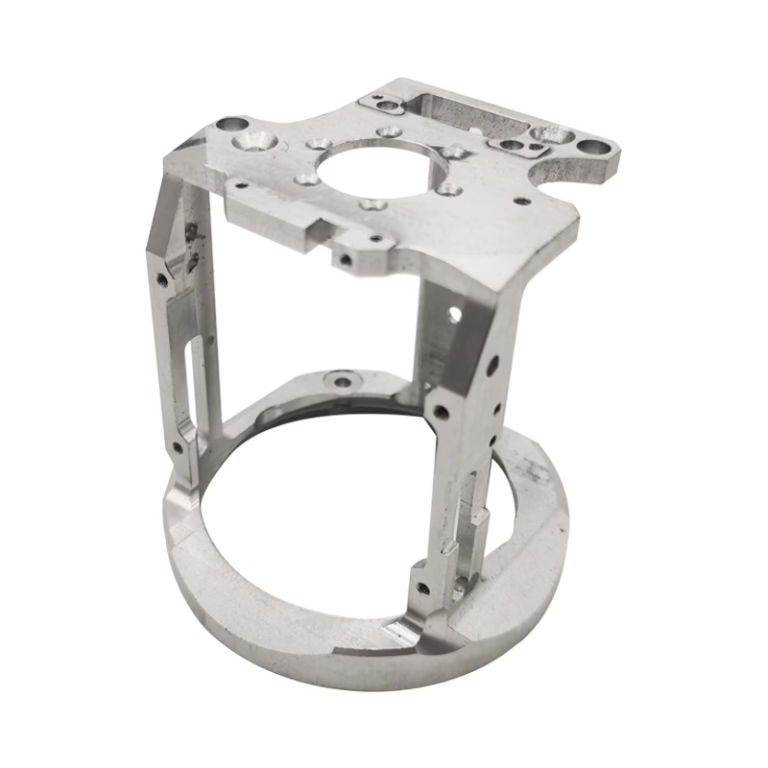
What Cheap Means on a CNC Quote
Unit price is the last number to look at, not the first.
Where the Money Goes in a Machined Part
A machined part price is four numbers added together: material, machine time, programming and setup, and inspection and documentation. Material and setup dominate a 20-piece run of a simple aluminum bracket. Machine time takes over once quantities climb past a few hundred pieces. Inspection stays roughly proportional to the number of critical features, not to the batch size.
Programming and fixturing are one-time costs. A part with six setups carries six times the setup burden of a part with one. This is why redesigning a bracket so it can be cut from two sides instead of five often drops the price more than any negotiation over hourly rates. Ask the shop what it would change on your drawing. A useful answer means they actually read it.
Material choice moves the number fast. Switching from 7075 to 6061 aluminum cuts both stock cost and cutting time. A 17-4PH stainless part runs several times the price of the same geometry in 303. If the application allows a softer alloy, that is often the single largest saving available, and it costs nothing in quality.
- 1Setup countEach additional setup adds fixturing, load time and cumulative tolerance error.
- 2Material gradeHarder alloys cut slower and wear tooling faster.
- 3Feature countEvery tight-tolerance hole has to be measured, not just cut.
- 4QuantitySetup cost spreads across the run, so volume lowers unit price.
Tolerance Is the Biggest Hidden Cost Driver
General tolerances on a machined drawing are cheap to hold. Tight ones are not. A feature called out at ±0.05 mm runs on standard tooling and normal feeds. The same feature at ±0.005 mm requires more passes, more measurement, and sometimes a temperature-controlled room and a finishing operation after heat treat.
Not every dimension needs to be tight. Engineers who mark only the features that affect function get lower quotes and fewer rejections, because the shop can then focus inspection where it matters. When a whole drawing is boxed with a single tight title-block tolerance, the shop must measure everything to that standard, and you pay for all of it.
Surface finish follows the same logic. As-machined surfaces run around Ra 1.6–3.2 μm and need no extra operation. A sealing face at Ra 0.8–1.6 μm may need a finishing pass. Below Ra 0.8 μm often means additional polishing or lapping, which is a separate cost line and a separate inspection step.
- 1±0.05 mmStandard milling and turning, no special process.
- 2±0.005 mmFinishing passes, careful clamping, in-process checks.
- 3Ra 1.6–3.2 μmAs-machined, no extra operation.
- 4Ra 0.2–0.8 μmAdditional finishing and separate inspection.
What Raises and Lowers the Price
Same part geometry, different requirements. The gap is often larger than the gap between two shops.
| Part requirement | Effect on price | Why |
|---|---|---|
| One setup instead of four | Lower | Less fixturing, less handling, less stacked tolerance |
| 6061 instead of 17-4PH | Lower | Faster cutting, cheaper stock, longer tool life |
| ±0.05 mm instead of ±0.005 mm | Lower | No finishing passes, simpler measurement |
| As-machined instead of polished | Lower | No separate finishing operation or re-inspection |
| 5-axis instead of 3-axis plus fixtures | Often lower | Complex angles cut in one setup, no custom fixtures |
| Full material and inspection reports | Higher | Extra documents, traceability and staff time |
| Hardcoat anodize plus laser marking | Higher | Two outside operations and a handling step between them |
When a Low Price Is Fine and When It Is Not
A low price is a good sign for simple parts. Flat plates, spacers, covers and brackets with loose tolerances and no cosmetic requirement can be made almost anywhere at almost the same cost. There is little process risk to hide, so shopping on price is reasonable.
The picture changes with parts that touch a moving assembly. A housing that sets bearing preload, a manifold with a sealing face, an implant component, or anything going into a crash structure has a failure cost far above the part price. Here a low quote usually means one of three things: fewer inspection steps, thinner material certification, or a shop that has not understood the drawing.
The middle ground is where most projects live. A prototype batch that only needs to fit and function can accept a looser tolerance and skip cosmetic finishing. The same part in production may need hardness testing, first-article reports and process capability data. Buying the cheap version first and the correct version later is normal. Paying for the tight version when the part is only used for a fit check is not.
What a Good Value Quote Actually Contains
A quote you can trust names the material grade, the tolerance class, the surface finish and the inspection level. It states the quantity, the lead time and whether finishing is included. If any of those are missing, the price is not comparable to another quote, and the cheapest number may simply be the vaguest one.
Look for feedback on the drawing. A shop that comes back with a note about a hard-to-reach feature, an unrealistic tolerance, or a cheaper material option has done engineering work before cutting metal. That work is worth more than a small discount.
Documentation matters too. Material certificates, first-article inspection reports and dimensional reports cost something to produce, but they protect you when a part fails or an audit arrives. For medical, automotive and aerospace work they are not optional. For a shop fixture they usually are.
Confidentiality belongs in the same conversation. Uploads should stay private, and an NDA should be available before you send a full assembly. A supplier that treats your drawings casually will treat your delivery dates the same way.
- 1Named materialGrade and condition, not just alloy family.
- 2Stated tolerancePer feature or per title block, clearly written.
- 3Finish definitionProcess and Ra value, so two quotes can be compared.
- 4Inspection scopeWhat is measured, and what report you receive.
Common Questions
Can a cheap price provide CNC machining parts service still hold tight tolerances?
Yes, if the tight tolerance is only on the features that need it. A shop with the right machines can hold ±0.005 mm on a few critical dimensions while leaving the rest at general tolerance. The price reflects the measurement and finishing work, not the whole part.
A quote that claims tight tolerance everywhere at a very low price is worth questioning. Ask which features are measured and what report you get.
Is it cheaper to machine a part in one setup?
Usually, yes. Each setup adds fixturing, load and unload time, and another chance for stacked tolerance error. Five-axis machining lets complex parts be cut from several directions in one setup, which often removes custom fixtures entirely.
For parts with features on four or five faces, a 5-axis quote can come in below a 3-axis quote plus fixtures.
How does quantity change the unit price?
Programming and setup are fixed costs. Spread over 10 pieces they dominate the price. Spread over 5,000 they nearly disappear, and material and machine time set the number.
This is why a prototype is never the cheapest way to buy a part, and why asking for a price break at 100 and 1,000 pieces is useful even if you only need 20 today.
Do surface finishing and heat treat add lead time?
They add operations, and operations take time. Anodizing, plating, powder coating and heat treat are usually sent to a specialist and then returned for final inspection. Each handoff is another chance for a scratch or a delay.
If a part needs both heat treat and tight tolerance, plan the sequence carefully. Heat treat can move dimensions, so critical features may need a finishing cut afterward.
What should I send to get an accurate quote?
Send a 3D model plus a 2D drawing with tolerances, material, finish and quantity. If you have a target price or a preferred process, say so. The more of that you supply up front, the fewer assumptions end up in the number.
Mark the critical dimensions. If everything is critical, nothing is, and the shop has to price for the worst case.
Is a domestic shop always more expensive than an overseas one?
Not always. Freight, duty, travel for a plant visit and the cost of resolving a quality problem remotely all add to the landed cost. For simple parts the gap can still favor overseas production. For a part that stops a line, the recovery time usually decides it.
Compare total cost, not unit price.
Get a Quote You Can Compare
Send a model and drawing. We return a quotation and a free DFM analysis within 12 hours, with the material, tolerance and finish written out.
12-hour quote100% inspectionNo MOQNDA on request









