
China CNC Processing Services for Custom Metal and Plastic Parts
This page explains how GreatLight runs China CNC processing services for engineers and procurement teams in North America and Europe. It covers machine capacity, materials, tolerances, inspection and the questions worth asking before you send a drawing. Read it and you can judge whether a part fits our process, and what to specify on the RFQ.
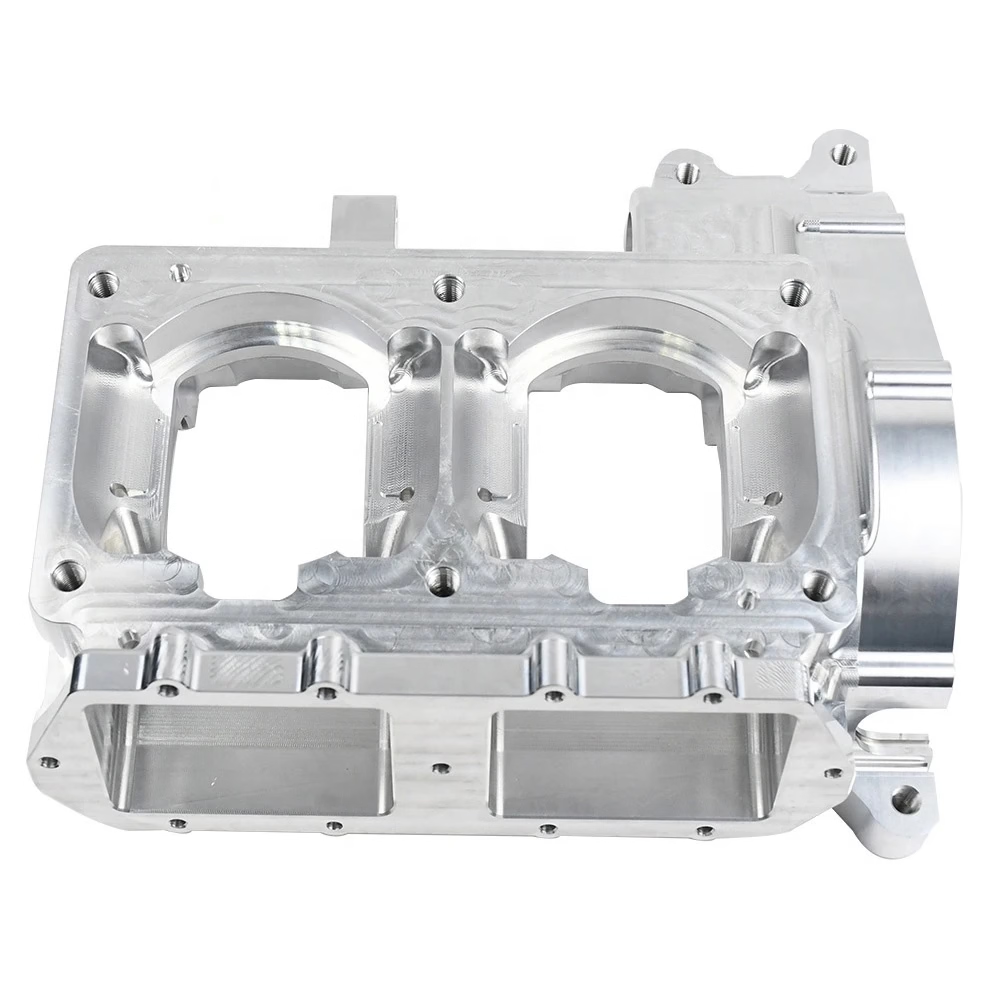
What these processing services actually cover
Machining, turning, finishing and inspection under one roof in Dongguan, with a second plant in Singapore.
Machine capacity and the size range we can quote
GreatLight was founded in 2011 and now runs three wholly-owned plants covering 7,600 m², with 150 technicians. The machine list is 127 high-precision CNC machines. That includes 16 simultaneous 5-axis machining centers, 12 four-axis mills, 27 three-axis machines and 16 mill-turn centers. The mix matters more than the total. A five-axis center removes a part from three or four separate setups, which is usually where position errors come from on angled holes and contoured faces.
Maximum processing size is 4,000 mm. Large travels are 4,000 × 400 × 150 mm, medium travels are 750 × 1,150 × 550 mm and 600 × 600 × 600 mm, and compact travels are 500 × 500 × 450 mm and 500 × 310 × 200 mm. Mill-turn work can use a Ø400 mm rotary table. If your part sits inside one of those envelopes and needs four or more faces machined, it is a candidate for a single-setup quote.
Not every part belongs on a five-axis machine. Simple prismatic plates with two drilled faces cut faster and cheaper on a three-axis mill, and we will quote them that way. Long, thin parts that need support along their length often run better on a mill-turn center, because the bar stays clamped while turning and milling happen in the same program. If your drawing calls for a 0.4 mm wall on a 300 mm aluminium plate, we will say so during DFM review rather than after the first cut.
- 15-axis16 simultaneous centers, best for contoured or multi-face parts
- 2Mill-turn16 centers with a Ø400 mm rotary table for shaft-type work
- 3Size limit4,000 mm maximum processing size on the largest travel
Tolerances, surface finish and what drives the cost
Standard tolerance is ±0.005 mm, which is ±0.0002 in. That figure is achievable, not automatic. It depends on the feature. A bored bore in 6061-T6 held in a fixture can hold that band all day. A 3 mm deep slot in a 40 mm long aluminium arm, machined before stress relief, will move after clamping is released. We flag those features during DFM and suggest either a looser band or an added stress-relief step.
Surface finish is quoted three ways: Ra 0.2–0.8 μm for fine finishes, Ra 0.8–1.6 μm for high cosmetic surfaces, and Ra 1.6–3.2 μm as-machined. A fine finish is a separate operation with extra time, so specify it only where a seal, bearing or optical surface needs it. The rest of the part can stay as-machined.
The cost drivers are usually setup count, feature count and finish callout, in that order. A part that fits one five-axis setup with 30 features is often cheaper than a simpler part that needs three fixtures and two hand operations. Send STEP plus a 2D drawing with datums and critical dimensions, and the free DFM analysis in the quote will list anything we would change.
Material and process selection at a glance
Common picks from our stock list. If your alloy is not listed, ask before you redesign.
| Part type | Typical material | Process route |
|---|---|---|
| Housings and brackets | 6061-T6, 6082, 7075 | 3-axis or 5-axis mill, bead blast, anodize |
| Shafts and pins | 303, 316L, 1045, 17-4PH | Mill-turn or turning, then grinding if needed |
| Aerospace brackets | 7075, Ti-6Al-4V, 4130 | 5-axis mill, hardcoat or black oxide |
| Medical fixtures | 316L, PEEK, titanium TA2 | 5-axis mill, passivation, full inspection |
| RF and electronic parts | C110 copper, 6061, ADC12 | Mill or die cast, plating or conductive anodize |
| Insulators and covers | POM, ABS, PC, PMMA | 3-axis mill, as-machined finish |
Inspection, certification and traceability
Every shipment gets 100% inspection before it leaves the plant. That means a raw material check on arrival, in-process monitoring while parts are running, and a final inspection on finished geometry. Inspection reports are available on request, including first-article reports and dimensional layouts for critical features. We do not ship a production lot on sampling alone.
The quality system holds ISO 9001:2015, IATF 16949:2016, ISO 13485:2016 and ISO 27001:2022. Those four cover different readers. IATF matters to automotive and EV programs because it brings the PPAP-style documentation and change control that tier-one suppliers expect. ISO 13485 applies to medical work and covers process validation and device history records. ISO 27001 is about your data, which is often the part procurement worries about most when a supplier is overseas.
The qualification rate across production runs is 99.99%. That number comes from inspection data, not from a marketing survey. Historical late-delivery probability is below 2%. Neither figure is a promise about your specific order. They describe what the shop has done, and they are the reason we can quote a 3–5 day ship date on many repeat jobs.
How quoting and confidentiality work
Quotation and free DFM analysis come back within 12 hours. Production can start within 24 hours of a released order, and parts ship in 3–5 days on jobs that fit our standard routing. There is no minimum order quantity. We run from one prototype to 10,000+ part runs, so a single bracket for a test rig and a production batch go through the same quoting path.
Uploads are secure and confidential. An NDA is available on request if your program requires one before drawings are shared. Sending STEP, PDF and a tolerance drawing together shortens the loop, because the DFM notes and the price come back in one pass instead of three.
The useful question is not whether a supplier is in China. It is which machines your part will run on, who inspects it, and what happens when a dimension is out. Ask for the machine list, the inspection plan and the material certificates. We answer all three in writing before the first chip is cut.
Questions engineers ask before sending an RFQ
What file formats and drawings do you need for a quote?
Send STEP or IGES for the 3D model, plus a 2D PDF drawing with datums, tolerances and any critical dimensions. If a feature is not toleranced on the drawing, we machine it to the general tolerance block or ask before quoting.
For assemblies, a bill of materials with material and finish per line item speeds up the DFM analysis. Native SolidWorks and Parasolid files are also fine.
Can you hold ±0.005 mm on every feature?
No, and no shop can. The ±0.005 mm band applies to features that a fixture can support and that do not move after machining. Thin walls, long unsupported sections and features far from a datum are quoted at a realistic band, with the reason listed in the DFM notes.
If a feature must hold the tight band, tell us which one. We will plan the setup and inspection around it rather than applying the tight band to the whole part and inflating the price.
Which materials are kept in stock?
Aluminium grades include 6061, 6061-T6, 2024, 5052, 5083, 6063, 6082, 7075 and ADC12. Stainless covers 303, 304, 316, 316L, 420, 430, 431, 440C and 17-4PH. Steel includes 1018, 1045, 4130, 4140, 4340, A36 and tool steel.
Copper and brass, titanium TA1, TA2 and TC4, Inconel, magnesium AZ31B and AZ91D, and engineering plastics such as PEEK, POM, PC and PA are also available. Exotic grades may add material lead time.
What finishing options are available after machining?
Anodizing in clear, colour, hardcoat and conductive types; electroless nickel, zinc, silver and gold plating; powder coating and black oxide; bead blasting, tumbling, brushing and polishing.
Laser marking and engraving are available with a minimum character height of 1.5 mm. Marking is normally the last operation, so specify the location and depth on the drawing.
How do you protect our design data?
Uploads are secure and confidential, and an NDA is available on request before drawings are exchanged. The plant holds ISO 27001:2022 for information security management.
Access to customer files is limited to the engineering and production staff who need them for the job.
What is the smallest and largest order you take?
There is no minimum order quantity. A single prototype and a 10,000+ part run are both quoted the same way.
At the large end, capacity is 127 CNC machines across three plants, so volume is limited by material supply and finishing throughput rather than by machine hours.
Send a drawing and get a price with DFM notes
Upload your STEP file and drawing. Quotation and free DFM analysis come back within 12 hours, with 100% inspection before shipment.
12-hour quoteNo MOQNDA on request









