
CNC processing in China: welfare and services
A sourcing guide for engineers who need machined parts from a Chinese shop and want to know what actually matters in the quote. We cover tolerance capability, lead time, MOQ, certifications and the quoting habits that separate a real partner from a trading desk. Read it before you send an RFQ.
In this article
- 1
- 2
- 3
- 4
- 5
- 6
- 7
- 8
Key takeaways
What to check before you place an order
Use this as a first-pass filter. Each row is a question you can put in writing to any supplier.
| Check | What a capable shop shows you | Warning sign |
|---|---|---|
| Tolerance | ±0.005 mm stated with the inspection method | Tolerance quoted without a measurement plan |
| Machine list | Machine count, axis count, travels in mm | Only 'advanced equipment' wording |
| Lead time | Quote and DFM in 12 hours, ship in 3–5 days | Delivery date promised before DFM |
| MOQ | One prototype to 10,000+ parts | High minimum on a first article |
| Certifications | ISO 9001, IATF 16949, ISO 13485, ISO 27001 | Certificate shown without scope |
| Inspection | 100% inspection, reports on request | Sample check only, no records |
| Confidentiality | Secure uploads, NDA on request | Drawings sent over personal email |
| Surface finish | Ra 0.2–0.8 μm up to Ra 1.6–3.2 μm as machined | One finish grade for every part |
Pick on capability, then compare price
If your part has tight positional tolerances, pick the shop that names its machines, its setups and its inspection method. If it is a simple bracket, the fastest quote with a clear assumptions block wins.
Why CNC processing in China is a capability question first
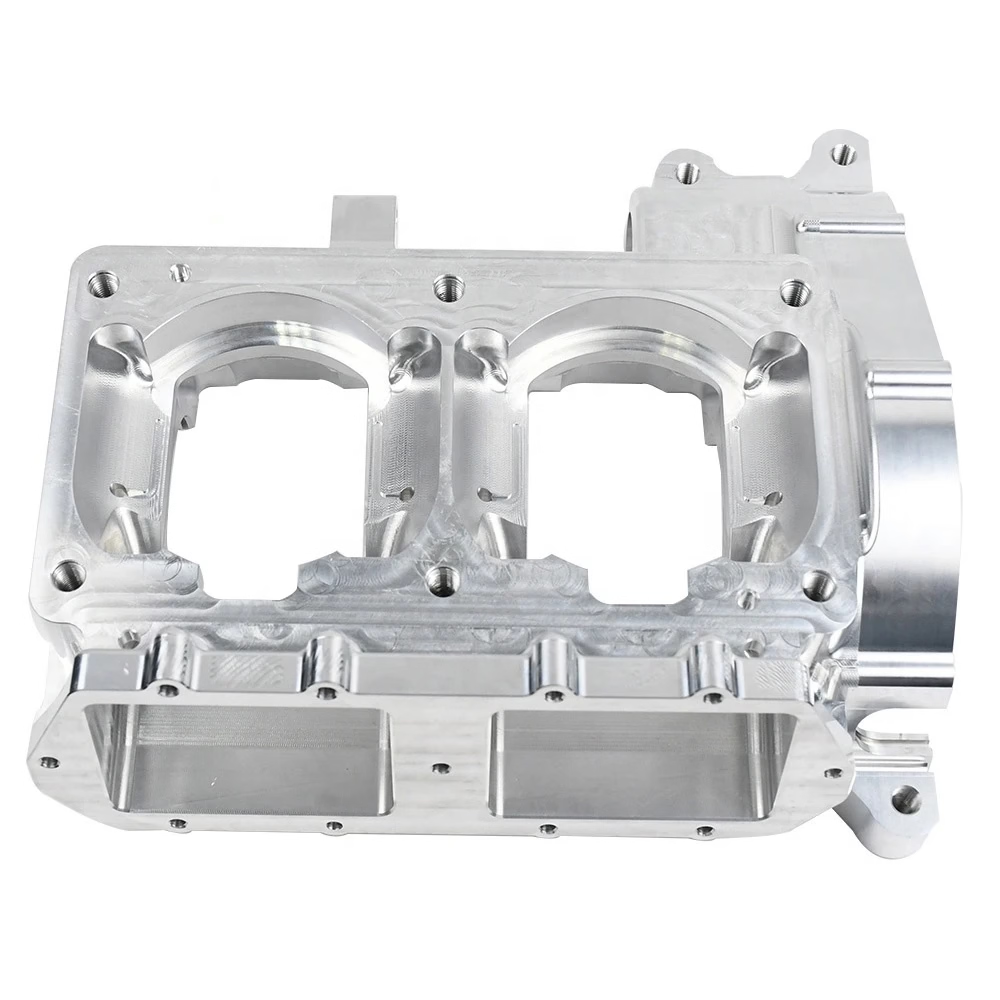
Most RFQs compare price per hour. That number tells you almost nothing about whether the shop can hold your drawing. A 5-axis machine with a Ø400 mm rotary table can cut five faces in one setup, so the position of a bore relative to a flange stays inside ±0.005 mm. Move that part to a 3-axis mill and you re-fixture it three times. Each setup adds stack-up error you cannot inspect away.
So the first question is not cost. It is which machine will run the part, how many setups it needs, and how the shop will measure the result. If the answer is vague, the price is meaningless.
China has a deep supplier base, which cuts both ways. You can find a shop with 127 high-precision CNC machines and a full inspection room. You can also find a trading company that forwards your file to a job shop and adds 20 percent. The difference shows up in the technical reply, not the brochure.
- 1One setup beats threeFewer setups means less stack-up error and a shorter route to first article.
- 2Ask for the inspection methodCMM, height gauge or optical. The method should match the tolerance.
- 3Materials set the cutting data6061 aluminium runs fast; Inconel and Ti-6Al-4V need slow feeds and rigid tooling.
Tolerance, finish and material: the three numbers that drive cost
Tolerance is the biggest cost lever. Going from ±0.05 mm to ±0.005 mm changes the machine, the tooling, the temperature control in the room and the inspection time. It is not a line item you can trim at the end of a negotiation.
Surface finish works the same way. As-machined parts sit around Ra 1.6–3.2 μm. A sealing face or a bearing bore often needs Ra 0.8–1.6 μm, and optical or medical parts can go to Ra 0.2–0.8 μm. Each step down means a different tool path, a different cutter and usually a second operation.
Material choice decides how hard the job is. Aluminium 6061-T6 and 7075 cut cleanly and hold tight tolerances. Stainless 316L work-hardens, so the shop needs sharp tooling and steady feed. Titanium Ti-6Al-4V and Inconel generate heat at the cutting edge, which pushes tool life down and cycle time up. A quote that ignores the alloy is not a real quote.
- 1State the tolerance you need, not the one you likeOver-tightening a clearance hole adds cost with no function gained.
- 2Group finish calls by functionSealing and sliding faces tight, cosmetic faces looser.
- 3Send the alloy grade6061 and 7075 behave differently. So do 304 and 316L.
Lead time, MOQ and certification: what the paperwork should prove
Lead time has two parts: the quote and the metal. A shop that returns a quotation and a free DFM analysis within 12 hours has read your file. Production can often start within 24 hours, and simple parts ship in 3–5 days. A historical late-delivery probability below 2% is a reasonable benchmark to ask about, but ask how it is tracked.
MOQ is where smaller buyers get filtered out. A shop that runs from one prototype to 10,000+ part runs does not change its process between the two. The setup is the setup. If a supplier quotes a high minimum on a first article, they are pricing risk, not machining.
Certifications should match your industry, not decorate a homepage. ISO 9001:2015 covers general quality management. IATF 16949:2016 applies to automotive and EV work. ISO 13485:2016 is the medical device standard. ISO 27001:2022 covers information security, which matters when your drawings are the product. Ask for the scope statement, not just the logo.
- 1Quote and DFM inside 12 hoursA technical reply beats a fast reply with no notes.
- 2No minimum order quantityOne piece to 10,000+ with the same fixturing logic.
- 3Match the standard to the sectorAuto, medical and general industrial use different certificates.
Finishing and secondary services: where quotes quietly diverge
Two shops can quote the same machined part and land 30 percent apart because one price includes finishing and the other does not. Anodizing, plating, powder coating and black oxide are separate operations with their own lead times. Bead blasting and tumbling change dimensions slightly, so a part that passed inspection before blasting may not pass after.
Laser marking is a good example of a hidden spec. Minimum character height is around 1.5 mm on most systems. If your drawing calls for a 0.5 mm data matrix, say so early and expect a different process.
The practical fix is to list the full route on the RFQ: machining, deburr, finish, marking, final inspection, packaging. Then each supplier quotes the same scope. Without that list, you are comparing different products with the same part number.
- 1Name every operationMachining, deburr, finish, mark, inspect, pack.
- 2Watch dimension shift after blastingMedia blasting removes material. Tight features need masking.
- 3Marking has a size floorMinimum character height around 1.5 mm for laser marking.
How to read a quotation from a Chinese machine shop
A useful quote has four parts: unit price, tooling or setup cost, lead time and assumptions. The assumptions section is the one people skip. It should state the material grade, the tolerance class, the finish, the inspection level and what the price excludes.
Watch for a quote with no assumptions. It usually means the number was built from a weight guess. That number will move once the shop sees the drawing, and the move is rarely downward.
Payment terms, shipping terms and packaging should also be explicit. Ask whether the price is ex-works or delivered, and who handles export documents. These are commercial details, but they decide your landed cost as much as the machining rate does.
Finally, check whether the shop will send a first article inspection report before the full run. On a tight-tolerance part, that report is worth more than a small discount.
- 1Demand an assumptions blockMaterial, tolerance, finish, inspection, exclusions.
- 2Confirm shipping termsEx-works and delivered prices are not comparable.
- 3Ask for the first article reportDimension results before the run continues.
Seven steps to qualify a supplier
Run these in order. Skipping step 3 is the most common mistake.
- 11. Write the functional requirementsList the interfaces that matter, the tolerance for each, and the finish. Keep non-critical faces loose so the shop can choose its own strategy.
- 22. Send a complete 3D model and 2D drawingSTEP for geometry, PDF with GD&T for tolerances. If the two disagree, the drawing wins. Say so in writing.
- 33. Ask which machine and how many setupsFor a 5-face part, expect a simultaneous 5-axis center with a Ø400 mm rotary table. Three or more setups on a 3-axis machine is a flag on tight positional tolerances.
- 44. Request the DFM note with the quoteA real shop flags thin walls, deep pockets with small radius corners, and features that need EDM or a custom cutter. Free DFM within 12 hours is a fair benchmark.
- 55. Confirm material and certificationMatch the alloy to the drawing and the certificate to the industry: IATF 16949 for auto, ISO 13485 for medical, ISO 27001 for confidential files.
- 66. Agree on inspection and reporting100% inspection before shipment, with raw material check, in-process monitoring and final inspection. Ask for reports on the features you care about, not a generic sheet.
- 77. Lock the full route and termsMachining, finish, marking, packaging, shipping terms and NDA. Sign the NDA before releasing controlled drawings.
Questions engineers ask before ordering
Can a Chinese shop hold ±0.005 mm on a production run?
Yes, on the right machine and with the right process control. Simultaneous 5-axis centers with temperature-stable spindles and a CMM in the inspection room can hold ±0.005 mm (±0.0002 in) on critical features.
The catch is part geometry. Long, thin parts move with heat and clamping force, so the tolerance has to be checked on the final part, not on the machine display.
Is there a minimum order quantity for a first prototype?
Not at every shop. Some suppliers run from one prototype to 10,000+ part runs with no minimum order quantity.
If a supplier insists on a high minimum for the first article, ask what the minimum is protecting. Usually it is risk pricing rather than a real production constraint.
How fast can parts ship after I approve the quote?
At a well-equipped shop, production can start within 24 hours and simple parts ship in 3–5 days after drawing release.
Complex parts with finishing, heat treatment or tight inspection add days. Build the finishing route into the schedule from the start, not after the machining is done.
What certifications should I ask for?
It depends on your industry. ISO 9001:2015 is the baseline. IATF 16949:2016 is expected for automotive and EV programs. ISO 13485:2016 applies to medical device parts. ISO 27001:2022 covers information security for confidential designs.
Ask for the certificate scope. A logo on a website proves less than a scope statement that names the process and the site.
How do I protect my drawings?
Use a supplier with secure uploads and an NDA available on request. Sign the NDA before you release controlled geometry.
Avoid sending native CAD files over personal email. A supplier that takes document control seriously will have a defined channel and will tell you who can see the file.
Which materials are commonly machined?
Aluminium 6061, 6061-T6, 7075 and 6082; stainless 303, 304, 316L and 17-4PH; steel 1018, 1045, 4140 and 4340; copper and brass C110 and C36000; titanium Ti-6Al-4V and Inconel for demanding parts; plus engineering plastics such as POM, PEEK and PC.
Send the grade, not just the family. 304 and 316L machine differently and price differently.
Send your drawing, get a technical reply
Upload a STEP file and a 2D drawing. You get a quotation and a free DFM analysis within 12 hours, with the machine route and inspection plan stated up front.
12-hour quoteNo MOQ100% inspectionNDA on request
More from the shop floor
We publish setup notes, tooling trials and inspection data from the factory floor.











