
China Easteel CNC Precision Machining Service: How to Judge One
This page is for engineers and sourcing teams comparing large China CNC suppliers, including the china easteel cnc precision machining service model. It covers machine mix, achievable tolerance, material choice, inspection evidence and DFM feedback. After reading, you should be able to tell whether a supplier fits your part or not.
What This Guide Covers
A practical way to read a supplier's capability sheet before you send a purchase order.
What the Term Actually Describes
A china easteel cnc precision machining service usually means a supplier that combines steel-focused machining with a broad precision shop: mills, lathes, mill-turn centers and inspection under one roof. The name matters less than the machine list behind it. Ask for the spindle hours per month, the axis count, and the largest part the shop can hold without re-fixturing.
Scale alone does not make a part accurate. Large suppliers win on purchasing power and volume, which suits standardized brackets, housings and shafts. They can struggle when a drawing changes mid-run or when a feature needs five-sided access in one setup.
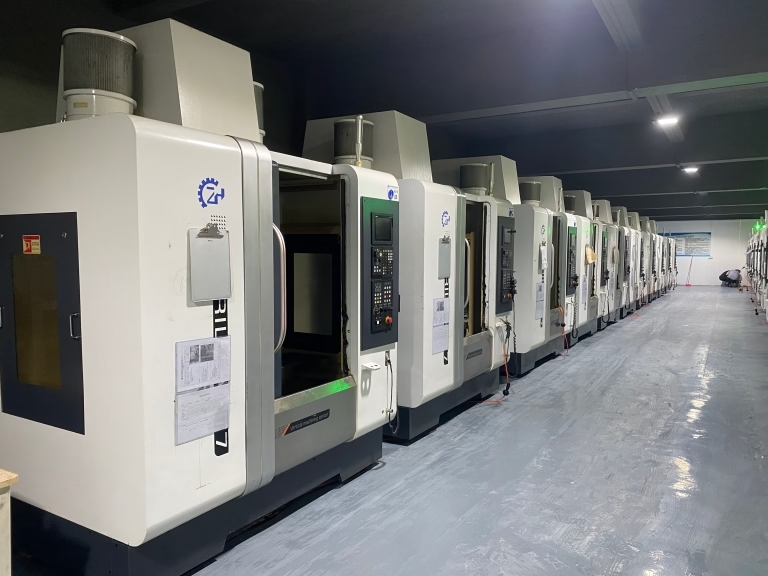
For our own shop, the split is 127 high-precision CNC machines across three wholly-owned plants, with 16 simultaneous 5-axis centers and 16 mill-turn centers. That mix decides what we quote and what we decline. A supplier that cannot tell you the same about itself is guessing.
Machine Mix Decides What a Shop Can Hold
Axis count is the first filter. A 3-axis mill cuts one face at a time, so a part with pockets on four sides needs four setups. Each setup adds a re-clamp error and a fixture cost. Five-axis simultaneous machining removes those setups for parts up to the machine travel, which is where you get true position instead of stacked tolerances.
Size and axis count trade off against each other. Long parts usually run on 3-axis or 4-axis machines with a large table, while compact complex parts run on 5-axis. If your part is 900 mm long and has a 20° angled port, no single machine class covers both well. That is a fixture question, not a machine question.
Turning adds another branch. Mill-turn centers cut a turned body and milled flats without a second operation, which matters for hydraulic and EV motor parts where concentricity between the bore and the flange drives the assembly. Ask whether the shop owns mill-turn capacity or subcontracts turning. The answer shows up in lead time.
- 13-axisFlat plates, covers, simple housings. Cheapest per part, most setups.
- 24-axisParts with features on four sides around one axis. Good for shafts and manifolds.
- 35-axis simultaneousContoured faces, angled holes, deep pockets. One setup, fewer datum shifts.
- 4Mill-turnTurned bodies with milled features. Keeps bore-to-flange concentricity in one chuck.
Machine Classes and Typical Travel
Use this to match a part envelope to a machine group before asking for a quote.
| Machine class | Typical travel | Best-fit parts |
|---|---|---|
| Large gantry / 3-axis | 4,000 × 400 × 150 mm | Long rails, beams, base plates |
| Medium 3-axis and 4-axis | 750 × 1,150 × 550 mm | Housings, manifolds, brackets |
| Compact 5-axis | 600 × 600 × 600 mm | Impellers, angled-port bodies |
| Small 5-axis | 500 × 500 × 450 mm | Medical and optics parts |
| Compact 5-axis | 500 × 310 × 200 mm | Small complex inserts |
| 4-axis with rotary table | Ø400 mm rotary table | Shafts, flanges, round parts |
Tolerance and Finish: What Is Realistic
A tolerance callout is a promise about the whole process, not just the cutter. ±0.005 mm (±0.0002 in) is achievable on tight features when the machine, the fixture, the material and the temperature are all controlled. It is not achievable on a 900 mm unsupported span in aluminium on a warm afternoon, no matter what the quote says.
Be specific about which features carry the tight tolerance. Calling every dimension on a 40-hole plate at ±0.01 mm raises cost with no benefit. Call the datum, the mating bores and the hole pattern, and let the rest sit at general tolerance.
Surface finish follows the same logic. Ra 1.6–3.2 μm is a normal as-machined result. Ra 0.8–1.6 μm needs a finishing pass and a rigid setup. Ra 0.2–0.8 μm usually means a secondary operation, and it is wasted on a surface that gets painted or gasketed.
Material Choice Changes the Process, Not Just the Price
Steel is where the name china easteel cnc precision comes from, and steel is also where the process decisions get sharpest. 1018 and 1045 cut cleanly and take a fine finish. 4140 and 4340 move during machining, so rough and finish passes need to be separated if the part has thin walls. 17-4PH holds a tight bore after heat treatment but machines slowly in the aged condition.
Aluminium 6061-T6 is the default for prototypes and light production. 7075 gives higher strength for aerospace brackets but chips differently and is less forgiving on deep pockets. 2024 needs attention to stress relief if you plan to anodize, because residual stress shows up as distortion after the coating.
Titanium TC4 (Ti-6Al-4V) and Inconel are on the list because they appear in aerospace and energy work. Both generate heat at the cutting edge. Tool life drops, cycle time rises, and the finishing strategy matters more than the roughing strategy. Magnesium AZ31B and AZ91D machine easily but need chip handling discipline.
Plastics are a separate process family. POM and PEEK hold tolerance well. ABS and PP move with temperature and clamp pressure, so a ±0.05 mm callout is realistic and ±0.005 mm is not.
- 1Aluminium6061, 6061-T6, 2024, 5052, 5083, 6063, 6082, 7075, ADC12
- 2Stainless303, 304, 316, 316L, 420, 430, 431, 440C, 17-4PH (SUS630)
- 3Steel1018, 1045, 4130, 4140, 4340, A36, tool steel
- 4Titanium and specialTA1, TA2, TC4 (Ti-6Al-4V), Inconel, magnesium AZ31B / AZ91D
Inspection Evidence Beats a Certificate Copy
Certificates tell you a management system exists. They do not tell you whether your bore is round. Ask what is measured, on which machine, and what data comes with the shipment. For our shop the answer is 100% inspection before shipment: raw material check on arrival, in-process monitoring during the run, and final inspection before packing. Reports come on request.
The measurement tool has to match the tolerance. Calipers read to about ±0.02 mm, so a ±0.005 mm bore needs a micrometer, a bore gauge or a CMM. If a supplier shows only caliper readings for a tight feature, the number is not real.
Process control matters more than a final sort. A shop running at 99.99% qualification is checking during the cut, not just finding scrap at the end. First-article inspection is the minimum for a new part. For production runs, ask for the sampling plan and the reaction plan when a trend appears.
Certifications we hold: ISO 9001:2015, IATF 16949:2016, ISO 13485:2016 and ISO 27001:2022. The last one covers data handling, which is relevant when your drawings are controlled.
How to Evaluate Any Supplier, Including This One
Start with a DFM review. Send the 3D model and the 2D drawing, then watch what comes back. A useful response names specific features: a wall too thin to hold, a corner radius smaller than the cutter can reach, a tolerance that drives a second operation. A generic reply that says everything is fine is a warning sign.
Then check the fixture plan. Complex parts need custom workholding, and that cost appears either in the quote or in the first-article scrap. Ask how the part will be located and clamped for each operation. If the answer is vague, expect surprises.
Ask about the finish and marking steps too. Anodizing, electroless nickel, zinc plating, powder coating, black oxide, bead blasting and laser marking all add handling. Laser marking has a minimum character height of 1.5 mm, so a 0.8 mm serial number will not read after coating.
Finally, look at the commercial terms. No minimum order quantity matters for prototypes, and the same shop should be able to scale to 10,000+ part runs. Quotation and free DFM analysis inside 12 hours, production starting within 24 hours, and parts shipping in 3–5 days is the timeline we work to. Historical late-delivery probability sits below 2%.
Sourcing Checklist for a China CNC Supplier
Six questions that separate a capable shop from a broker.
| Question | What a good answer looks like | Red flag |
|---|---|---|
| Which machine holds my part? | Named machine, axis count, travel | We have many machines |
| How is the tight feature measured? | Micrometer, bore gauge or CMM | Calipers only |
| Who designs the fixture? | In-house tooling with a plan | We will figure it out |
| What DFM feedback came back? | Named features and risks | Everything looks fine |
| What ships with the parts? | Inspection report on request | No data available |
| How is my drawing handled? | NDA available, secure upload | Email attachments only |
Questions Engineers Ask Before Ordering
Can a china easteel cnc precision machining service hold ±0.005 mm on a production run?
Yes, on specific features with the right machine, fixture and temperature control. It is a feature-level claim, not a part-level one.
Tell us which dimensions carry the tight tolerance. We will confirm before quoting instead of after the first article.
What is the largest part you can machine?
Maximum processing size is 4,000 mm, with a large-machine travel of 4,000 × 400 × 150 mm. Medium machines run 750 × 1,150 × 550 mm and 600 × 600 × 600 mm.
Long parts are usually split across more setups, which affects both price and tolerance stacking.
Do you accept a single prototype?
There is no minimum order quantity. We run from one prototype to 10,000+ part runs on the same process.
Prototypes are quoted with the same DFM review as production, so the feedback carries over when the design freezes.
How do you protect our drawings and data?
Uploads are secure and confidential. An NDA is available on request, and our ISO 27001:2022 certification covers information security management.
Send files through the quote page rather than a personal email if your documents are controlled.
Which finishes can you apply after machining?
Anodizing in clear, colour, hardcoat and conductive types; electroless nickel, zinc, silver and gold plating; powder coating and black oxide; bead blasting, tumbling, brushing and polishing.
Laser marking and engraving are available with a minimum character height of 1.5 mm.
How fast can a quote and first parts arrive?
Quotation and free DFM analysis come back within 12 hours. Production can start within 24 hours of approval, and parts ship in 3–5 days.
Historical late-delivery probability is below 2%. Exact dates are confirmed on the order, not on this page.
Send the Drawing, Get a DFM Answer
Upload your model and 2D drawing. You get a quote and a free DFM analysis within 12 hours, with the risks named.
12-hour quote100% inspectionNDA on request









