
CNC and machining center key differences: what a quote actually buys
Every machining center is CNC controlled, but not every CNC machine is a machining center. The gap sits in tool changers, enclosures, axis count, and how many setups a part needs. This page explains those differences from the shop floor, so you can tell which process a part belongs in before you request a quote.
In this article
- 1
- 2
- 3
- 4
- 5
- 6
- 7
Plain CNC machine vs machining center: the practical comparison
Compare the machine class you are quoting, not the brand.
| Feature | Plain CNC machine | Machining center |
|---|---|---|
| Tool change | Manual, or one tool in spindle | Automatic changer, 20 to 60+ tools |
| Enclosure | Open or partial guarding | Full enclosure with coolant control |
| Axes | Usually 2 to 3 axes | 3, 4, or 5 simultaneous axes |
| Setups per part | Two to five, one per operation | One to two, done in a single setup |
| Repeatability | Depends on operator skill | Held by the machine and fixtures |
| Best batch | One-offs, repairs, simple turned parts | Complex parts, 10 to 10,000+ pieces |
| Floor space | Small, easy to move | Large, needs foundation and power |
What the terms actually mean on the shop floor
CNC stands for computer numerical control. It describes the control system, not the machine. A CNC lathe, a CNC router, a CNC grinder, and a CNC mill all share the same idea: a program tells the axes where to move, how fast to feed, and when to start the spindle. The machine itself can be small, open, and built for one job.
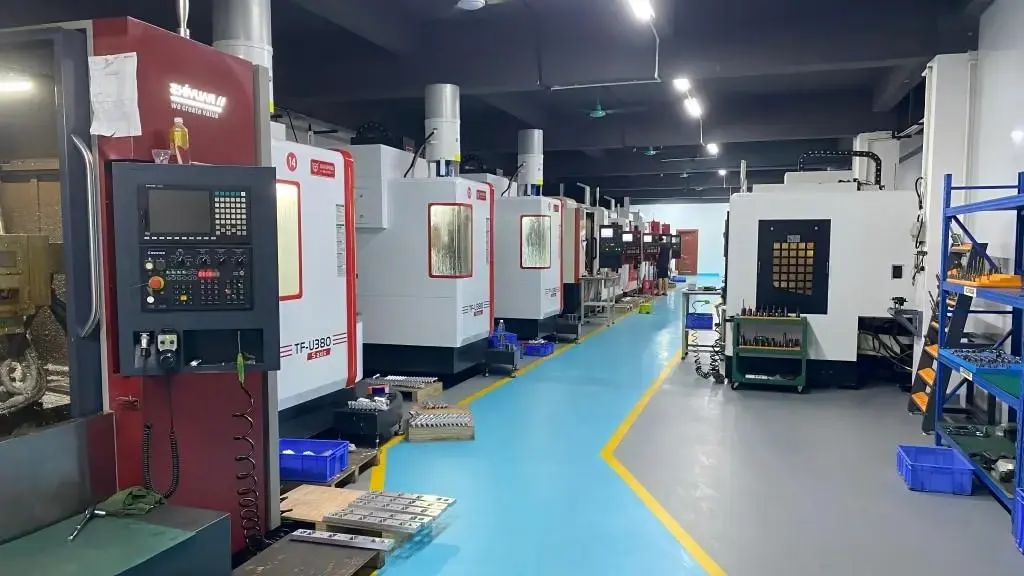
A machining center is a specific class of CNC machine tool. It has an automatic tool changer, a spindle that can position in Z, and normally a full enclosure. The spindle takes milling, drilling, boring, and tapping tools without an operator touching the machine. That single detail is what separates the two terms.
The confusion comes from sales language. Many suppliers call any CNC mill a machining center, and many buyers use the words interchangeably on a request for quote. For costing, the difference matters. A part quoted on a plain CNC mill and the same part quoted on a machining center are not the same process, even when the drawing is identical.
- 1CNCThe control method. Applies to lathes, mills, routers, grinders, and centers.
- 2Machining centerA machine class with automatic tool change and multi-operation capability.
- 3The overlapAll machining centers are CNC; most CNC machines are not machining centers.
Tool changing and setup count drive the real cost gap
On a plain CNC mill, changing from a 10 mm end mill to a 6 mm drill means stopping the program, waiting for the spindle to stop, and swapping the tool by hand. Then you touch off the new tool and restart. On a simple part this takes a few minutes. On a part with eight tools and 200 pieces, the same manual change repeats 1,600 times.
A machining center holds 20 to 60 or more tools in a carousel or chain. The program calls a tool number and the changer swaps it in a few seconds. Tool length offsets are stored, so there is no touching off between tools. Setup moves from the spindle to the fixture, and the machine runs the rest.
This changes how a job is quoted. Parts with many features on different faces, or parts with tight position tolerances between features, get cheaper on a machining center because every feature is cut in one setup. Simple turned parts or one-off repair work do not benefit. The tool changer adds nothing when the job only needs one tool.
The rule we use: if a part needs three or more tools and more than a handful of pieces, a machining center is normally the lower-cost route. Below that, a plain CNC machine keeps the overhead down.
- 1Manual changeRoughly 2 to 5 minutes per tool, plus re-touch-off time.
- 2Automatic changeRoughly 3 to 10 seconds per tool, offsets stored in the program.
- 3Setup countOne setup on a center vs two to five on a plain mill.
Axis count and part geometry decide the machine
A three-axis machining center moves X, Y, and Z only. It cuts prismatic parts well: plates, housings, brackets, manifolds, and anything you can reach from one direction. Add a fourth axis, a rotary table, and the part can index to new faces without a second setup. We run 12 four-axis mills and a Ø400 mm rotary table for exactly this work.
Five-axis machining moves the tool and the part at the same time. That lets a ball nose cutter follow a curved surface at a constant angle, or drill a hole at 30° off the part face without a special fixture. We keep 16 simultaneous five-axis machining centers for impellers, turbine blades, medical implants, and complex aerospace housings.
The trade-off is not only cost. Five-axis machines need more programming time, more simulation, and more careful fixturing. For a flat bracket with six holes, that effort is wasted. For a part with undercuts, deep pockets, or contoured surfaces, it removes the special tooling and the extra setups that would otherwise be needed.
Ask one question before choosing: can every feature be reached from fewer than three tool directions? If yes, three or four axes are enough. If no, five-axis is usually the only way to hold the tolerance.
- 13-axisPrismatic parts, flat faces, parts reachable from one side.
- 24-axisCylindrical parts, slots and holes on multiple faces, indexing work.
- 35-axisContoured surfaces, undercuts, angled holes, tight true-position callouts.
Accuracy, finish, and repeatability in production
A machining center holds tolerance because the part stays in one fixture. Every feature is cut from the same datum, so position errors do not stack the way they do across multiple setups. On our machines, that supports tolerances down to ±0.005 mm (±0.0002 in) on the features that need it.
Surface finish follows the same logic. A rigid spindle, a balanced tool holder, and controlled coolant flow give a predictable finish. As-machined surfaces land around Ra 1.6–3.2 μm, high-finish surfaces at Ra 0.8–1.6 μm, and fine finishes down to Ra 0.2–0.8 μm when the geometry allows.
Repeatability across a batch is the part buyers feel most. Tool wear is compensated in the control, coolant and chip evacuation stay inside the enclosure, and the operator checks a part instead of re-clamping one. We inspect 100% of parts before shipment, with raw material checks, in-process monitoring, and a final inspection report on request.
A plain CNC machine can hit the same numbers on a single part. It struggles to hold them across 500 parts, because each setup introduces a new chance for variation. That is a process difference, not an operator skill difference.
- 1Single setupOne datum, so position errors do not accumulate.
- 2Thermal controlEnclosed machines hold size better over a long run.
- 3Inspection100% check before shipment; reports available on request.
Materials and part size that fit each machine class
Both machine classes cut the same materials: aluminium 6061, 7075, and 2024; stainless 303, 304, 316L, and 17-4PH; steels such as 4140 and 4340; titanium Ti-6Al-4V and Inconel; copper alloys; and engineering plastics from POM to PEEK. The difference is how well each handles the hard ones.
Titanium and Inconel generate high cutting forces and heat. A machining center with a rigid structure, high-pressure coolant, and a fully enclosed work zone manages them far better than an open machine. That is why aerospace and medical work sits almost entirely on centers.
Part size sets the upper limit. Our largest travel is 4,000 × 400 × 150 mm, with medium envelopes of 750 × 1,150 × 550 mm and 600 × 600 × 600 mm, and compact envelopes of 500 × 500 × 450 mm and 500 × 310 × 200 mm. Long, thin parts often need a machine with a long X travel and a light finishing pass, while small precision parts go on the compact machines.
If your part is larger than 4,000 mm in any direction, it is not a machining center job for us. We will say so early rather than quote something we cannot hold.
- 1Soft and easyAluminium and plastics run well on either class.
- 2Hard and hotTitanium, Inconel, and hardened steel favour an enclosed center.
- 3Size limit4,000 mm maximum processing size; smaller envelopes for precision work.
When a plain CNC machine is the better choice
Not every job should go on a machining center. A single prototype bracket with two holes is faster on a three-axis mill, because programming and fixturing a center takes longer than the cut. We run 27 three-axis machines for this kind of work, and they stay busy.
Repair and modification work is the same story. One-off shafts, weld repairs, and parts that come in without a model are easier to handle on an open machine where the operator can see and measure as they go. The enclosure that helps in production gets in the way here.
Simple turned parts belong on a lathe or a mill-turn center, not a vertical machining center. We keep 16 mill-turn centers for parts that need turning and milling in one cycle, which is a different comparison from the one on this page but often the right answer.
The honest test is quantity and geometry. One part, one or two tools, reachable from one direction: plain CNC. Ten parts or more, three or more tools, multiple faces or curved surfaces: machining center. Everything in between needs a look at the drawing rather than a rule.
- 1Choose plain CNCSingle parts, repairs, simple geometry, one or two tools.
- 2Choose a centerRepeat production, many tools, multiple faces, tight position tolerances.
- 3Choose mill-turnParts that are mostly round but need milled features.
The verdict: match the machine to the part, not the label
For a one-off part, a repair, or simple geometry that one or two tools can reach, a plain CNC machine is cheaper and faster. For anything in a batch of ten or more, with three or more tools, multiple faces, or contoured surfaces, use a machining center. If the drawing needs five axes to reach the features, no amount of fixturing on a three-axis machine will hold the tolerance.
Questions engineers ask about these two machine classes
Is every CNC machine a machining center?
No. CNC describes the control system. A machining center is a machine class defined by an automatic tool changer, a positioning spindle, and normally a full enclosure.
A CNC lathe, router, or grinder uses the same control principle but is not a machining center.
Can you hold ±0.005 mm on a three-axis machine?
On a single part, often yes, if the fixture is rigid and the machine is in good condition. Across a production batch, an enclosed machining center holds it more reliably because the part stays in one setup.
The tolerance also depends on feature size, material, and whether the dimension is measured in-process or after the part cools.
Does a machining center always cost more per part?
No. The hourly rate is higher, but the setup count is lower and the cycle runs unattended. For parts with several tools or multiple faces, the total cost per part usually drops.
For a one-off job with a single tool, the plain machine wins on price.
How many axes do I actually need?
Count the directions from which the tool must reach the part. One direction means three axes are enough. Features on several faces usually need four. Curved surfaces, undercuts, or angled holes normally need five.
If you are unsure, send the STEP file and we will tell you which machine class fits.
What file formats and information do you need to quote?
A 3D model in STEP or IGES plus a 2D drawing with tolerances, material, surface finish, and quantity. If a drawing is not available, notes on critical dimensions are enough to start.
We return a quotation and a free DFM analysis within 12 hours. Uploads are kept confidential, and an NDA is available on request.
Can you handle both small prototypes and large production runs?
Yes. There is no minimum order quantity, so a single prototype and a 10,000+ part run both go through the same process.
Production can start within 24 hours of order confirmation, and parts typically ship in 3–5 days depending on scope.
Send the drawing and we will pick the right machine
Upload your STEP file and get a quotation plus a free DFM analysis within 12 hours. We quote the machine class that fits the part, and we tell you when a plain CNC machine is the cheaper route.
12-hour quote100% inspectionNo minimum order quantityNDA on request
More machining notes from our shop
We publish setup notes, tooling trials and inspection data from the factory floor.











