
CNC vs manual machining: key differences
Both cut metal. They fail in different ways. This page compares CNC vs manual machining on tolerance, cost per part, volume and lead time, so you can pick the right process before you cut chips. Written for design engineers and sourcing teams.
In this article
- 1
- 2
- 3
- 4
- 5
- 6
- 7
CNC vs manual machining at a glance
Values below are typical shop-floor ranges, not guarantees for every geometry.
| Factor | CNC machining | Manual machining |
|---|---|---|
| Positioning | Servo drives read G-code | Handwheels and dials |
| Typical tolerance | ±0.005 mm repeatable | ±0.025 mm to ±0.05 mm |
| Best volume | 10 to 10,000+ parts | 1 to 20 parts |
| Setup effort | Programming plus fixture | Fixture plus dial-in |
| Part repeatability | Same program, same result | Depends on operator feel |
| Complex 3D geometry | Fits 5-axis motion | Needs rotary work and fixtures |
| Surface finish | Ra 0.8–1.6 μm as machined | Ra 1.6–3.2 μm typical |
| Change cost | Edit program, re-run | Re-dial the setup |
Which process fits your part
| Your situation | Choose | Why |
|---|---|---|
| 1 to 5 simple parts | Manual | No programming or CAM overhead |
| 1 to 5 complex parts | CNC | Geometry needs stored toolpaths |
| 20 to 10,000+ parts | CNC | Setup cost spreads across the run |
| Tolerance tighter than ±0.025 mm | CNC | Stored offsets hold the number |
| Multi-face part, one setup | CNC | 4 or 5 axes reduce re-clamping |
| Soft material, flat geometry | Manual | Fast, cheap, no setup cost |
| Hard alloy or titanium | CNC | Controlled feeds protect tool life |
What actually separates CNC vs manual machining
The real split is not old against new. It is where the judgment lives. In manual machining, the operator reads the dial, feels the cut and decides when the tool has taken enough material. In CNC, that judgment is moved into a program written before the part is clamped.
That single change explains almost every other difference. CNC repeats a stored toolpath, so part five hundred matches part five. Manual machining repeats a human motion, so part five hundred matches part five only as well as the operator's attention held that morning.
It also explains where each process struggles. CNC cannot see the part. If the program has the wrong offset, the machine will cut the wrong offset perfectly. Manual machining forgives small errors because the operator notices them mid-cut and corrects.
So the question is rarely "which is better." It is whether your part rewards stored precision or on-the-spot judgment. Quantity, tolerance and geometry usually answer that for you.
Tolerance, repeatability and where each process drifts
Manual machining can hit tight numbers. A skilled turner on a good lathe can hold ±0.025 mm on a short, rigid part. The catch is that the result depends on tool wear, temperature and how the operator feels the cut. Do it again tomorrow and the number moves.
CNC holds ±0.005 mm because the machine measures its own position and corrects it. Thermal compensation, ball screw mapping and tool offsets keep the toolpath where the program says it is. The result is repeatability, not just accuracy.
Repeatability matters more than most drawings admit. If you need one tight bore, either process can deliver it. If you need that bore in 300 housings, the CNC run is the one where the last part still gauges in spec.
Manual machining drifts in a different direction. Each setup is re-dialed by hand, so a five-operation part accumulates error at every re-clamp. CNC reduces that by cutting more faces in one setup, and 5-axis work can reach pockets that manual setups cannot hold at all.
- 1Single tight featureManual can pass, but check it with a gauge, not a caliper.
- 2Tight feature in volumeCNC, because offsets are stored and applied to every part.
- 3Multi-face partCNC with 4 or 5 axes cuts more faces per setup.
- 4Loose tolerance, one partManual is often the faster route to a finished piece.
Cost per part: where the money actually goes
For one part, manual machining usually wins on price. There is no programming, no CAM time, no fixture design. The operator clamps the stock and starts cutting. You pay for hours, not for preparation.
Around 10 to 20 identical parts, the two paths cross. Manual still carries no programming cost, but the labor hours pile up linearly. CNC spreads its setup cost across the run, so the second part is cheap and the fiftieth is cheaper.
Above a few hundred parts, the comparison is over. CNC cost per part flattens because the program does not get tired. The upfront programming and fixturing, once paid, stop growing.
The trap is a part that looks like a prototype but is really a pilot run. If your drawing is close to final and you expect 200 units, quoting it as manual work because it is a "first batch" usually costs more in the end. Ask for both numbers before you commit.
Complex geometry and materials: when manual hits a wall
Manual machines are built around straight cuts and round turns. Angled faces, blended radii and deep pockets need fixtures, rotary tables and a lot of setup time. Each new angle is a new dial-in.
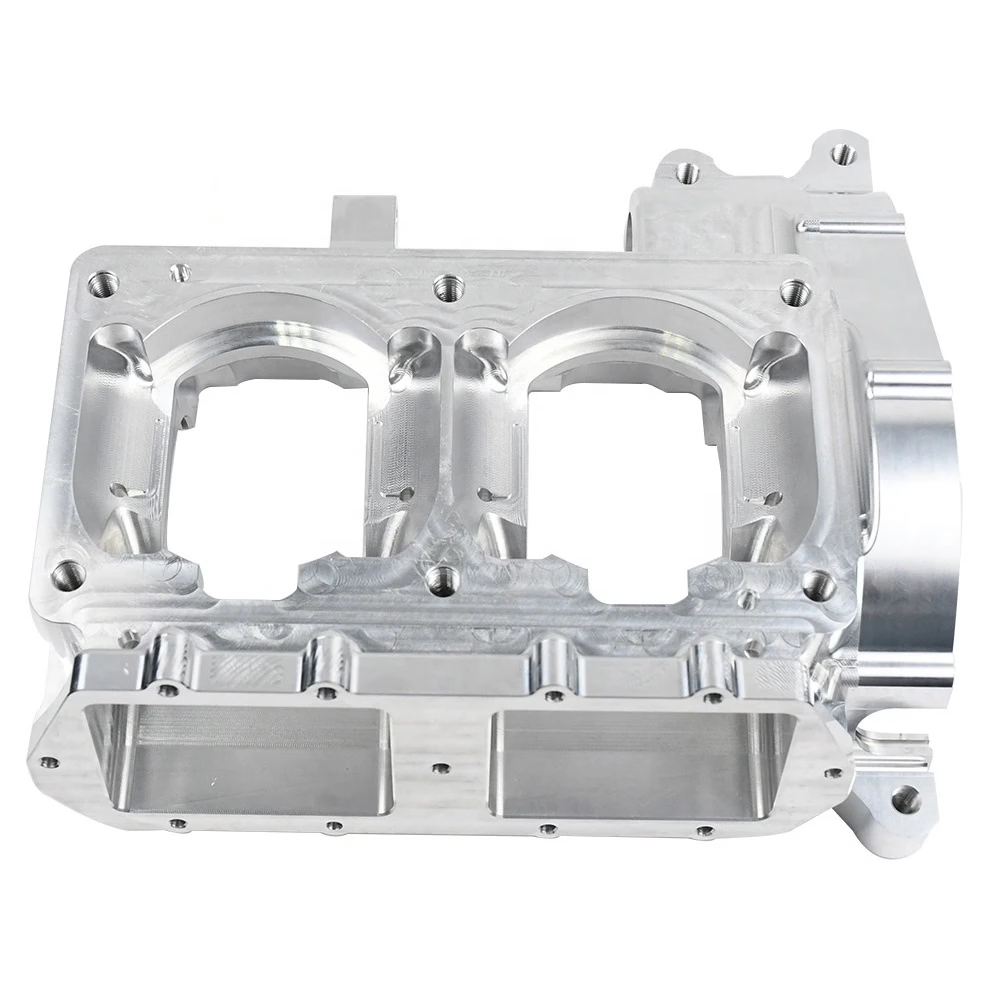
CNC handles that geometry as math. A contoured surface, a tapered pocket, a port with a blended entry: the toolpath is calculated, not fixtured. Five-axis work goes further and reaches undercuts and side walls in one setup.
Hard and gummy materials widen the gap. Titanium TC4, 17-4PH stainless and Inconel punish manual feed decisions, because the operator has to feel a cut that is already burning the edge. CNC holds programmed feed and speed, which keeps tool life predictable.
Manual still has a place with soft, simple stock. A quick aluminum bracket, a spacer, a fixture plate: turning a handwheel beats writing a program. When the geometry is simple and the quantity is one, manual is not a compromise.
- 1Angled and contoured facesCNC, unless you want to build a fixture per angle.
- 2Deep pockets and undercuts5-axis CNC, single setup.
- 3Hard alloysCNC for controlled feeds; manual tool life is unpredictable.
- 4Flat plates and simple spacersManual is fine and often faster.
Lead time, prototyping and small-batch reality
Manual machining starts fast. If the material is on the shelf, a simple part can be finished the same day. There is nothing to program and nothing to simulate. That speed is real and worth keeping in your toolbox.
CNC adds a front end: CAM, tool selection, simulation, fixture design. On a simple part that front end can be a couple of hours. On a complex 5-axis part it can be a day or more before the spindle turns.
But the front end is paid once. If the design changes, editing the program is faster than re-dialing a manual setup, especially on a part with several operations. That is why CNC tends to win the second and third revision, not just the high-volume run.
For prototypes, the honest answer depends on what the prototype is for. If you are checking fit and form on a simple shape, manual or a quick CNC run both work. If you are validating a production process, run it the way it will be made, or the data will not transfer.
The short verdict
If you need one or two simple parts in soft material, manual machining gets you there faster and cheaper. If you need tight tolerance, complex geometry, or more than about 20 identical parts, choose CNC, because the setup cost is paid once and every part after that repeats it.
CNC vs manual machining questions
Can manual machining hold the same tolerance as CNC?
On a single, short, rigid feature, a skilled operator can hold ±0.025 mm, and sometimes tighter with careful measurement. The limit is not skill alone.
The problem is repeatability. Temperature, tool wear and feel all move the number between parts. CNC holds ±0.005 mm because the machine reads its own position and applies stored offsets to every part in the run.
At what quantity does CNC become cheaper than manual?
It depends on part complexity, but a common crossover sits around 10 to 20 identical parts. Below that, manual avoids programming and fixture cost.
Above a few hundred parts, CNC cost per part flattens while manual labor keeps accumulating. Ask for quotes at both volumes before you decide.
Is manual machining still useful in a modern shop?
Yes. Manual machines are efficient for one-off fixtures, simple spacers, repair work and quick modifications where writing a program would take longer than cutting the part.
They also serve as a fast way to check whether a design is even machinable before committing to a full CNC setup.
Does CNC always give a better surface finish?
Not automatically. As-machined CNC surfaces typically land at Ra 0.8–1.6 μm, and finer finishes down to Ra 0.2–0.8 μm are reachable with the right tool and parameters.
Manual work usually sits at Ra 1.6–3.2 μm because feed and depth depend on hand control. For a mirror finish, both processes need a separate finishing pass or a secondary operation.
What about materials like titanium and Inconel?
These alloys punish inconsistent feeds. In manual machining the operator adjusts by feel, which is exactly when tool edges burn and work-hardening starts.
CNC holds programmed feed and speed, so tool life becomes predictable. That is why titanium TC4, 17-4PH and Inconel parts are almost always quoted as CNC work.
Can I start manual and switch to CNC later?
You can, but plan for it. A manual prototype proves geometry, not production cost or cycle time. If the part will be made in volume, the CNC process may call for different stock sizes and fixtures.
Running the first batch on the intended process gives you real data on cycle time, tooling and finishing, which manual work cannot provide.
Send us the drawing, get both numbers
Upload your files and we will tell you which process fits, with a quotation and free DFM analysis within 12 hours. No minimum order quantity, from one prototype to 10,000+ parts.
12-hour quote100% inspectionNDA on request±0.005 mm
More machining notes from GreatLight
We publish setup notes, tooling trials and inspection data from the factory floor.











